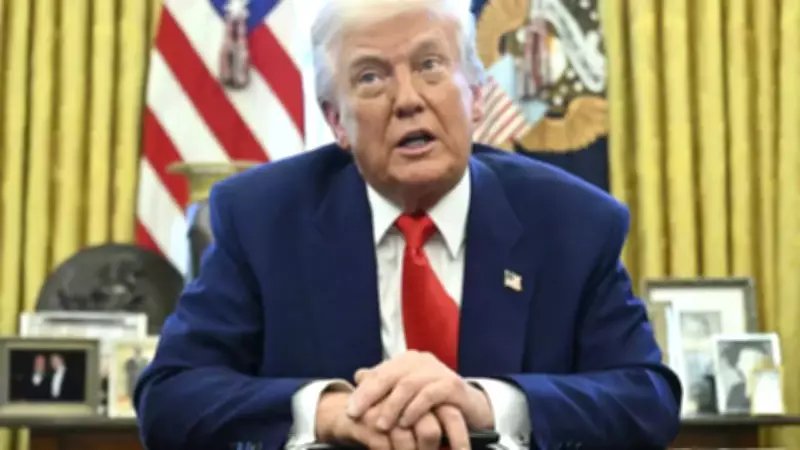
Trump's State of the Union Address: A Stark Trade Warning and Tariff Vision
In a comprehensive State of the Union speech that spanned nearly two hours on Tuesday night, US President Donald Trump delivered a forceful message to America's trading partners. He cautioned nations to adhere to existing trade agreements and continue negotiations as planned, or risk facing significantly tougher conditions in any future deals.
"Don't Even Think About Ripping Up What We've Built"
From the podium in the House chamber, Trump's voice resonated with his trademark confidence as he directed his remarks toward the European Union, India, and other countries that have agreed to framework deals. "Don't even think about ripping up what we've built," he declared. "Those deals are the best you'll ever get. Try for something new, and it'll be worse for you."
He elaborated that most nations and corporations prefer to maintain their current agreements, aware of the legal authority he holds to negotiate potentially less favorable terms. "They know the legal power that I have to make a new deal could be far worse for them. They will continue to work along the same successful path we negotiated, or they will find the next chapter far more painful," Trump warned, setting an economically charged tone for his address.

Tariffs as a Cornerstone of US Prosperity
Trump emphasized protectionism as a key driver of American prosperity, advocating for tariffs as a versatile economic tool. He boldly asserted that increasing tariffs on imports could eventually eliminate the need for federal income taxes. "Imagine an America where hardworking folks keep every penny they earn, and we fund our great nation through smart tariffs on foreign goods," he proclaimed, drawing cheers and multiple standing ovations from Republican lawmakers.
He envisioned a tariff-based revenue system that would "make America rich again" by shifting the tax burden to international competitors. "As time goes by, I believe the tariffs paid for by foreign countries will, like in the past, substantially replace the modern-day system of income tax," Trump stated, framing this shift as a "liberation of the American worker" that could spark a "Golden Age" of manufacturing.
Economic Context and Supreme Court Challenges
While economists note that tariffs currently generate only a fraction of income tax revenue and question the feasibility of such a transition, Trump remained undeterred. He highlighted a "stunning economic turnaround" and a Dow Jones index surpassing 50,000 points as evidence of success.
However, his tariff strategy faces legal hurdles. Just four days prior, a landmark 6-3 Supreme Court ruling struck down the administration's use of emergency powers to bypass Congress on trade levies. As Trump entered the chamber, passing four attending Supreme Court justices—including Chief Justice John Roberts and Justice Amy Coney Barrett, who ruled against him—there was palpable tension. He offered a brief handshake before labeling the ruling "very unfortunate" and "defective," signaling that the judiciary would not halt his trade agenda.
Implementing New Tariffs Without Congressional Approval
Trump confirmed he has already turned to Section 122 of the Trade Act of 1974 to impose a new 15% global tariff surcharge. "Congressional action will not be necessary," he added, a statement met with thunderous applause from Republicans and stoic silence from black-robed justices and Democrat lawmakers, many of whom boycotted the address.
This move underscores his commitment to advancing trade policies despite opposition, reinforcing the protectionist themes that dominated his speech.