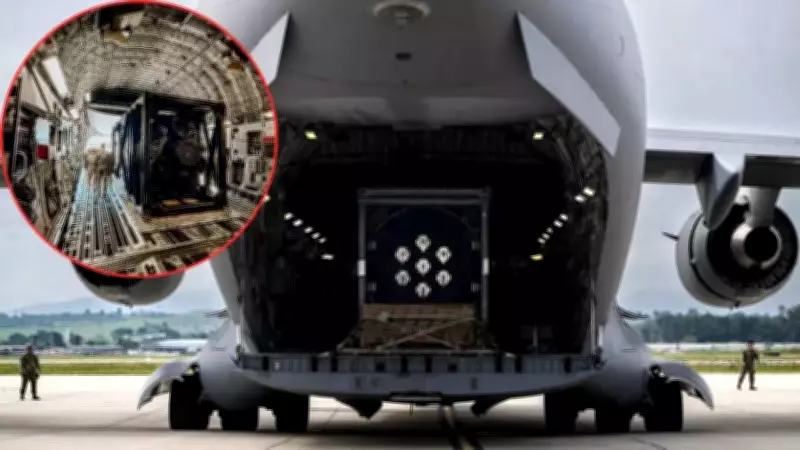
US Air Force Makes History with First-Ever Airlift of Miniature Nuclear Reactor
The United States military has achieved a significant milestone in nuclear energy deployment by conducting the first-ever airlift of a miniature nuclear reactor using C-17 Globemaster III aircraft. This groundbreaking operation, which took place on Monday, represents a major advancement in rapidly deployable nuclear energy systems with both strategic and military implications.
Operation Windlord: A Joint Departmental Initiative
The historic mission was executed as part of Operation Windlord, a collaborative effort between the Department of Defense and Department of Energy. Three C-17A Globemaster III aircraft from the US Air Force's 62nd and 437th Airlift Wings transported eight nuclear modules on Sunday, moving unfuelled components of the Valar Atomics Ward 250 reactor from March Air Reserve Base in California to Hill Air Force Base in Utah.
Officials described this achievement as "The first-ever airlift of a nuclear reactor and ancillary systems via C-17, opening a wide aperture for strategic nuclear deployment around the World." The modules will subsequently be transferred to the Utah San Rafael Energy Lab in Orangeville for comprehensive testing under the Department of Energy's Nuclear Reactor Pilot Program.

Technical Specifications and Capabilities
The Ward 250 reactor represents cutting-edge nuclear technology with several distinctive features:
- Compact Design: The 5 megawatt reactor is specifically engineered to fit inside a C-17 aircraft, enabling unprecedented mobility for nuclear power systems
- Scalable Power Output: Testing will commence at 250 kilowatts, with the system capable of eventually producing the full 5 megawatts - enough theoretical capacity to power approximately 5,000 homes
- Advanced Fuel Technology: The reactor utilizes TRISO fuel, consisting of uranium kernels encased in multiple ceramic layers, providing enhanced safety characteristics
- Innovative Cooling System: Unlike traditional reactors, this system employs helium coolant instead of water, reducing infrastructure requirements
Strategic Implications and National Security Context
This airlift operation occurs within a broader context of nuclear energy expansion and military base energy security initiatives. On May 23, 2025, President Donald Trump signed four executive orders aimed at advancing America's nuclear energy posture, including specific measures to "Reinvigorating the Nuclear Industrial Base" and "Deploying Advanced Nuclear Reactor Technologies for National Security."
Utah Governor Spencer Cox emphasized the national security dimensions, stating: "Energy is not just an economic issue, although it is that, it is a national security issue as well. America cannot project freedom if we lack reliable deployable power at home and in the field."
Military Applications and Departmental Coordination
Michael P Duffey, the undersecretary of war for acquisition and sustainment, highlighted the critical importance of interdepartmental cooperation: "It's clear to me that advancing President Trump's priority on nuclear energy depends on close coordination between the Department of Energy and the Department of War. This partnership ensures advanced nuclear technologies are developed, evaluated and deployed in ways that strengthen energy resilience and national security."
Duffey further elaborated on military implications: "Powering next generation warfare will require us to move faster than our adversaries, to build a system that doesn't just equip our warfighters to fight, but equips them to win at extraordinary speed." For military applications, such deployable nuclear systems could provide crucial energy security at forward operating bases while reducing dependence on vulnerable civilian power grids.
The C-17 Globemaster III: Enabling Strategic Mobility
The Boeing C-17 Globemaster III serves as one of the US Air Force's primary strategic airlift platforms, with capabilities perfectly suited to this mission:

- Payload Capacity: Can transport more than 70 tonnes of cargo, including heavy military equipment
- Operational Flexibility: Capable of operating from short and austere runways in challenging environments
- Rapid Deployment: Features a rear ramp design that enables swift loading and unloading of critical equipment
Broader Nuclear Renaissance and Future Prospects
Energy Secretary Chris Wright positioned this development within a larger revival of American nuclear capabilities: "The American nuclear renaissance is to get that ball moving again, fast, carefully, but with private capital, American innovation and determination." He revealed ambitious plans, noting that by July 4, ten small reactors will achieve critical status, characterizing this as "the start of a nuclear renaissance."
The Nuclear Reactor Pilot Program, established following President Donald Trump's Executive Order 14301, provides the regulatory framework for these developments. This airlift operation signals a strategic shift toward modular nuclear systems that can be transported rapidly across states and potentially across continents, granting the United States unprecedented flexibility in deploying nuclear energy infrastructure where needed most.
This historic achievement demonstrates how compact reactor modules can be mobilized efficiently, potentially transforming how nations approach energy security, military logistics, and strategic power projection in an increasingly complex global security environment.