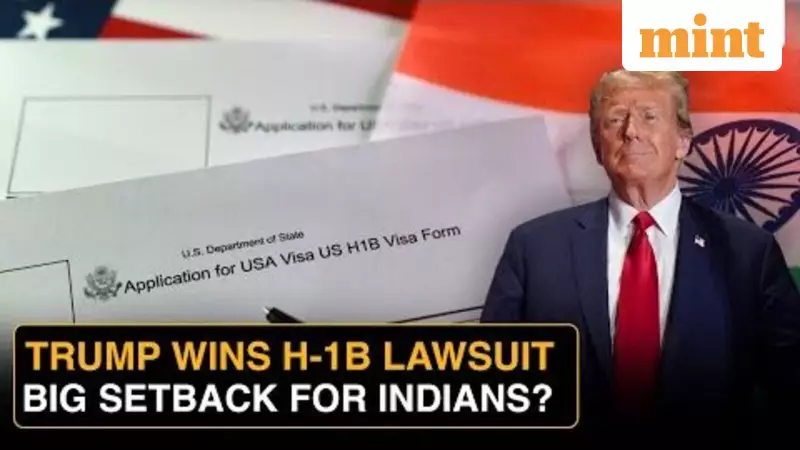
A recent ruling by a United States court has delivered a significant setback to thousands of Indian professionals aspiring to work in America. The court upheld a controversial policy instituting a dramatically higher fee for new H-1B visa applications, a move that experts warn will disproportionately affect Indian nationals who form the majority of applicants.
Court Backs $100,000 Fee, Dismisses Legal Challenge
The legal battle concluded with a judge supporting the implementation of a $100,000 fee for new H-1B visa applications. This decision came after the U.S. Chamber of Commerce lost its legal challenge against the fee hike. The ruling, dated around December 29, 2025, effectively clears the path for the enforcement of this massive cost increase.
Separately, a coalition of 19 U.S. states has filed lawsuits opposing the policy. They argue that the exorbitant fee will cripple critical sectors like hospitals and schools, which rely heavily on skilled foreign professionals, including many from India, to fill essential roles.

System Overhaul: From Lottery to Salary-Based Selection
Beyond the fee increase, the policy mandates a fundamental change in how H-1B visas are allocated. The traditional random computer lottery system is being scrapped. It will be replaced by a salary-weighted selection system. This means candidates offered higher wages by U.S. employers will receive priority in the visa allocation process.
While intended to attract higher-skilled labor, this shift poses a direct threat to entry-level and early-career professionals. These individuals, who typically command lower starting salaries, are likely to be priced out of the new system. Given that over 70% of all H-1B visas are granted to Indian citizens, this demographic is expected to feel the harshest impact.
Implications for Indian Talent and U.S. Industries
The confluence of the steep fee and the new selection criteria has sparked concerns about the end of the American Dream for a generation of young Indian talent. The financial barrier of $100,000 is insurmountable for most fresh graduates and mid-level workers, potentially closing a major career pathway.
The repercussions extend to American industry. Sectors such as technology, healthcare, and education, which have long benefited from Indian expertise, now face a potential talent crisis. The lawsuits from 19 states underscore the domestic anxiety over the policy, highlighting fears of staffing shortages and operational disruption.
In summary, the U.S. court's decision to uphold the Trump-era H-1B visa rules marks a pivotal moment. It establishes a high-cost, merit-based (via salary) gateway that fundamentally alters the landscape for Indian professionals seeking opportunities in America, while simultaneously testing the resilience of U.S. sectors dependent on this global talent pool.