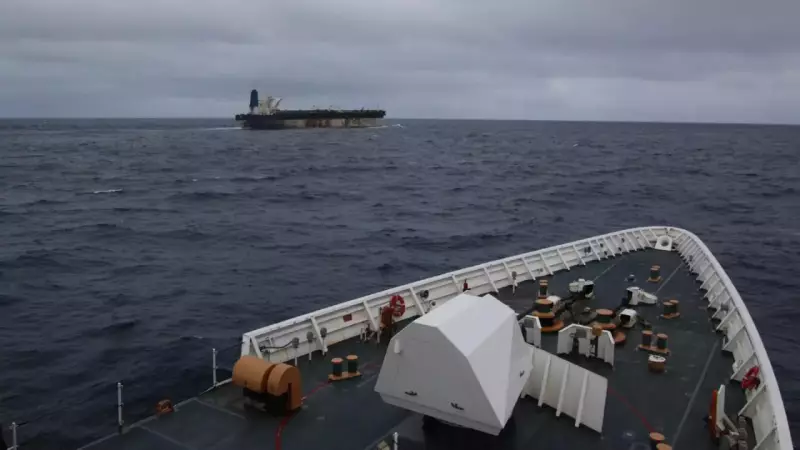
In a dramatic demonstration of its renewed foreign policy posture, the United States under President Donald Trump has taken two aggressive steps that signal a decisive shift towards unilateral global dominance. The US Navy seized a Russian-flagged oil tanker from Venezuela in European waters, while simultaneously, the administration formally articulated its intent to acquire Greenland, dismissing international concerns.
Naval Seizure and a Doctrine of Strength
On Wednesday, the US Navy intercepted and seized a Russian-flagged tanker carrying oil from Venezuela. The action was taken for violating US sanctions, with American forces reportedly reaching the vessel just ahead of a Russian submarine dispatched to protect it. This high-stakes move in European waters underscores Washington's willingness to enforce its sanctions regime unilaterally, even against major powers like Russia.
The seizure was accompanied by unequivocal statements from Trump administration officials framing the action within a broader philosophy of power. Vice-President JD Vance dismissed global alarm, including criticism from the United Nations, stating on social media platform X, "but are we just supposed to allow a communist to steal our stuff in our hemisphere and do nothing? Great powers don't act like that." He added a warning: "The United States, thanks to President Trump's leadership, is a great power again. Everyone should take note."

Trump's White House aide, Stephen Miller, offered a clearer articulation of this outlook on CNN. "You can talk all you want about international niceties and everything else, but we live in a real world that is governed by strength, that is governed by force, that is governed by power...These are the iron laws of the world since the beginning of time," Miller asserted. Defense Secretary Pete Hegseth reinforced the message, declaring the blockade on sanctioned Venezuelan oil remains in "FULL EFFECT — anywhere in the world."
The Greenland Gambit: Purchase or Power?
Parallel to the naval action, the Trump administration officially laid out its case for taking over Greenland, either through purchase or by force, despite protests from European allies. Miller stated it has always been the "formal position" of the administration that "Greenland should be part of the United States."
Secretary of State Marco Rubio attempted to calm disquiet among US lawmakers, suggesting President Trump plans to buy the territory rather than invade it. However, the White House maintained a more ambiguous and threatening stance. Spokeswoman Karoline Leavitt said, "The president and his team are discussing a range of options to pursue this important foreign policy goal, and of course, utilizing the US military is always an option at the commander in chief’s disposal."
This stance has stunned even US lawmakers. Senators Jeanne Shaheen (Democrat) and Thom Tillis (Republican) issued a joint statement urging the US to respect Denmark's sovereignty, stating, "When Denmark and Greenland make it clear that Greenland is not for sale, the United States must honor its treaty obligations." Both Denmark and Greenland have repeatedly stated the territory is not for sale.
Legal Justifications and International Backlash
Undeterred, Trump surrogates are citing a 1951 agreement with Denmark that allows Washington extensive military rights in Greenland, including to "construct, install, maintain, and operate" bases and "control landings, takeoffs... of ships, aircraft." They argue this could be a basis for a takeover. However, this pact was updated in 2004, mandating US consultation with Denmark and Greenland before any significant changes to military operations. Denmark has also granted Greenland considerable autonomy, though it retains control over foreign policy and defense.

The twin developments mark a stark departure from rules-based international norms, firmly aligning with the "America First" doctrine. The message from Washington is clear: the era of Trumpian foreign policy is one defined by raw power, unilateral action, and a willingness to challenge both allies and adversaries to assert American dominance.