

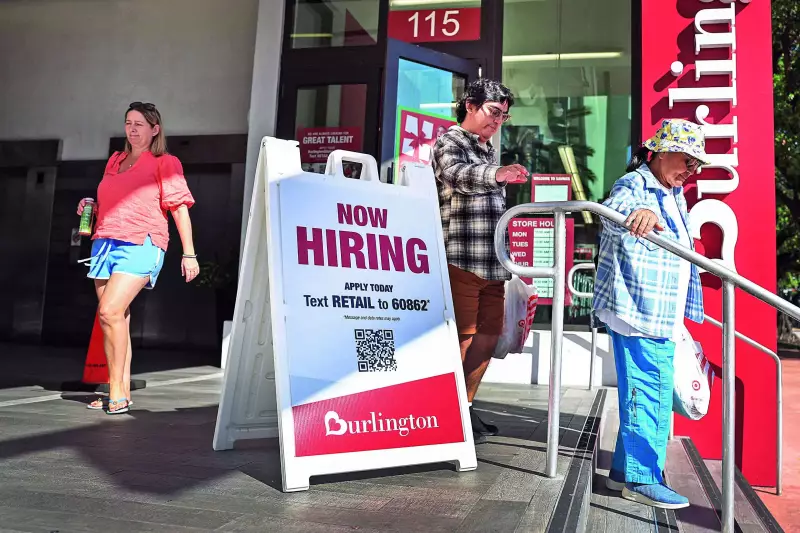
The United States labour market is showing clear signs of losing momentum, with the latest employment data revealing a significant deceleration in hiring. While specific figures for November were distorted by temporary shutdowns, economists confirm the overarching trend: job creation has shifted into a prolonged period of sluggish growth.
A Labour Market in Low Gear
Although employers continue to add workers, the current pace of hiring is among the weakest witnessed in the past two decades. The unemployment rate has edged higher, partly driven by more Americans entering the workforce but not immediately securing jobs. Simultaneously, concerning trends have emerged, including a rise in long-term unemployment, an increase in the number of discouraged workers, and a widening of economic disparities, as reported by CNN.
Dan North, senior economist for North America at Allianz Trade, described the situation vividly. "Hiring, while certainly not on a freeze, is on hold; and people that have jobs are absolutely holding on to them with white knuckles," he stated. He further told CNN, "I see that as definitely a labour market that's stagnating."

Structural Shifts and a New Normal for Job Creation
Despite the hiring cooldown, the broader US economy has not contracted. Economic growth remains steady, and productivity levels are holding up. The average monthly job gain now stands at approximately 55,000, a figure that reflects heightened uncertainty stemming from trade policy, immigration rules, and the wider political climate.
Joe Brusuelas, chief economist at RSM US, explained to CNN that deep structural changes are reshaping employment dynamics. As the Baby Boomer generation retires and immigration faces more restrictions, the overall supply of labour is shrinking. Consequently, the economy no longer needs to generate as many jobs monthly to maintain stability. "My estimate is that we need to hire 50,000 a month to keep the labour market conditions stable," Brusuelas said.
Under these conditions, economic growth could hover near 2%, financial conditions may stay supportive, and inflationary pressures might ease. From a purely economic perspective, Brusuelas noted this scenario is sustainable and could last for years. However, he issued a stark warning: the benefits of this stability will not be shared equally. In a K-shaped economy, higher-income households are poised to continue benefiting from growth, while lower-income groups face increasing strain as hiring slows.
Forces Shaping the Future: AI, Policy, and Uncertainty
Looking forward, economists point to multiple forces that could pull the labour market in different directions. A major unknown is artificial intelligence (AI) and the speed at which it might transform employment patterns. In the short term, uncertainty around AI adoption is making companies cautious about expanding their workforce, according to economists at Pantheon Macroeconomics.
"The longer-term implications for labour displacement and wage dynamics, however, remain an open question," wrote Seema Shah, chief global strategist at Principal Asset Management, in a recent note. Tyler Schipper, associate professor of economics at St. Thomas University in Minnesota, stated that AI, combined with tougher immigration enforcement and unresolved policy questions, is acting as a drag on labour market growth.
"The question I ask myself is, 'What would be the conditions in which I think the labour market would ramp back up?' and some of those are policy-related," Schipper said. "I have a hard time seeing those resolving themselves anytime soon." He somberly added, "For better or worse, I think we could be in this K-shaped economy for some time. And I think the way out of it probably is that there's a recession before things get better, which is never what you want to hear if you're on the lower leg of the K."
Other analysts believe the slowdown may not be permanent. Cory Stahle, an economist at Indeed Hiring Lab, suggested hiring could eventually accelerate, though the turnaround will be gradual. "The US labour market is like a pretty big ship turned by a rudder," he told CNN. "Sometimes it takes a little time to turn around."

Recent interest rate cuts by the Federal Reserve could eventually help stimulate hiring, though their full impact typically takes three to five quarters to filter through the economy. Reduced uncertainty, whether through clearer policies or economic stability, might also encourage employers to be less cautious. For now, as Brusuelas noted, uncertainty remains a dominant force, with businesses grappling with unanswered questions on interest rates, prices, government policy, and impending tax laws.





