

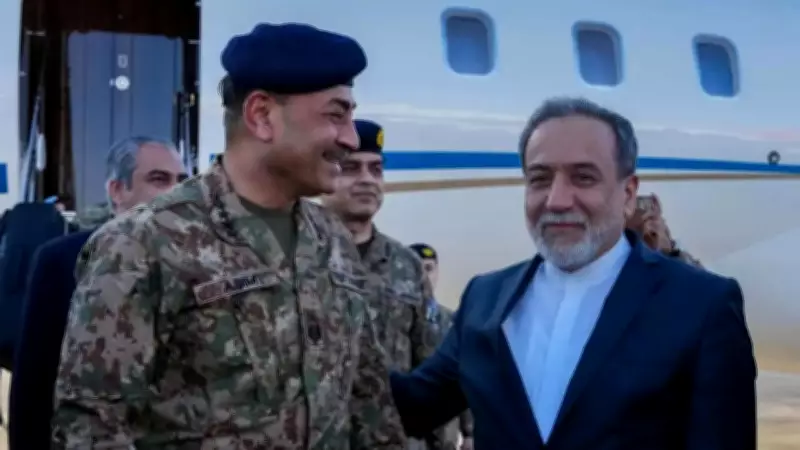
US Intelligence Raises Concerns Over Pakistan Army Chief's Role in Iran Peace Talks
United States intelligence agencies have identified Pakistan's Army Chief General Asim Munir as a significant potential liability for the Donald Trump administration. This assessment comes as Islamabad actively serves as a mediator between Iran and the United States during critical peace negotiations, occurring against the backdrop of escalating tensions across the Middle East region.
"Red Flag" Designation Due to Iranian Connections
According to a detailed Fox News report, intelligence officials have labeled General Munir a "red flag" for the Trump administration. This designation stems primarily from his longstanding personal relationships with high-ranking Iranian military figures. Retired Pakistani General Ahmed Saeed confirmed to Fox News Digital that Munir maintained close connections with key Iranian leaders, including the late Quds Force commander Qassem Soleimani and current IRGC commander Hossein Salami.
While President Trump has publicly praised General Munir, referring to him as his "favorite field marshal," intelligence assessments warn that Munir's dual role could potentially compromise vital United States interests. The concern centers on whether Munir's personal rapport with Iranian leadership might influence his mediation efforts in ways unfavorable to Washington.

Pakistan's History as "Perfidious Ally" Adds to Concerns
The intelligence report further highlights Pakistan's historical role as what it describes as a "perfidious ally," particularly referencing its actions in Afghanistan. This track record makes Pakistan's current close coordination with Iran appear as an additional security risk from the American perspective.
Analysts point to Pakistan's contradictory behavior during the Afghanistan conflict, where Islamabad simultaneously provided support to Taliban forces while accepting substantial United States military and economic aid. Bill Roggio of the Foundation for Defense of Democracies explicitly warned Fox News Digital that Donald Trump should exercise extreme caution regarding Pakistan, characterizing the nation as a historically unreliable ally in Afghan affairs.
Roggio specifically flagged General Asim Munir's alleged connections with Iran's Islamic Revolutionary Guard Corps as a matter of serious concern for Washington policymakers. Experts from the Foundation for Defense of Democracies have suggested that Munir might potentially leverage his relationship with President Trump to quietly advance Iranian interests while simultaneously positioning Pakistan as an essential yet unpredictable intermediary between the two nations.
Military Dominance Over Civilian Leadership
Pakistani political commentator Raza Rumi observed that General Munir's rising influence signals the Pakistani military's increasing dominance over civilian leadership structures within the country. Critics note that since Munir assumed the position of army chief in late 2022, Pakistan has experienced a noticeable intensification of political crackdowns, including the marginalization of former Prime Minister Imran Khan and his political opposition.
The Fox News report referenced General Munir's remarks during the Margalla Dialogue in Islamabad in November 2024, where he cautioned that unchecked freedom of expression was eroding moral values globally. These comments have been interpreted by analysts as reflecting Munir's inclination toward centralized control and alignment with the army's General Headquarters rather than with Pakistan's elected civilian leadership.
This perspective aligns with broader criticisms that Pakistan's foreign policy is increasingly directed by military leadership rather than by its democratically elected government. Despite these multiple warnings from intelligence and analytical sources, President Trump appears to maintain substantial reliance on General Munir's mediation capabilities.

Solidified Relationship During Regional Crisis
The relationship between President Trump and General Munir solidified significantly during the May 2025 India-Pakistan crisis, where Munir received credit for helping de-escalate dangerous tensions between the nuclear-armed neighbors. Currently, General Munir is facilitating back-channel communications between the Trump administration—specifically involving senior advisors Jared Kushner and Steve Witkoff—and Tehran's leadership.
President Trump has publicly credited Munir with doing a "great job" in arranging and advancing peace talks between the United States and Iran. This praise comes even as Vice President JD Vance recently walked out of negotiations held in Pakistan, citing Iran's refusal to make firm commitments regarding its nuclear program.
The intelligence assessment presents a complex picture where personal relationships, historical alliances, and geopolitical strategy intersect, creating both opportunities and significant risks for United States foreign policy in one of the world's most volatile regions.
