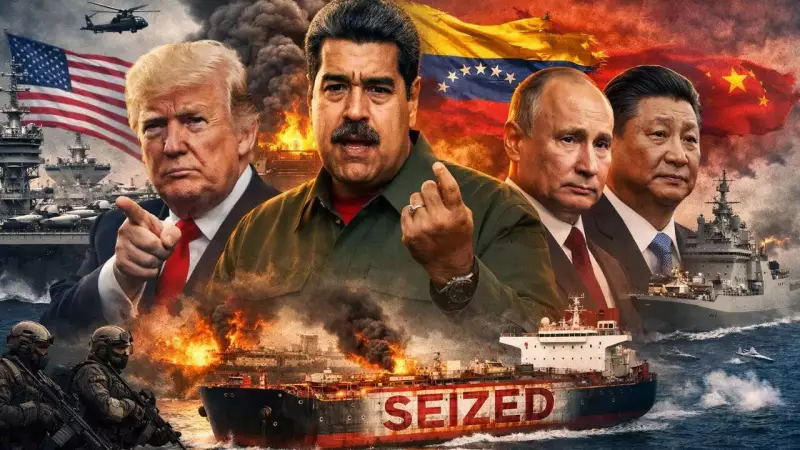
In a dramatic escalation of pressure on the socialist government of Nicolás Maduro, former US President Donald Trump has announced and enforced a "total and complete blockade" of Venezuela. The move shifts US policy from sanctions to open military enforcement in the Caribbean Sea.
Military Encirclement and Oil Seizures
The policy, announced by Trump on his Truth Social platform, is being executed by a formidable naval force. Eleven US Navy ships, including the aircraft carrier USS Eisenhower, are currently patrolling the waters around Venezuela's coast. US forces have conducted airstrikes on vessels suspected of smuggling and have begun seizing tankers in international waters.
Among the first casualties of this blockade are two Chinese-owned oil tankers. One of these vessels was reportedly carrying a massive 1 million barrels of Venezuelan crude oil. US military officials confirm that dozens of other ships are being tracked, and more strikes and seizures are likely. "They took our oil, they took our land and we want it back," Trump wrote, referencing Venezuela's nationalization of US oil assets in 2007. "We will finish the job."

Why Venezuela's Oil Collapse Matters Globally
The stakes are astronomically high because Venezuela sits atop the world's largest proven oil reserves, estimated at over 303 billion barrels. However, its oil industry and economy are in a state of advanced collapse due to hyperinflation, corruption, and years of sanctions.
National oil output has plummeted from a peak of 3.2 million barrels per day in 2000 to roughly 850,000 barrels today. Most of this oil has been flowing to China, evading US sanctions through a clandestine network of aging tankers often called a "shadow fleet." Venezuela's state oil company, PDVSA, is on the brink, with less than 15 days of storage capacity before operational shutdowns become inevitable.
The only US company operating there, Chevron, which works under a special waiver, produces about 10% of Venezuela's total output. That waiver is now under review as the Trump administration pushes for full economic isolation of the Maduro regime.
International Outcry and the 'Iraq Playbook' Parallels
Trump's blockade has ignited a geopolitical firestorm. Beijing has condemned the action after the seizure of its tanker. Russia has flown surveillance planes to Venezuela and denounced the US moves as "naval piracy." While UN Security Council members have demanded an emergency session, the US has blocked any formal action.
Analysts and scholars are drawing unsettling parallels between the current escalation and the lead-up to the US invasion of Iraq in 2003. The pattern appears familiar: allegations of criminal behavior (narco-terrorism in Venezuela, WMDs in Iraq), followed by diplomatic isolation, economic strangulation, military encirclement, and finally, the objective of regime change.
Research by Alexander Downes, a political scientist at George Washington University, cited in Foreign Policy, shows that of the 35 US-led regime change operations since 1898, over one-third resulted in civil war within a decade. The catastrophic outcomes in Iraq, Libya, and Afghanistan serve as stark warnings.
Venezuela's response mirrors that of past targets. Defense Minister Vladimir Padrino López has accused the US of "lies, manipulation, interference, military threats, and psychological warfare." President Maduro has framed the confrontation as a defense of sovereignty against imperial aggression aimed at stealing Venezuela's oil.
Risks and the Uncharted Role of China
The blockade carries severe environmental and humanitarian risks. The shadow fleet consists of old, often uninsured tankers; a major spill could devastate Caribbean ecosystems. Inside Venezuela, the collapsing fuel supply threatens power outages, food shortages, and could trigger a new wave of migration, adding to the nearly 7 million Venezuelans who have fled since 2015.

A critical new variable absent in the Iraq scenario is China. Venezuela sends about 80% of its crude exports to China, meeting roughly 4% of Beijing's import needs. While China has so far responded only with diplomatic condemnation, calling the blockade "unilateral bullying," a sustained disruption poses a significant economic challenge for Beijing. However, there is no indication China will militarily challenge US naval dominance in the Caribbean.
Legally, the move exists in a grey area. Many experts argue a blockade is an act of war under the UN Charter unless authorized by the Security Council. The US is justifying its actions under expanded anti-smuggling and anti-terror laws. The lack of Congressional approval for the use of force has prompted accusations of constitutional overreach from opponents, with US Representative Joaquin Castro calling it "unquestionably an act of war."
The bottom line is that while Venezuela is not Iraq, the path unfolding—with warships deployed, tankers seized, and rhetoric hardening—is eerily familiar. The world now watches to see if this escalation can be stopped before it reaches a point of no return.