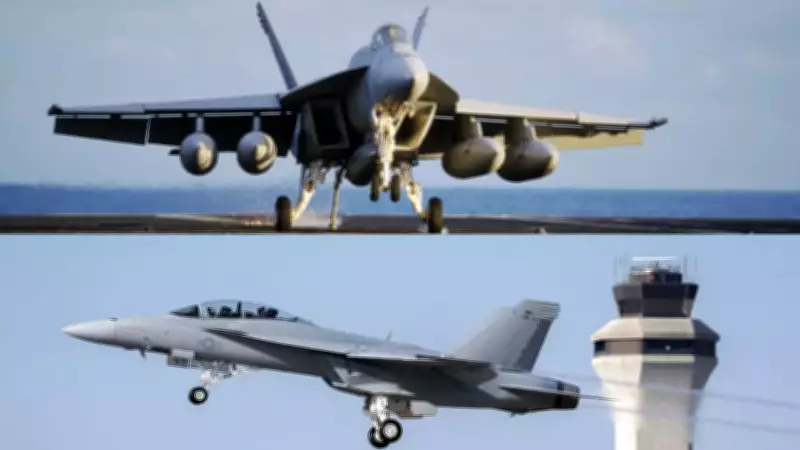
US Navy Deploys EA-18G Growlers to Middle East Amid Rising Iran Tensions
The EA-18G Growler, the US Navy's premier electronic attack aircraft, has become a pivotal asset aboard the USS Gerald R. Ford and the USS Abraham Lincoln. This deployment occurs as Washington intensifies its military posture in the Middle East, driven by escalating tensions with Iran.
Carrier Redeployments and Strategic Moves
The 100,000-ton nuclear-powered USS Gerald R. Ford has been redirected from the Caribbean Sea to the Middle East, joining the Abraham Lincoln Carrier Strike Group already stationed in the region. Initially departing Norfolk, Virginia, on June 24, 2025, for operations in European waters, the Ford was later sent to the Caribbean in October for US military actions against Venezuela. During this operation, American forces extracted serving President Nicolás Maduro from Caracas.
US officials confirmed that crew members were notified of the redeployment on Thursday. The carrier is now embarking on its third Atlantic transit and is not expected to return to Norfolk until late April or early May.

Capabilities and Specifications of the EA-18G Growler
The EA-18G Growler combines fighter aircraft speed and manoeuvrability with advanced electronic attack capabilities. Crewed by a pilot and an electronic warfare officer, it measures 18.3 metres in length with a wingspan of 13.7 metres. The aircraft achieves a maximum speed of Mach 1.6, equivalent to 1,960 km/h, and operates at a ceiling of 50,000 feet. When fully armed with external fuel tanks, its range extends to 1,570 km.
Powered by two F414-GE-400 turbofan engines producing 44,000 pounds of thrust, the Growler is equipped with ALQ-99 low- and high-band jamming pods. It is designed for electromagnetic spectrum dominance, enhanced situational awareness, and networking. Its weaponry includes AGM-88 anti-radiation missiles, AIM-120 air-to-air missiles, and the AIM-9X "Sidewinder" short-range air-to-air missile.
Self-Protection and Advanced Features
The Growler's self-protection capabilities are robust, featuring AIM-120 Advanced Medium-Range Air-to-Air Missiles and improved radar resolution through its APG-79 Active Electronically Scanned Array radar. It maintains uninterrupted communications in heavily jammed environments using the INCANS Interference Cancellation System. Additionally, it can digitally jam enemy communications across a broad frequency range with the ALQ-227 Communications Countermeasures Set.
Defence analysts emphasize that as modern conflicts increasingly depend on control of the electromagnetic spectrum, aircraft like the Growler are poised to play a decisive role in future high-threat missions.
Growlers Central to Electronic Warfare
Among the squadrons aboard the USS Gerald R. Ford is Electronic Attack Squadron 142, which operates the EA-18G Growler. The Lincoln Carrier Strike Group also fields Growlers, highlighting their critical importance in potential operations involving Iran.
Derived from Boeing's combat-proven F/A-18F Super Hornet, the Growler is a carrier-based electronic warfare aircraft engineered to dominate the electromagnetic spectrum. It can disrupt, deceive, or deny a wide array of military electronic systems, including radars and communications.
The aircraft provides tactical jamming and electronic protection to US forces and allies, replacing the older EA-6B Prowler in US Navy service. Production commenced in 2007, with operational service beginning in late 2009. To date, approximately 170 aircraft have been built.
The EA-18G is regarded as one of the most advanced airborne electronic attack platforms and remains the only one still in production. It shares over 90 per cent of its characteristics with the standard Super Hornet.
Role in Maduro Capture Operation
Media reports indicate that EA-18G Growlers played a key role in blinding Venezuela's air defences during the military operation that led to the capture of President Nicolás Maduro. In this operation, the Growler was part of a large US air armada that suppressed radar and communications systems, enabling special forces aircraft to swiftly enter and exit Venezuelan airspace. Over 150 US aircraft were involved, including fighter jets, bombers, and drones.

Electronic warfare specialists explain that jamming pods on the Growler listen for enemy radar emissions, analyse them in real time, and send back tailored signals to confuse or overwhelm the systems. This can cause radar screens to display false targets or lose track of real aircraft.
By executing these functions, the Growler can prevent surface-to-air missiles from locking onto US aircraft, protecting both strike jets and transport helicopters. A single Growler can shield an entire formation of aircraft, acting as a significant force multiplier.
Recent Drone Incident in Arabian Sea
The deployment follows a recent incident where the USS Abraham Lincoln shot down an Iranian drone in the Arabian Sea. The US military described the drone's approach as "aggressive" toward the vessel.
Captain Tim Hawkins, spokesperson for US Central Command, stated that the incident occurred while the carrier was transiting international waters about 500 miles from Iran's southern coast. "The Iranian drone continued to fly toward the ship despite de-escalatory measures taken by US forces operating in international waters," Hawkins said. An F-35C fighter jet launched from the aircraft carrier destroyed the drone to ensure the safety of the ship and its personnel.
Hawkins confirmed that no American service members were harmed, and no US equipment was damaged during the incident.
Hours later, two Iranian gunboats operated by Iran's Islamic Revolutionary Guard Corps approached the US-flagged chemical tanker M/V Stena Imperative in the Strait of Hormuz. The gunboats passed the vessel at high speed on three occasions while an Iranian Mohajer drone flew overhead.
During one pass, the Iranian vessels threatened via radio communication to board and seize the tanker, according to US officials. The US deployed the USS McFaul to escort the tanker away from the area, supported by defensive air cover, leading to a subsequent de-escalation of the situation.