

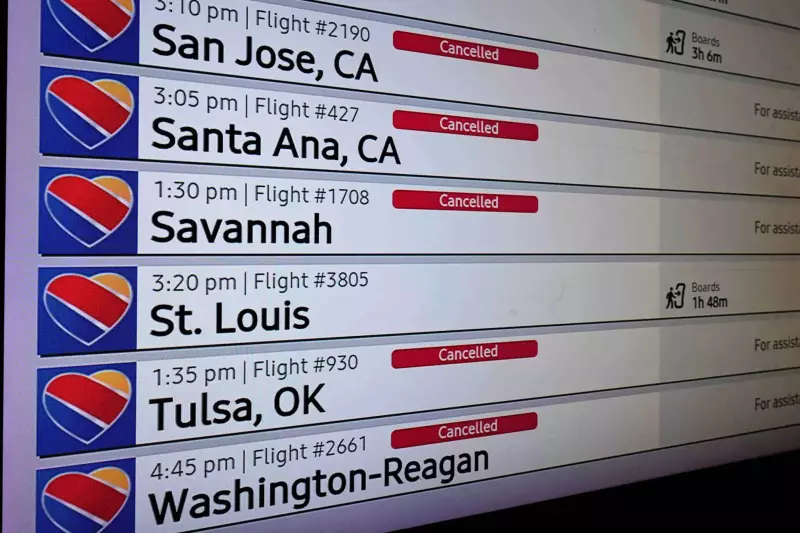
A massive winter storm sweeping across the United States from Texas towards New England has severely disrupted air travel, leading to thousands of flight cancellations and grounding air traffic across large parts of the country. This system is being described as potentially one of the most severe winter storms in recent years, causing widespread chaos for travelers and airlines alike.
Scale of Disruption: Worst Since Government Shutdown
According to data from flight tracking website FlightAware, more than 13,000 flights within the United States were cancelled between Saturday and Monday, with cancellations continuing to rise as the storm advances. The scale of this disruption marks the worst period for American air travel since last year's government shutdown, as reported by Bloomberg. Aviation analytics firm Cirium further indicates that some airlines are expected to see Sunday disruption levels approaching those recorded during the Covid pandemic, when air travel was sharply reduced due to global restrictions.
Airport-Specific Impacts
The storm's impact has been particularly severe at several key airports across the nation. By 9:30 am New York local time on Saturday, cancellations accounted for 90% of outbound flights from Memphis International Airport, 76% from Oklahoma City's Will Rogers World Airport, and 75% from Dallas-Fort Worth International Airport. Major disruptions were also reported at airports in Austin, Charlotte, and Nashville, while airports in Washington and New York were expected to face increasing impact as the storm progresses eastward.

Historical Context and Weather Forecast
Meteorological experts have compared this storm system to significant historical weather events. Rob Carolan, chief executive officer of Hometown Forecast Services, was cited by Bloomberg suggesting that for the country overall, this system could rank among the most expansive winter storms since the 1993 "superstorm" that affected much of the eastern United States.
Allison Santorelli, a forecaster with the US Weather Prediction Center, told Bloomberg that "this is a significant long-duration winter storm that threatens 180 million Americans with widespread heavy snow, sleet and freezing rain from the southern Rocky Mountains to New England." Santorelli added, "South of the snow area we are continuing to expect catastrophic ice accumulation," noting that up to 0.5 inch of ice may fall across parts of the US South and into Northern Virginia.
Airlines' Response and Contingency Measures
US airlines had announced contingency measures earlier in the week in anticipation of the storm's impact. These measures included waiving change fees and fare differences for passengers booked to travel over the weekend. American Airlines Group Inc. implemented specific operational adjustments, adding nearly 1,800 extra seats on flights departing Dallas Fort Worth International Airport on Friday, along with more than 1,400 seats on inbound flights scheduled for Sunday after the storm passes.
The airline also introduced additional flights between Charlotte Douglas International Airport and Chicago O'Hare International Airport on Saturday to accommodate displaced passengers and maintain some level of service despite the challenging conditions.
Airport Preparations and Safety Protocols
Airports across the affected regions began implementing comprehensive winter weather preparations as the storm approached. The Port Authority of New York and New Jersey announced on Friday that it had activated winter storm protocols at the major airports it operates: John F. Kennedy International, Newark Liberty International, and LaGuardia. These protocols included ensuring snow removal equipment was fuelled and ready for use, with crews prepared to maintain operational safety.
Dallas-Fort Worth International Airport issued a statement on Friday confirming that its crews are "prepared to treat runways and taxiways on the airfield, as well as bridges, overpasses and roadways across airport property" to maintain accessibility and safety during the winter weather event.

Regulatory Monitoring and Traveler Advisory
The US Federal Aviation Administration stated in a social media post that its "weather and air traffic professionals are monitoring the winter storm around the clock to maintain the safety of the national airspace system." This continuous monitoring aims to minimize risks and coordinate responses across the aviation infrastructure.
Travelers affected by the storm are advised to check official sources for real-time airport updates and flight status information. The FAA recommends using their official website for the most current information regarding airport conditions and operational status across the United States during this significant weather event.





