

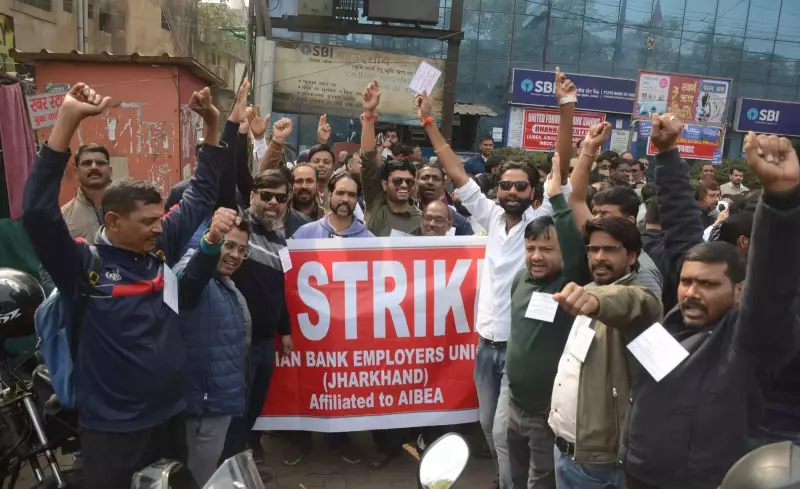
Banking Operations Grind to Halt in Jharkhand Amid Nationwide Strike
Banking services across Jharkhand faced severe disruption on Tuesday as public sector banks remained completely shut due to a nationwide strike called by the United Forum of Bank Unions (UFBU). The strike, demanding the implementation of a five-day working week, affected major banks including State Bank of India (SBI), Punjab National Bank (PNB), Bank of Baroda, Bank of India, Canara Bank, and Indian Bank.
Extended Closure Raises Concerns for Cash Flow and Daily Operations
The strike followed three consecutive holidays, resulting in banks remaining closed for the fourth straight day. This extended shutdown has sparked significant concerns regarding cash flow disruptions, particularly affecting small businesses, traders, and daily wage earners who depend heavily on branch-based banking services.
Several critical banking facilities were impacted, including loan sanctioning processes, cash deposits and withdrawals from branches, and real-time gross settlement systems. The closure has created substantial inconvenience for customers who rely on physical banking operations for their financial needs.

Union Leaders Detail Demands and Willingness to Compromise
Rajesh Munda, Zonal President of the SBI Officer's Association, explained the strike's purpose: "The strike has been called for one-point demand, that is five working days a week. The Indian Bank Association had forwarded a recommendation in this regard to the Union government. During the wage agreement on March 8, 2024, the demand was also approved. No step, however, has been taken on the issue."
Munda further clarified that bank employees have agreed to increase working hours by 40 minutes per day if the five-day work week is implemented. Currently, bank staff receive Sundays off along with the second and fourth Saturdays of every month, while they seek Saturday and Sunday as weekly holidays similar to other government offices.
Growing Resentment Among Employees Over Unfulfilled Promises
Union leaders revealed that a consensus on five-day banking was reportedly reached between the government and bank unions in 2024. However, the absence of an official notification has led to growing resentment among employees who feel their demands have been ignored despite previous agreements.
Ranjit Kumar Jaiswal, SBI Zonal Secretary, emphasized the employees' willingness to compromise: "The bank employees were even willing to work an additional 40 minutes daily if a two-day weekly holiday is granted. Rising mental stress, increasing workload and health-related issues make the demand for five-day banking both justified and necessary."
Digital Banking Provides Partial Relief While Protests Continue
Despite the widespread branch closures, digital banking services including UPI transactions, internet banking platforms, and ATM networks functioned normally, offering partial relief to customers. Private sector banks also remained open and operational, minimizing the overall impact on essential financial transactions.
In Ranchi, bank employees including officers staged peaceful demonstrations in front of their offices, shouting slogans in support of their demand. Kunal Kumar, State President of the All India Bank Officers' Association, confirmed: "In Ranchi, bank employees, including officers, staged a dharna in front of their offices and shouted slogans in support of their demand. The protests were held peacefully."
Customer Experiences Highlight Widespread Inconvenience
The strike created significant inconvenience for customers across Jharkhand. Dinesh Singh, who traveled 35 kilometers from Bero to the SBI branch at Kutchery More, expressed frustration: "I had work related to a loan in this branch. I have come from Bero, covering 35 km only to find the bank closed."
Another customer from Harmu in Ranchi, who arrived to update his cash credit facility, stated he was completely unaware of the strike, highlighting communication gaps about the banking disruption.

Bankers Address Concerns and Warn of Escalation
Regarding customer inconveniences, bankers noted that steps were taken to ensure adequate cash availability in ATMs. They pointed out that approximately 98% of transactions now occur through digital channels, though this provides little comfort to those requiring in-person banking services.
The UFBU has issued a stern warning that if the government continues to delay the notification implementing the five-day week, the agitation may intensify in coming days. This could potentially lead to further disruptions in public sector banking services across the country.
Work-Life Balance Concerns Drive Employee Demands
Bank employees emphasized that a five-day working week would significantly improve their work-life balance. A woman bank employee highlighted how prolonged work pressure leaves little time for family and personal health, leading to increased stress and burnout among banking professionals.
The ongoing strike underscores the growing tension between bank employees' demands for improved working conditions and the operational requirements of India's banking sector, with Jharkhand experiencing particularly severe service disruptions during this nationwide protest action.





