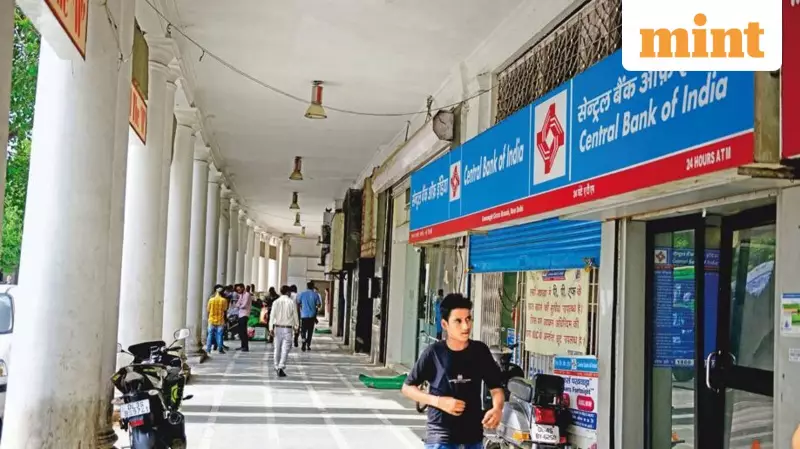
In a strategic move to diversify its portfolio, the state-run Central Bank of India has announced plans to significantly increase its corporate lending. The bank's Managing Director, Kalyan Kumar, revealed in an interview that the lender aims to alter its loan book composition, targeting a shift from the current 72:28 ratio in favor of retail, agriculture, and MSME (RAM) segments to a 65:35 mix by March 2026.
Balancing Core Strength with Strategic Diversification
Kalyan Kumar, who took charge on 30 September, emphasized that the RAM segments will forever remain the institution's priority and core strength. However, the decision to grow the corporate book is driven by a dual need for risk diversification and the improving quality of investment proposals in the market. As of September 2025, the bank's total loan book stood at ₹2.93 trillion, with corporates accounting for only 28%, or just over ₹83,000 crore. This relatively small base presents a substantial headroom for expansion without diluting the bank's focus on its rural and semi-urban customer base.
The bank is selectively eyeing opportunities in specific high-growth sectors. These include renewable energy, power transmission, roads and infrastructure, and hospitality projects such as hotels. For the financial year 2026, the bank has already sanctioned fresh loans worth ₹1.21 trillion, with an additional ₹85,000 crore to ₹1 trillion in the pipeline.
Riding the Wave of a Capex Recovery
This strategic shift coincides with emerging signs of a recovery in India's private capital expenditure (capex) cycle. A report by CareEdge Ratings dated 17 December noted initial recovery signals, reflected in the swelling order books of capital goods companies and a rise in private investment announcements. Order books for a sample of these firms grew 20.7% year-on-year in FY25, with the momentum continuing into the first half of FY26.
Sectors like oil and gas, power, telecom, automobiles, and metals are at the forefront of this capital spending revival. Investments in power generation are projected to grow at a compound annual rate of 8% during FY26-28, with renewables and storage expanding even faster at a 13% CAGR. This improving environment provides the "necessary ingredients" for corporate loan growth, as described by SBI Capital Markets.
The bank's corporate loan book has already shown robust growth, rising nearly 11% year-on-year in Q2FY13 to ₹98,363 crore. Kumar expects this trend to continue, leveraging the bank's smaller corporate base as a competitive advantage to capture new business, even offering interest concessions and processing fee waivers to win back clients.
Managing Margins and Future Ambitions
Despite the growth focus, the bank faces pressure on its Net Interest Margins (NIMs), which compressed to 2.89% in the September quarter from 3.16% in the previous quarter. Kumar attributes this to the faster transmission of repo rate cuts on loans compared to deposits. To counter this, the bank plans to focus on cost rationalization, boosting fee income from cash management and trade finance, and aggressively growing low-cost CASA deposits.
Looking beyond the immediate portfolio rebalancing, Kumar has set an ambitious long-term goal: to expand the bank's balance sheet to ₹10 trillion by March 2028, up from ₹7.37 trillion at the end of September 2025. The bank is also preparing for new regulatory challenges, including the implementation of the expected credit loss (ECL) model by April 2027. Kumar stated the bank is ready for this transition, estimating an impact of approximately ₹2,700-2,800 crore on its balance sheet.
The Central Bank of India's strategy underscores a nuanced approach to growth—fortifying its traditional strengths in RAM lending while strategically capitalizing on the resurgence in corporate investment to build a more diversified and resilient portfolio for the future.