

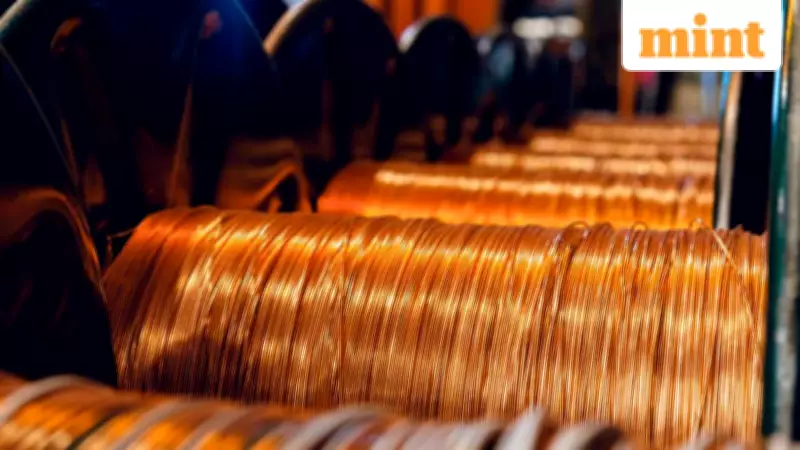
Copper Prices Experience Sharp Correction After Record Rally
Copper markets witnessed a significant downturn this week, with prices retreating sharply from the unprecedented highs recorded recently. The correction has sparked intense debate among traders and investors about the future trajectory of this crucial industrial metal.
Market Performance Shows Substantial Declines
On the Multi Commodity Exchange (MCX), copper prices crashed nearly 5% to settle at ₹1,169 on Monday. This represents a substantial 18% decline from the all-time peak reached earlier. The international markets mirrored this trend, with copper falling as much as 4.2% to $12,600 per ton on the London Metal Exchange.
The recent volatility marks a dramatic reversal from last Thursday, when copper had surged to a record above $14,500 per ton. However, the momentum shifted dramatically on Friday, with prices tumbling below $13,000 per ton during intraday trading sessions.

Multiple Factors Driving the Price Correction
Several interconnected factors have contributed to copper's sharp price correction. The initial rally in recent weeks was fueled by strong investor interest from China, where substantial funds flowed into commodities amid concerns about the US dollar and a strategic shift away from traditional currencies and government bonds.
This bullish momentum reversed abruptly on Friday following US President Donald Trump's nomination of Kevin Warsh as the new head of the Federal Reserve. Market participants view Warsh as a staunch inflation hawk, which triggered widespread selling across metals markets.
Analysts Weigh In on Market Dynamics
Kaynat Chainwala, AVP - Commodity Research at Kotak Securities, provided detailed analysis of the situation. "Copper witnessed a sharp pullback on Friday, ending the week at $13,150 per tonne on the LME and ₹1,293 per kg on the MCX," she explained. "The rebound in the US dollar following the Trump administration's nomination of Kevin Warsh, widely viewed as an inflation hawk, as the next Federal Reserve Chair accelerated profit-taking across the metals complex."
The turbulent trading follows what had been a stellar run for copper throughout 2025, with futures jumping more than 40% on the back of multiple supportive factors. These included supply disruptions at major mines, strong expectations for demand growth from the global energy transition, and potential US import tariffs that could reshape trade patterns.
Physical Demand Concerns and Market Sentiment
The scale of recent price movements has prompted many traders to reduce their market exposure due to elevated risks and a growing disconnect between prices and weakening physical demand. Despite the correction, discussions around potential buying opportunities during price dips continued to dominate Chinese trading chat rooms and social media platforms over the weekend.
Analysts have not ruled out the possibility of another sharp upswing, noting that copper remains fundamentally attractive due to robust long-term demand prospects and constrained supply conditions. However, last week's surge occurred despite signs of slowing manufacturing activity in China, adding complexity to market analysis.
Short-Term Outlook and Technical Factors
Anuj Gupta, Director at Ya Wealth Research & Advisory, offered insights into the technical aspects of the correction. "Copper touched a high of 1,480.30 on January 29, 2026, but has since corrected by about 19% and is currently trading around the 1,198 level," he noted. "The decline was largely driven by margin hikes imposed by exchanges such as the CME and MCX."
Chainwala further elaborated on near-term expectations, stating that copper price action now hinges critically on a revival in physical demand, particularly from China. "Near-term upside potential stays limited after plunging over 15% from last week's record highs," she added. "The pre-Chinese Lunar New Year period, leading to February 17, typically sees inventory accumulation and deferred restocking by fabricators, which may temporarily suppress demand."

Broader Market Context and Investment Considerations
The copper market's volatility reflects broader uncertainties in global commodity markets, with similar patterns observed in precious and base metals. The combination of geopolitical developments, monetary policy expectations, and fundamental supply-demand dynamics continues to create challenging conditions for market participants.
While copper maintains its status as a compelling long-term investment due to structural demand drivers and supply constraints, recent events highlight the importance of careful risk management and thorough market analysis for investors navigating these turbulent conditions.
Disclaimer: This analysis is for educational purposes only. The views and recommendations expressed are those of individual analysts or broking companies. Investors should consult certified experts before making any investment decisions.





