

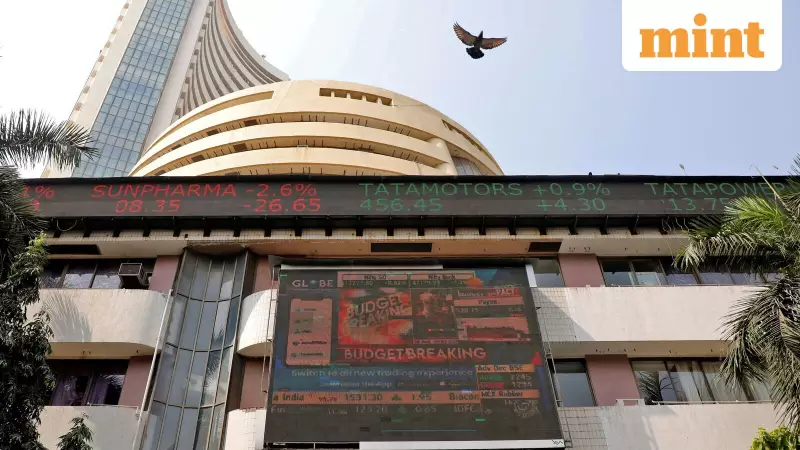
Dalal Street's Gold Rush: The Real Winners Are Selling the Shovels
In 1848, Samuel Brannan became California's first millionaire not by mining gold, but by selling shovels to hopeful prospectors. Today, a similar dynamic is unfolding on Dalal Street, where the biggest wealth creators are not the flashy stocks but the firms that provide the essential market infrastructure.
The Historical Blueprint
Samuel Brannan, a businessman and preacher, capitalized on the California gold rush by setting up a store selling picks, shovels, and pans. He fueled the frenzy by parading through San Francisco with a vial of gold, shouting about the riches. As thousands flocked to California, his store boomed, earning him immense wealth without ever digging for gold himself.
This story offers a powerful lesson for modern investors. In financial markets, the real fortune often lies not in chasing the next hot stock, but in supporting the systems that enable trading and investment.

Wealth Creation in Post-Covid India
Which Indian stock has been the fastest wealth creator since the pandemic? It might surprise you. The answer is BSE, with a five-year total return CAGR of 124% from 2020 to 2025, as per Motilal Oswal's recent study.
This performance highlights a broader trend. India's capital market infrastructure is experiencing explosive growth. Mutual fund AUM has surged from ₹12.75 trillion in 2015 to over ₹80 trillion by 2025. Demat accounts have multiplied from 41 million in FY20 to over 216 million today. SIP inflows now average around ₹31,000 crore monthly, up from below ₹10,000 crore a few years ago.
Sneha Poddar of Motilal Oswal notes, "Capital market infrastructure players offer a compelling long-term growth story, driven by deepening equity culture and financialization of household savings."
The Market Plumbing Ecosystem
India's capital market infrastructure includes several key players:
- Brokers: They execute trades for investors, with discount brokers like Zerodha and Groww leading the post-covid retail boom.
- Exchanges: Platforms like NSE and BSE facilitate trading. NSE dominates with 90% cash segment share, while BSE is gaining ground in derivatives.
- Depositories: NSDL and CDSL hold securities electronically, ensuring seamless transfers and corporate actions.
- RTAs: Firms like CAMS maintain investor records, handling dividends and stock splits.
These entities generated ₹70,000 crore in revenues in FY25, with brokers and exchanges leading the way.
Why Infrastructure Firms Are Thriving
Asutosh Mishra of Ashika Stock Broking explains that India's equity culture is shifting from a trend to a structure. This makes capital market infrastructure an attractive investment for the medium to long term.
Exchanges, depositories, and RTAs benefit from asset-light, scalable models with strong moats. They enjoy high ROE and limited balance-sheet risk. Depositories and RTAs are seen as defensive, with growth tied to account proliferation and AUM expansion. Exchanges, while strong, face higher regulatory risks due to their dominance in derivatives.
Brokers offer high operating leverage but are more cyclical and competitive. Their success often depends on non-broking services like wealth management.
Stock Exchanges: The Toll Booths of Finance
Exchanges have become hot bets on Dalal Street. BSE's shares jumped 50% in 2025, and MCX soared nearly 80%. The anticipated NSE IPO is a key market event, expected to boost BSE further as NSE will list on its platform.
Mishra describes exchanges as "the toll booths of India's financialization story." The explosion in derivatives activity drives revenue, with fixed costs creating powerful operating leverage. However, regulatory risks, especially around derivatives, remain a concern.
Sonam Srivastava of Wright Research PMS cautions that MCX is a proxy for volatility and hedging demand, not direct commodity prices. Its rally reflects normalization after regulatory issues, not just the commodity supercycle.

Risks and Resilience
A prolonged market slowdown could impact different segments variably. Exchanges and brokers are most cyclical, with earnings tied to trading volumes. RTAs are more defensive, though growth may slow. Depositories are the most insulated, thanks to annuity-like revenues.
Analysts highlight regulatory intervention as a key risk. Sebi has taken steps to cool speculative derivatives trading, such as increasing contract sizes and limiting weekly expiries. Jefferies estimates that changes to weekly index options could reduce exchange earnings by 20-50%.
Despite this, the structural drivers remain strong. SIP inflows of over ₹31,000 crore show a behavioral shift toward rule-based investing, providing cushion during downturns.
Conclusion: Learning from History
The California gold rush taught us that the biggest winners often sell the tools, not mine the gold. On Dalal Street, capital market infrastructure firms are proving this adage true. As retail participation grows and savings shift to financial assets, these picks-and-shovels businesses are poised to benefit most from India's financial gold rush.





