

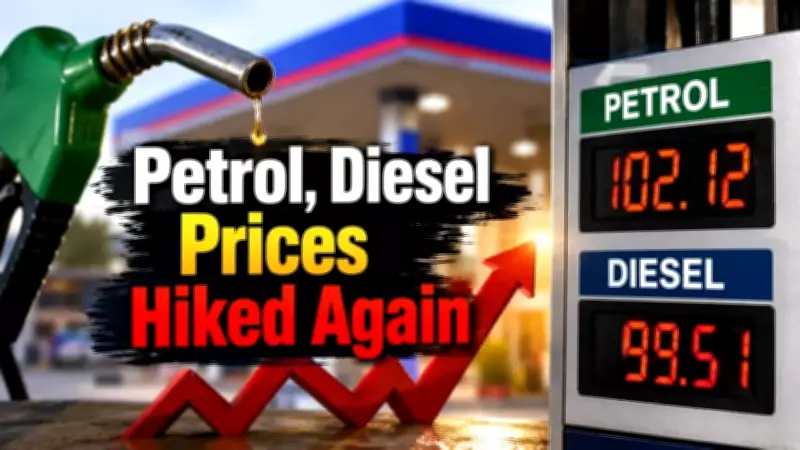
State-run fuel retailers increased petrol and diesel prices again on Monday by Rs 2.61 to Rs 2.71 per litre, continuing to pass on the impact of rising global crude oil prices to consumers. This latest revision has pushed fuel prices to their highest levels since May 2022.
Fuel prices had largely remained unchanged since April 2022, except for a Rs 2 per litre reduction announced in March 2024 ahead of the national elections. Economists believe that if global crude oil prices remain elevated, frequent hikes in petrol and diesel prices may become the new norm.
The successive hikes follow an extended period during which retail fuel prices stayed static despite higher global crude prices, shrinking refining margins, and a weakening rupee that significantly increased import costs. The sharp rise has intensified concerns about inflation and higher transportation costs across the economy, as fuel price revisions resume after a long freeze.

Fourth Petrol Price Hike in 11 Days
Petrol and diesel prices were first increased on May 15, 2026, and since then have seen three more hikes in just 11 days. The initial hike of around Rs 3 per litre was the first in four years. On May 19, 2026, petrol rose by 87 paise and diesel by 91 paise. Another hike of 87-91 paise per litre occurred on May 23, 2026. Following Monday's revision, the cumulative increase since May 15 has approached nearly Rs 7.5 per litre.
Which Cities Have the Highest Petrol and Diesel Prices?
After Monday's revision, petrol in Hyderabad (Telangana) stands at Rs 115.69 per litre, while diesel is at Rs 103.82. In Thiruvananthapuram (Kerala), petrol is Rs 115.49 and diesel Rs 104.40. Kolkata saw petrol and diesel rise to Rs 113.51 and Rs 99.82 per litre, respectively. Mumbai's petrol price at public sector stations reached Rs 111.21 per litre, with diesel at Rs 97.83. In Bengaluru, petrol is now Rs 110.93 per litre and diesel Rs 98.80. Chennai's petrol is priced at Rs 107.77 per litre, diesel at Rs 99.55. In Delhi, petrol climbed to Rs 102.12 per litre from Rs 99.51, while diesel increased to Rs 95.20 from Rs 92.49.
States Urged to Cut VAT
Fuel prices differ across states due to variations in local taxes. The recent increases have only marginally reduced the under-recoveries faced by oil marketing companies, intensifying pressure on state governments to reduce Value Added Tax (VAT), which in some states is as high as 30%. While oil companies continue to face financial strain, the central government has already absorbed part of the burden through excise duty cuts. Consumers are paying higher prices, and states are under pressure to sacrifice some tax revenue so that fuel retailers can sustain operations and continue investments.
States with the lowest VAT rates levy taxes of around 20%, while others impose rates over 30% through additional per-litre charges and infrastructure cess components. States such as Tamil Nadu, Kerala, and West Bengal continue to record among the highest fuel prices largely due to state-level taxes, with Telangana and Kerala having the costliest pump rates. Although discussions have taken place regarding bringing petrol and diesel under the GST framework, states across party lines have opposed the proposal. Apart from excise duty on liquor, VAT collected on fuel remains one of the largest independent revenue sources for states.
Why Are Petrol and Diesel Prices Rising?
The repeated increases follow a sharp rise of more than 50% in global crude oil prices since late February after US-Israeli strikes on Iran and disruptions in shipments through the Strait of Hormuz, a vital route for global oil transportation. During the initial two-and-a-half months of the conflict, fuel retailers kept pump prices unchanged despite rising input costs, with the government saying the move was intended to shield consumers from inflationary pressure. Opposition parties, however, accused the Centre of postponing fuel price hikes until after important state elections.

State-owned fuel retailers—Indian Oil Corporation, Bharat Petroleum Corporation Limited, and Hindustan Petroleum Corporation Limited—together account for nearly 90% of India's fuel retail market. Whenever state-run retailers revised prices upward, private companies such as Nayara Energy quickly matched the increases with similar hikes. These revisions came in addition to earlier hikes implemented by private retailers before the first PSU-led fuel price increase on May 15. Nayara Energy had raised petrol and diesel prices by Rs 5 and Rs 3 per litre, respectively, in March, while Shell increased petrol prices by Rs 7.41 per litre and diesel rates by as much as Rs 25 per litre from April 1. Meanwhile, Jio-bp—the fuel retail joint venture between Reliance Industries and BP—has continued to align fuel prices at its outlets with those of public sector companies.





