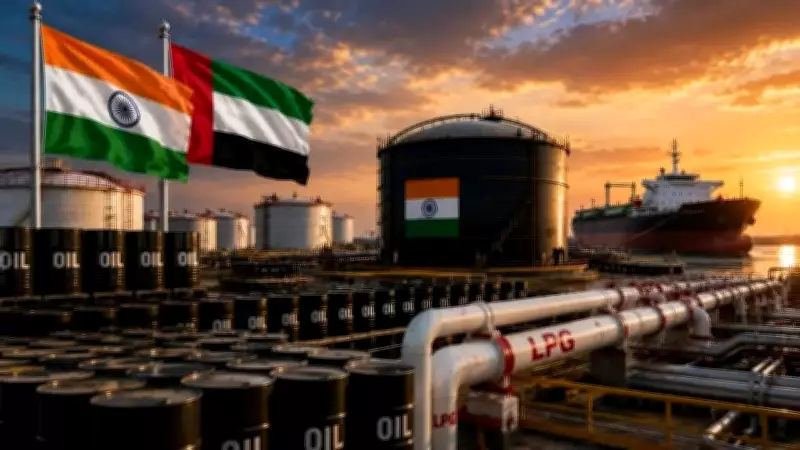
India and the United Arab Emirates are accelerating efforts to construct 30 million barrels of strategic oil reserves, a move aimed at bolstering energy security following Prime Minister Narendra Modi's recent visit to the UAE, where memorandums of understanding were signed. India, the world's third-largest energy consumer, relies on imports for nearly 88% of its crude oil requirements.
Expansion of Strategic Crude Oil Storage
India's Ambassador to the UAE, Deepak Mittal, confirmed that both nations are working to increase UAE-linked crude storage capacity in India from the current 5.8 million barrels to 30 million barrels. This expansion will utilize existing underground storage caverns and new infrastructure projects. Mittal emphasized the objective is to move forward as quickly as possible, though new facilities may take several years to become operational, depending on site selection, technical viability, and execution timelines. The initiative will involve investments and joint participation from both sides.
Commercial and Strategic Dual Purpose
The two countries are evaluating multiple storage arrangements, including commercial models allowing crude stored in India to be sold to third countries under certain circumstances. Mittal stated that strategic reserves can serve multiple purposes: a portion may be maintained as national emergency stockpiles, while another can be used commercially. Stored crude can be sold within India or supplied to other countries, offering greater operational flexibility as production capacity expands.

Last month, Abu Dhabi National Oil Company (ADNOC) indicated that any future expansion of its participation in India's Strategic Petroleum Reserves (SPRs) could involve existing facilities at Mangalore and potential new sites at Visakhapatnam and Chandikol on India's eastern coast. ADNOC currently has access to about 5.86 million barrels at the Mangalore SPR facility.
Storage at Fujairah and Gas Reserves
India and the UAE have also agreed to explore storing crude oil at Fujairah, the UAE's key oil hub, which would be treated as part of India's strategic petroleum reserves. Additionally, discussions are advancing on creating a strategic gas reserve framework. Mittal noted that options include using existing LPG storage caverns in India and developing new LNG storage infrastructure.
Significance for India's Energy Security
Industry experts welcomed the agreements as a significant boost to India's long-term energy security strategy. The importance of robust strategic petroleum reserves has been highlighted by the US-Iran conflict, exposing vulnerabilities in major economies. India, now the world's sixth-largest economy, faces unprecedented risks from potential supply disruptions. Strategic reserves serve as a safeguard during geopolitical tensions or disruptions to maritime trade routes, particularly around chokepoints like the Strait of Hormuz. They cushion against sudden supply shocks, ensure domestic crude availability, and limit panic-driven buying.
India's reserve capacity remains modest compared to the US, Japan, and China. The latest agreements are viewed as a crucial step toward expanding storage capabilities. Closer collaboration with the UAE strengthens India's emergency storage, improves access to crude during disruptions, and provides greater flexibility in procurement and inventory management.