

DSP Mutual Fund CEO Warns Indian Market is 18 Months Ahead of Fair Value
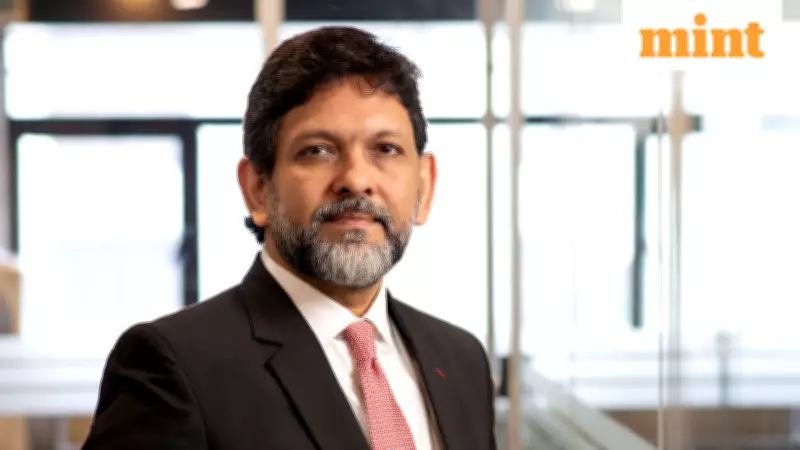
In a comprehensive interview, Kalpen Parekh, Managing Director and CEO of DSP Mutual Fund, delivered a sobering assessment of India's equity markets. Despite consolidating over the past year, Parekh emphasized that valuations remain elevated, with the market essentially trading 18 months ahead of its fair value.
The current price-to-earnings multiple stands at 21-22, significantly above what Parekh considers a fair range of 17-18 for the Indian market. This valuation gap necessitates moderated return expectations from investors who have enjoyed substantial gains over the previous five years.
Navigating Financial Noise in a 24/7 News Cycle
Parekh addressed the challenge of modern investing in an environment saturated with financial information. "Financial news is now a 24/7 cycle of nonstop alerts, tempting investors to react to every minor market ripple," he observed. True long-term wealth creation, he stressed, rarely depends on tax tweaks or daily headlines but rather on disciplined behavior and mental endurance.

The executive drew a powerful analogy from author Rolf Dobelli: "News is to the mind what sugar is to the body." Parekh cautioned that by the time news reaches individual investors, markets have typically already priced in the information, making reactive trading futile and often counterproductive.
Budget Obsession and Investor Behavior
When asked about events like the Union Budget, Parekh offered a long-term perspective. "I've been an investor since 1998. There is a Budget almost every year, and some years there are two," he noted. Despite all the political and economic ups and downs over three decades, Indian markets have compounded at more than 13% annually.
Parekh characterized the Budget as essentially "an annual accounting exercise of the government of India, like our household budget that we make once a month or so." He argued that investors tend to over-allocate attention to such annual events when managing money over several decades.
The only factor that truly matters, according to Parekh, is investor behavior at different market junctures. So long as investors remain disciplined—avoiding excitement during sharp rallies and fear during corrections—they should achieve satisfactory outcomes. Obsessing about Budgets, credit policies, or Federal Reserve statements makes for interesting conversation but has almost no connection to long-term return outcomes.
Tax Changes and Market Impact
Regarding recent futures and options taxation changes, Parekh explained that the marginal tax increase aims to discourage intense speculation among retail investors, most of whom lose money in this segment. While it may impact high-frequency trading firms and near-term market liquidity, investors not engaged in F&O trading won't be affected.
For the mutual fund industry, Parekh sees minimal impact since 99% of mutual fund investors hold equity funds. The only marginal effect concerns arbitrage funds, where rolling costs may increase by 25-30 basis points, primarily affecting larger investors in these vehicles.
Building Disciplined Portfolios
Parekh outlined a timeless approach to portfolio construction:
- Match time horizons with appropriate asset classes: One-year goals belong in safe assets like debt or arbitrage funds; five-year horizons suit hybrid funds; 10-20 year goals warrant equity exposure.
- Embrace systematic investment plans (SIPs): The beauty of SIPs lies in averaging costs over time, making today's market level irrelevant.
- Avoid chasing popular assets: The best returns typically come from investing in out-of-favor asset classes with poor recent performance.
Precious Metals: Caution After Massive Run-up
Parekh expressed caution about gold and silver after their substantial appreciation. "The best time to discuss gold and silver was two or three years ago, when they were cheap," he remarked, noting that DSP's silver fund launched three years ago has gained 500% since inception.

When asset classes with no cash flows increase fivefold in a few years, getting excited represents a mistake, Parekh warned. Gold and silver have reached a stage where they dominate conversations, often signaling impending volatility.
His advice for precious metals allocation:
- Never view them in isolation but as part of a diversified, multi-asset portfolio.
- If you have zero exposure, start a small SIP to build a 3-5% position gradually.
- Avoid allocating 10% of your portfolio just because prices have declined 30% from highs.
- Consider multi-asset funds where professional managers can tactically adjust allocations between 10-20% based on valuations.
Active vs. Passive Fund Selection
Parekh offered nuanced guidance on the active versus passive debate:
Passive funds offer cost advantages but require understanding what you're buying among over 200 options in the category. For beginners, he recommends broad market index funds like Nifty 50 or Nifty Equal Weight 50 funds, cautioning against "smart-beta funds" that investors often buy at the wrong times when their "smartness" has become expensive.
Active funds carry higher fees but provide potential for index outperformance. Parekh noted an interesting paradox: "I would actually prefer to invest in an active fund when it is underperforming its benchmark, rather than when it is at an all-time high." He emphasized that even legendary investors like Warren Buffett have underperformed for extended periods, urging investors to maintain loyalty to fund managers during difficult phases.
Market Risks and Opportunities
Looking ahead, Parekh identified several key considerations:
Primary risks: Elevated valuations remain the foremost concern, with the market trading at premium multiples despite recent consolidation. Return expectations must be tempered accordingly.
Opportunities: The consolidation itself presents opportunities. Parekh recalled that between 2008 and 2013, markets delivered zero returns, yet disciplined SIP investors earned 9-10% annually. Current opportunities include:
- Diversification into Indian and global companies
- Precious metals at appropriate allocations
- Fixed income with bond yields around 7% versus 4% inflation
- Banking stocks that have underperformed for five to six years
Personal Portfolio Strategy
Parekh revealed his own investment approach, which emphasizes infrequent rebalancing. "I don't rebalance too often. I only act when an asset class hits an extreme," he explained. Recently, he trimmed gold mining stock exposure by 3-4% after sharp appreciation.
His core portfolio maintains 65% in growth assets (Indian and global stocks), 25% in bonds, and approximately 12% in gold—a balanced approach reflecting his long-term, disciplined philosophy.
Throughout the interview, Parekh returned to a central theme: successful investing requires tuning out daily noise, maintaining behavioral discipline, and focusing on time-tested principles rather than reacting to transient market movements or popular narratives.





