

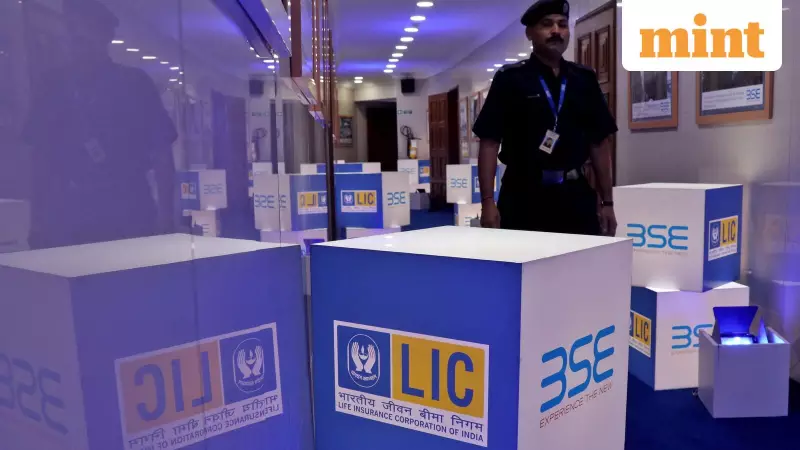
A recent investigation into the voting patterns of India's Life Insurance Corporation (LIC) has reignited a decades-old debate about its fundamental identity. Is it primarily a fiduciary guardian for millions of policyholders, or has it evolved into a strategic instrument for state-led economic interventions? The findings point towards a persistent dichotomy at the heart of the nation's largest insurer.
A Pattern of Inconsistent Voting
The investigation highlights a striking inconsistency in LIC's approach to shareholder resolutions. Over the past two-and-a-half years, LIC did not reject a single resolution proposed by Reliance Industries or companies within the Adani Group. This stands in sharp contrast to its routine rejection of similar proposals from other listed firms.
Furthermore, evidence suggests LIC may have violated its own publicly stated voting policy. The insurer approved auditor-qualified accounts for certain companies, an action explicitly prohibited by its internal guidelines. While LIC may have its justifications for each decision, the lack of uniform application of standards inevitably sows doubt. For an institution managing ₹57 lakh crore in assets—a sum comparable to the world's top sovereign wealth funds—such ambiguity is particularly concerning.

Historical Precedents of Strategic Intervention
This is not a new controversy for LIC. Its current voting pattern echoes historical instances where its actions appeared guided by factors beyond pure financial returns.
In the 1980s, during the hostile takeover attempts by London-based industrialist Swraj Paul on Escorts and DCM, LIC used its decisive voting power to side with the incumbent promoter families. This blocked Paul's bids, despite his premium offers to shareholders, marking an early example of strategic positioning.
A more recent chapter unfolded between 2009 and 2014 during the UPA-II government. LIC became the government's preferred investor for its public sector unit (PSU) disinvestment program. It absorbed 60% of NMDC's offering, nearly half of NTPC's, and the entirety of BHEL's block deals, injecting over ₹30,000 crore to support the program. Each episode followed a familiar cycle: intervention, controversy, and assurances of compliance, leaving underlying questions unresolved.
The Core Dichotomy and Global Comparisons
The pattern exposes LIC's essential conflict: it is an insurer by its founding charter but has become a sovereign investor due to its enormous size and circumstances. Unlike globally respected sovereign funds, LIC operates without clear firewalls separating investment decisions from other national priorities, such as market stabilization.
Funds like Norway's Government Pension Fund Global or Singapore's GIC and Temasek operate with strict independence, transparent governance, and decision-making based on risk-adjusted returns. LIC's response to the investigation, citing "overall economic and strategic considerations," highlights this divergence. The ambiguity carries a tangible cost, as seen when LIC's market capitalization fell by ₹65,000 crore in five sessions following the Hindenburg report in 2023.
For the auto driver in Patna or the shopkeeper in Surat, whose life savings are managed by LIC, this ambiguity means uncertainty over whether their premiums are deployed for maximum returns or for broader strategic goals.
The Path Forward: Governance Over Dismantling
The solution is not to dismantle LIC or strip its voting rights. Instead, it requires acknowledging its evolved role as a sovereign investment vehicle that manages citizens' savings. The imperative is to build governance structures that match this function.
LIC's voting policies must be applied consistently, based on transparent principles, without unexplained exceptions. This can only happen by addressing the fundamental tension between its insurance mandate and its assumed role as an instrument for managing economic imperatives. Resolving this core conflict is crucial to restoring unambiguous trust for its millions of policyholders.






