

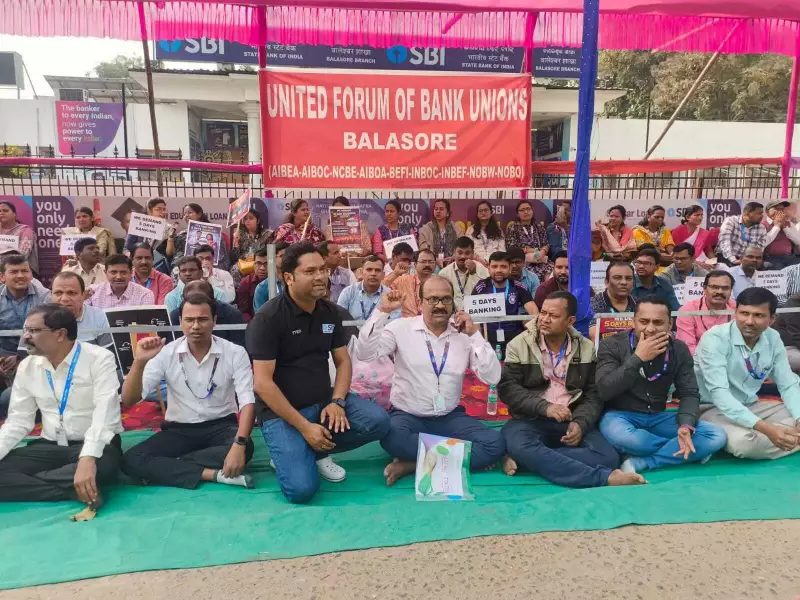
Banking Services Grind to a Halt Across Odisha Amid Nationwide Strike
Banking services throughout Odisha experienced significant paralysis on Tuesday as employees of public sector banks (PSBs) participated in the nationwide strike organized by the United Forum of Bank Unions (UFBU). The industrial action, which commenced at midnight on January 26, has been called to press for the implementation of a five-day working week for bank staff.
Widespread Operational Disruption Across Major Cities
The strike's impact was felt acutely across Odisha's urban centers, including Bhubaneswar, Cuttack, Rourkela, Balasore, Sambalpur, and various district headquarters. This mirrored the nationwide scale of the protest, with banking operations severely curtailed or completely suspended in many locations.
Major public sector banks such as State Bank of India (SBI), Punjab National Bank, Bank of Baroda, Union Bank, and Canara Bank operated with drastically reduced staff strength across their Odisha branches. The absence of employees from service counters resulted in long customer queues and, in many cases, complete suspension of banking services.

Customer Woes and Transaction Delays
Customers reported substantial delays in essential banking activities including cash deposits, withdrawals, cheque clearing, and routine administrative work. The timing of the strike—following two consecutive holidays—exacerbated the difficulties for many account holders.
"Most of us rely on branch counters for cheque deposits and cash transactions. With the strike falling after two back-to-back holidays, it's been extremely challenging to manage payments," said Akash Sahoo, a trader waiting outside an SBI branch in Bhubaneswar's Saheed Nagar area.
Similar scenarios unfolded in Cuttack, Sambalpur, and Berhampur, where numerous branches operated with insufficient staffing levels. State-level public sector banks had previously issued advisories cautioning customers about potential service disruptions.
Union Stand and Employee Perspective
Sourav Kumar Pani, spokesperson for the Odisha Bank Employees' Association, explained the union's position: "We have been forced into this strike by the government's inaction. We have presented legitimate demands and expect the government to listen. We remain committed to our stance and will not withdraw from the strike until our demands are properly addressed."
Digital Banking Functions Normally Amid Cash Shortages
While digital banking channels including Unified Payments Interface (UPI), mobile banking applications, and internet banking platforms continued to function normally across Odisha, several areas witnessed ATM cash shortages.
Parts of Bhubaneswar, Cuttack, and Rourkela reported depleted ATM cash reserves, creating additional challenges for customers requiring physical currency.
"This is undoubtedly a digital age where most transactions occur through UPI, but cash remains essential for conducting business. I needed to withdraw money to clear a vendor payment but couldn't accomplish this today due to the cash shortage," explained Abhinash Nanda, a businessman from Bomikhal.
Compounding Challenges and Public Sentiment
The banking disruption may persist as another statewide strike called by the Nabanirman Krushak Sangh is scheduled for Wednesday. This consecutive industrial action could extend the difficulties faced by banking customers across Odisha.
Public reaction to the strike has been mixed. Bidyadhar Mohanty, a customer outside a bank ATM at Acharya Vihar, commented: "This situation affects everyone for two days. Bank employees already enjoy two working Saturdays each month. Perhaps this could have been extended to four Saturdays for the greater benefit of all stakeholders."
The nationwide bank strike has thus created a significant operational challenge for Odisha's banking sector, highlighting the ongoing tension between employee demands for improved working conditions and the immediate service needs of the banking public.






