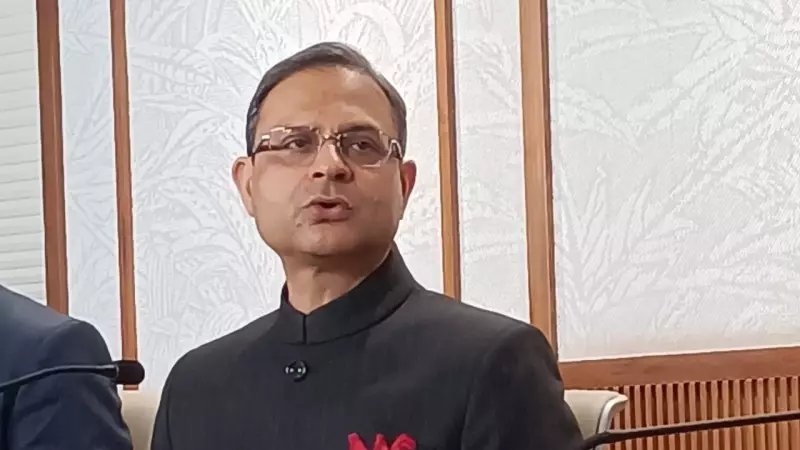
In a significant move, the Reserve Bank of India (RBI) has reduced the policy repo rate by 25 basis points. Governor Sanjay Malhotra, addressing the media post-policy announcement, attributed this decision to benign inflation conditions and an economy primarily driven by strong domestic demand.
Growth, Inflation, and the Rationale for Rate Cut
Governor Malhotra stated that the Monetary Policy Committee's (MPC) action was predominantly guided by the current growth-inflation dynamics. He expressed confidence that inflation, particularly when excluding volatile items like gold and precious metals, is expected to remain very low in the foreseeable future. Inflation has sharply declined from historical levels of 7% and 5%, moving towards the central bank's 4% target.
On growth, the Governor noted that while the Indian economy delivered an impressive average of 8% growth over the last three to four years, a moderation is anticipated. High-frequency indicators suggest that the 8% growth seen in the first half of the fiscal year may not be sustained. He clarified that a growth rate of 7% or more is a realistic baseline, given that monetary policy primarily influences short-term demand and cannot accelerate long-run growth on its own.

RBI's Stance on Rupee and External Sector Volatility
Addressing concerns about the rupee's depreciation, Governor Malhotra emphasized that the RBI does not target any specific level or band for the rupee. The central bank's objective is solely to curb excessive or abnormal volatility in the foreign exchange market, allowing market forces to determine the price. He assured that India's external sector position remains comfortable.
He provided a crucial insight into the inflation impact of currency movement, revealing that the RBI's projections factor in current exchange rates. According to their estimates, a 5% depreciation in the rupee leads to approximately 35 basis points of inflation. Conversely, it also boosts exports and GDP growth by about 25 basis points.
Transmission, Liquidity, and Credit Growth Outlook
A key focus for the RBI now is ensuring effective monetary policy transmission following the rate cut. Governor Malhotra addressed concerns about lending rates not falling in tandem, explaining that the weighted average lending rate can be skewed by a change in the composition of loans. For instance, if the share of higher-interest unsecured retail loans increases, the average rate rises even if rates for individual loan segments like housing have fallen.
On liquidity, the Governor committed to maintaining ample liquidity in the system to facilitate smooth transmission. He indicated that with recent operations like bond repurchases and forex swaps, liquidity could exceed 1% of banking system liabilities.
Regarding credit growth, Malhotra dismissed the notion that it must grow at twice the pace of GDP. He pointed out that for the last decade, credit growth has been roughly in line with GDP growth, and the period of very high credit growth before 2011-12 adversely impacted bank asset quality. He also suggested that deposit rates are expected to soften somewhat following the repo rate reduction, as real interest rates remain high for both borrowers and savers given the low inflation environment.