

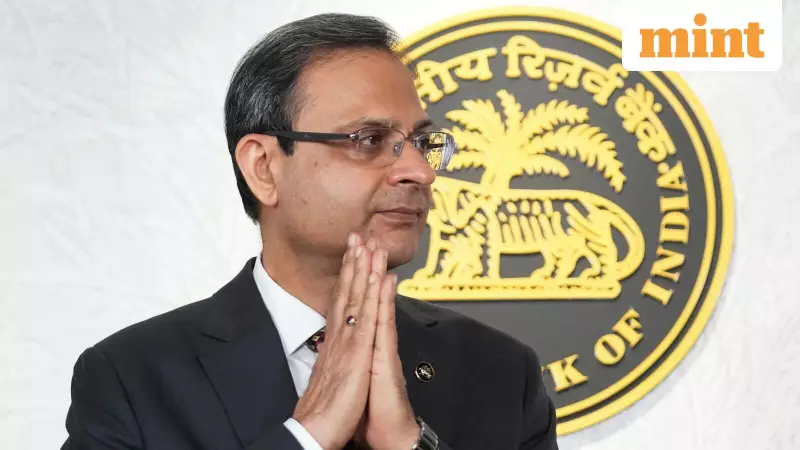
The financial markets are holding their breath as the Reserve Bank of India's (RBI) Monetary Policy Committee (MPC) prepares to announce its crucial bi-monthly decision on Friday, December 5, 2025. Governor Sanjay Malhotra will unveil the policy in a complex economic environment marked by record-low inflation, surprisingly robust GDP expansion, and rising external uncertainties.
The Great Rate Debate: To Cut or to Pause?
The central question dominating the pre-policy discourse is whether the RBI will choose to extend its rate-cutting cycle or opt for a strategic pause. A recent poll of 13 economists revealed a divided house: nine expect the MPC to hold the repo rate steady, while four anticipate a 25-basis-point reduction, which would bring the key rate down to 5.25%.
Arguments for a pause have gained strength following the stunning 8.2% real GDP growth recorded in the September quarter, a figure that significantly overshot the RBI's own projection of 6.8%. Analysts at Standard Chartered Bank contend that ample system liquidity and front-loaded government spending are already providing sufficient support to economic activity, diminishing the immediate need for a rate cut.

However, the dovish camp, including economists at Nomura who see a 65% probability of a cut, points to inflation's persistent undershooting of the central bank's medium-term target path. The consensus expectation is that the MPC will maintain a neutral stance while keeping the door open for potential easing in 2026.
Navigating the Growth-Inflation Paradox
The policy announcement comes against a backdrop of seemingly contradictory data. On one hand, headline inflation for October plummeted to a historic low of 0.25%, driven by food price deflation, GST rationalisation, and favourable base effects. SBI Research notes that consumer price index (CPI) inflation, excluding gold, is already in negative territory.
Consequently, analysts anticipate the RBI will slash its inflation forecast for the full fiscal year 2025-26 to around 1.8-2%, down from its previous estimate of 2.6%. Its projection for the first quarter of FY27 is also expected to be trimmed to 4% from 4.5%.
On the growth front, the RBI's current FY26 GDP estimate of 6.8% appears conservative after consecutive positive surprises. HDFC Bank has revised its growth projection upward to 7.3%. While the MPC is widely expected to upgrade its GDP guidance above 7%, economists believe it may refrain from a very large upward revision. This caution stems from concerns over weakening nominal GDP growth, which slowed to 8.7% in Q2, looming global headwinds, US tariff policy uncertainty, and an expected moderation in government capital expenditure in the latter half of the fiscal year.
Liquidity, the Rupee, and the Governor's Tone
Beyond the headline rate decision, market participants will scrutinise the central bank's moves on liquidity and currency management. With transmission of past rate cuts remaining uneven and government bond yields steepening, there is expectation for steps to cool the yield curve.
SBI Research expects "calibrated easing within a neutral stance," potentially through open market operation (OMO) purchases to maintain durable liquidity at 2.0–2.5% of net demand and time liabilities (NDTL). Other measures could include examining state development loan (SDL) issuances from a duration perspective and introducing uniform pricing in bond auctions to curb volatility.
The Indian rupee, which has depreciated by approximately 5% against the US dollar in 2025 and recently crossed the 90 mark, is another critical focus area. The decline is attributed to weak capital inflows, a widening trade deficit, and limited RBI intervention due to constraints in its forward book. Markets will keenly watch for reassurance from Governor Malhotra that the RBI stands ready to act against any disorderly currency volatility, while balancing forex market interventions with domestic liquidity management.
Ultimately, the overall tone and forward guidance in the policy statement and the Governor's commentary will be paramount, providing crucial direction to financial markets for the coming months.






