

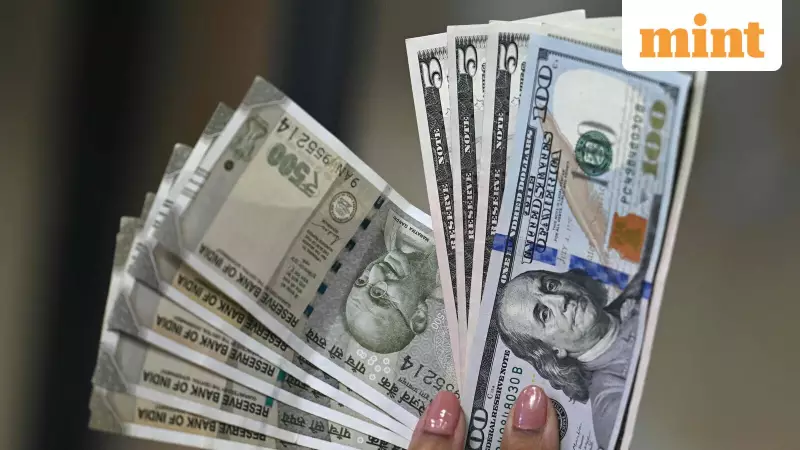
Indian Rupee Closes Marginally Weaker on Tuesday
The Indian rupee ended Tuesday's trading session with a slight decline against the US dollar. Market pressure came from falling domestic stock indices and weaker performances across Asian currencies. However, active intervention by the Reserve Bank of India helped prevent a steeper drop.
Closing Figures and Market Pressure
The local currency settled at 90.19 per US dollar. This marked a marginal weakening from its previous close of 90.1625. The decline occurred alongside a broader regional trend.
Asian currencies generally slipped during the session, with losses ranging between 0.1% and 0.8%. Domestically, India's key equity benchmarks also moved lower. The BSE Sensex declined by 0.2%, while the Nifty 50 index fell by 0.3%. Both underperformed compared to most regional peers.

An additional factor weighing on sentiment was the confirmed deferral of Indian bonds' inclusion in a major global index. This news negatively impacted the rupee's position.
Central Bank Action Limits Decline
The Reserve Bank of India stepped in to sell US dollars across markets. This intervention occurred in both the non-deliverable forward market and the local spot market. The central bank's actions effectively blunted the multi-front pressure on the currency, containing its losses.
Analysts See Potential for Recovery
Despite the day's headwinds, some analysts suggest a modest recovery could be possible for the rupee. They point to seasonal factors that may turn positive. Analysts at banking giant HSBC have expressed a tactical preference for the Indian rupee in the first quarter of 2026.
Their outlook hinges on an expected seasonal narrowing of India's trade deficit. It also assumes progress in ongoing trade discussions between the United States and India. HSBC forecasts the rupee could strengthen to 88 per dollar by the end of March 2026. Following that, they expect it to drift back towards levels around 90 by the end of that year.
Trade Talks and External Factors
Progress in US-India trade negotiations remains a critical factor for the currency's future trajectory. The US Ambassador to New Delhi stated on Monday that officials from both nations would hold a call on trade matters on Tuesday.
However, a new layer of uncertainty emerged from an announcement by former US President Donald Trump. He declared a 25% trade levy on any country conducting business with Iran. Official data from India's commerce ministry shows total bilateral trade with Iran stood at $1.34 billion for the first ten months of 2025.
Market participants are also monitoring other external developments. They are awaiting the release of key US inflation data. Traders are also watching closely for any new developments regarding ongoing threats to the operational independence of the US Federal Reserve.






