

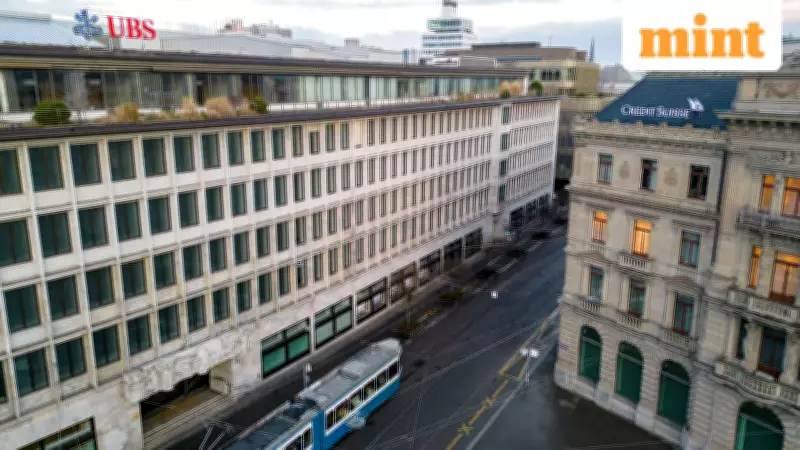
Swiss Banking's Dark Chapter Reopens with Discovery of Hundreds of Nazi-Linked Accounts
In a stunning revelation that has reignited decades-old controversies, independent investigators have uncovered hundreds of Swiss bank accounts with suspected Nazi connections during a deep archival probe. The findings emerge as banking giant UBS engages in a legal battle to prevent Jewish organizations from revisiting a historic settlement from the late 1990s.
Senate Testimony Reveals Extensive Findings
Neil Barofsky, the independent investigator examining archives at UBS's Credit Suisse unit, testified before the Senate Judiciary Committee on Tuesday, revealing that his team has identified close to 900 accounts that may be tied to Nazi officials and party members. Committee Chairman Sen. Chuck Grassley disclosed that Barofsky also found indications the bank assisted fleeing Nazi officials in resettling in Argentina.
"The scope of these discoveries is significant and troubling," said Grassley in statements to journalists. "This represents new information that wasn't available during previous investigations."

UBS's Dual Approach: Transparency and Legal Defense
While UBS has publicly stated its commitment to bringing greater transparency to Switzerland's wartime history, the bank has simultaneously taken legal action against the Simon Wiesenthal Center, the Jewish organization that requested the Credit Suisse probe in 2020. In Brooklyn federal court, UBS has essentially told the organization to remain quiet and cease requesting additional compensation.
Rob Karofsky, President of UBS Americas, emphasized in prepared remarks to the Senate committee that UBS has "voluntarily and extensively cooperated" with Barofsky's investigation. However, the bank firmly opposes reopening the 1990s settlement or sharing information about Credit Suisse's legal decision-making from that period.
The 1990s Settlement and Its Aftermath
The late-1990s settlement between Swiss banks and Jewish groups resulted in nearly $1.3 billion in payments to Holocaust victims, bank account holders, slave laborers, and others whose assets were looted or who were refused refuge in Switzerland. At the time, Credit Suisse claimed to have identified only 14 likely Nazi clients, while UBS acknowledged finding one account for a former Reichsbank president and another opened by an SS officer's widow decades after the war.
"The settlement was intended to draw a permanent line under the Swiss banks' wartime activities," explained Karofsky in his testimony. "Reopening it now would undermine that resolution."
Legal Battles and First Amendment Concerns
In a recent court filing, UBS requested a judge's order to prohibit the Simon Wiesenthal Center and other Jewish groups from questioning the settlement's validity. The bank specifically asked the court to explicitly forbid any further legal action, additional payments, or public controversy regarding the settlement and the banks' conduct.
Lawyers for the Simon Wiesenthal Center responded in a letter to the judge, arguing that UBS's proposed order would violate their First Amendment rights and obstruct their "longstanding mission of investigating and bringing to light the full scope of the antisemitic campaign engaged in by the Nazis before, during, and after World War 2."
Historical Context and Ongoing Investigations
For decades following World War II, Swiss banks routinely turned away families of Holocaust victims, claiming they had no records of their loved ones' accounts and assets. Neutral Switzerland consistently denied suggestions that it helped finance the Nazis or prolonged their terror.
Barofsky's investigation, which began after Credit Suisse hired him in 2021, has uncovered documents indicating that the bank discovered and documented key Nazi-linked accounts during 1990s probes but failed to disclose them. In at least one instance, the bank denied having any relevant records when they actually existed.
Credit Suisse fired Barofsky in 2022 for allegedly overreaching his mandate, but UBS rehired him after taking over the troubled bank in March 2023 following its collapse due to financial troubles and scandals.

Archival Challenges and Future Implications
While UBS has allowed Barofsky's team extensive access to Credit Suisse archives, the bank has declined to open its own war-era records. UBS previously acknowledged destroying potentially relevant documents in the 1990s, a revelation that came to light when a night watchman witnessed the destruction and saved some documents.
Karofsky noted that the current probe's scope has "increased significantly" beyond initial expectations. "Our priority now is to complete the review," he stated. "UBS will continue to follow the facts wherever they lead."
A court hearing on UBS's request to restrict the Simon Wiesenthal Center's actions is scheduled for March 12. The two parties have already undergone mediation sessions in December and January, with Karofsky emphasizing that any suggestion UBS is attempting to silence the organization is "false."
The revelations come at a sensitive time for Swiss banking, as the country continues to grapple with its complex wartime legacy while maintaining its reputation as a global financial center.





