There was a time, not too long ago, when India’s banking sector stood out globally for an unusual reason: the number of women at the very top. From Arundhati Bhattacharya, who became the first woman to chair State Bank of India, to Naina Lal Kidwai at HSBC, Chanda Kochhar at ICICI Bank, and Shikha Sharma at Axis Bank, women were not just in senior positions but helming some of the country’s largest financial institutions. That moment was often described as exceptional. Today, it looks more like a precursor.
A striking number of global capability centres (GCCs) run in India by American, European, and British banks and financial services firms are led by women. These centres span everything from core banking technology and risk management to advanced analytics and operations, supporting some of the world’s largest financial institutions and increasingly shaping how they function globally. The parallels with the earlier phase of Indian banking are difficult to ignore, though the reasons this time are more layered, rooted as much in the nature of the GCC model as in broader social shifts.
The GCC Fillip
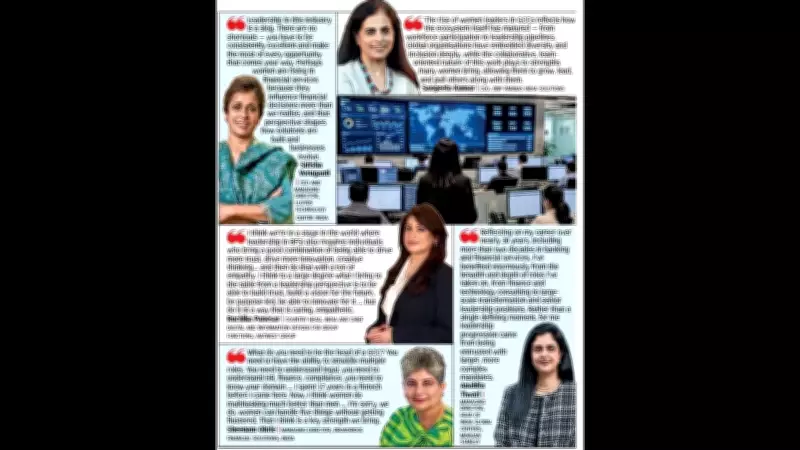
Sirisha Voruganti still remembers what it meant to be employee number one. When Lloyds Banking Group decided to build out its technology centre in India, she was the first hire, tasked with creating not just a team but an entire capability from the ground up. A decade on, that centre has grown into a critical engine for the bank’s global technology roadmap, working on everything from core banking systems to digital identity and analytics. Voruganti, now chief executive and managing director of Lloyds Technology Centre India, offers a pragmatic explanation on why so many women are in such leadership positions.

“A lot of payment decisions are either taken by women or influenced by women,” she says, suggesting that the industry itself may naturally lend itself to female leadership. “You’re influencing those decisions, architecting solutions, and perhaps that has something to do with why you see so many women growing in this space.” Her rise has been anything but accidental. With more than three decades in the industry, including stints at Mastercard and other financial services firms, she describes leadership not as a breakthrough moment but as the accumulation of opportunities seized. “It’s a slog,” she says plainly. “There are no easy routes to the top. You have to make the most of every opportunity, even if it’s just two minutes with the CEO.”
That thought is echoed by Anahita Tiwari, managing director and head of India global centres at Morgan Stanley. Having spent nearly three decades in banking and consulting, she sees leadership progression as a function of scale and trust rather than gender. “Leadership at this level requires navigating complexity, building trust with global teams, and delivering at scale,” she notes, adding that structured mentorship, internal mobility, and rigorous performance frameworks have helped create “a more level playing field” within the organisation. Morgan Stanley, one of the world’s largest investment banks, runs extensive operations in India that span technology, risk, operations and finance, supporting its global business. Like many multinational banks, it has leaned heavily on its Indian GCC to drive both cost efficiencies and innovation.
The Role of Diversity and Inclusion
It is within this evolution that women have found space to rise. Sangeeta Kumar, chief executive of BNP Paribas India Solutions, the GCC arm of the bank, believes the answer lies partly in the maturity of the industry itself. “This sector is now 25 to 30 years old. We’ve seen the entire cycle evolve, and alongside that, the percentage of women in the workforce has grown from about 10% to nearly 35–40%,” she says. BNP Paribas, one of Europe’s largest banks, operates across corporate and institutional banking, investment solutions and retail services, with its India GCC playing a key role in technology and operations. Kumar points out that global diversity mandates have played a crucial role in catapulting women to the forefront of these centres. “The culture in GCCs is heavily influenced by global organisations where diversity and inclusion practices are deeply embedded,” she explains.

These policies, combined with flexible work arrangements and return-to-work programmes, have helped address what Kumar calls the “leaky pipeline” — the tendency for women to drop out mid-career. Yet challenges remain. “At entry level, we see a 50–50 split, but over time it reduces. Social factors still play a role,” she says. Even so, the trajectory is unmistakably upward. Kumar also points to the unique exposure that GCC roles provide. “Teams in India often work closely with global leaders. That level of access accelerates leadership development,” she says, adding that the collaborative nature of the work may also favour leadership styles often associated with women.
Different Kind of Leadership
That emphasis on collaboration and empathy comes through strongly in the views of Ruchika Panesar, country head for India and chief digital and information officer for group functions at NatWest Group, which operates a significant global capability centre in India. “I am a business leader first, a technologist first, and I happen to be a woman,” she says. “It’s not about gender; it’s about the kind of leadership the industry needs today — trust, innovation, and empathy.” Panesar argues that the demands of modern financial services — particularly in a world shaped by digital transformation and heightened regulatory scrutiny — have created a natural alignment with these traits. “There is a match between what the industry needs in this moment and what leaders today are bringing,” she says.
At Broadridge Financial Solutions’ GCC in India, managing director Sheenam Ohrie says that running a GCC is less about specialisation and more about range. At Broadridge, Ohrie has had to navigate everything from compliance and finance to people management and technology strategy. “You have to be able to straddle multiple roles,” she says. That ability to juggle complexity, she believes, is one reason more women are finding their way into these roles, particularly in environments that demand both technical depth and organisational agility. Ohrie also sees this as a continuation of a longer story. “Earlier women leaders in Indian banking made people realise that women can do this too,” she says. In her own case, that shift began at home, where expectations were deliberately different. Over time, she says, organisations have also begun to recognise the value women bring — not just in technical expertise, but in how they think about teams, decisions and outcomes.
Beyond the executives interviewed, the pattern is visible across the industry. Mamatha Madireddy leads India global service centres for HSBC, overseeing large-scale operations that support the bank’s global businesses. Madhurima Khandelwal heads the credit and fraud risk centre of excellence at American Express, a role central to managing risk in one of the world’s largest payments networks. These are not peripheral positions but roles deeply embedded in the strategic functioning of global institutions.