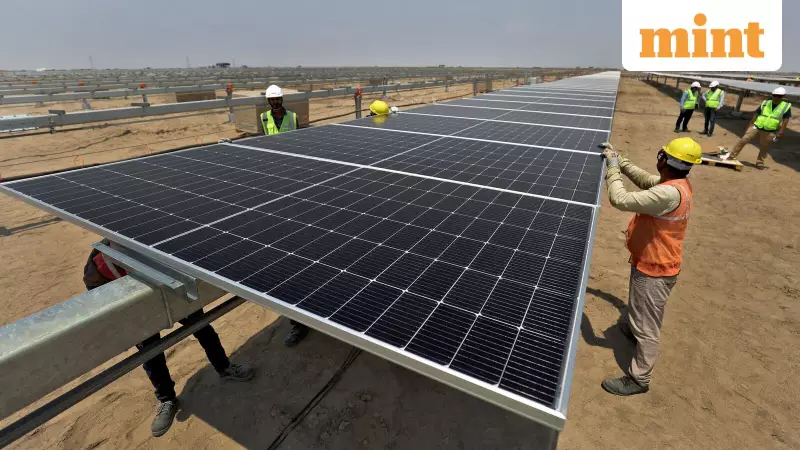
Adani Green Energy's Q3 Profit Nosedives to ₹5 Crore Amid Merchant Market Pressure
Adani Green Energy Ltd, the renewable energy subsidiary of the Adani Group, reported a dramatic plunge in profitability for the quarter ended December 31, 2025. The company's consolidated net profit for the third quarter of fiscal year 2026 (Q3 FY26) collapsed to a mere ₹5 crore, a stark contrast to the ₹474 crore recorded in the same period last year. This significant decline occurred despite a 9% year-on-year increase in operational revenue, which rose to ₹2,618 crore.
Merchant Market Sales and Interest Costs Squeeze Margins
The primary driver behind this profit slump was the company's high volume of power sales in the merchant or spot market, where electricity prices are substantially lower compared to long-term utility contracts. During the nine months ending December 31, 2025, Adani Green sold 27.6 billion units of electricity, with 12 billion units directed to the merchant market. Notably, 7 billion units of this merchant sale were originally intended for long-term power purchase agreements but were instead sold on the spot market, as revealed in an investor presentation.
This strategic shift proved costly. Revenue from renewable energy under long-term agreements typically ranges between ₹2-3 per unit, but spot market prices can plummet to near-zero levels during peak solar generation hours, severely impacting profitability. The company did not provide a detailed breakdown of these sales specifically for the December quarter.

Rising Financial Burdens Compound Challenges
Compounding the margin pressure from merchant sales, Adani Green faced escalating financial expenses. Interest costs surged by 36% year-on-year to ₹1,698 crore during the quarter. Additionally, other expenses nearly doubled, reaching ₹328 crore. These rising costs further eroded the company's bottom line, highlighting the financial strain amidst aggressive expansion.
Robust Growth Trajectory and Ambitious Targets
Despite the quarterly profit setback, Adani Green Energy continues to demonstrate strong operational growth. The company reported an operational renewable energy portfolio of 17.2 gigawatts (GW) as of December 31, 2025, the largest in India. It added approximately 500 megawatts (MW) of capacity during the quarter and has maintained a 40% compounded annual growth rate in capacity addition since FY20, the fastest pace in the industry. The firm is targeting 50 GW of capacity by FY30.
Over two-thirds of its power capacity comes from standalone solar projects, with the remainder from wind or hybrid installations. Its flagship project near Khavda in Gujarat had a capacity of 7.7 GW at the quarter's end, with ambitions to become the world's largest renewable energy installation at 30 GW by 2029.
Financial Position and Market Reaction
Adani Green Energy did not disclose its net debt position as of December 31, 2025. However, as of September 30, 2025, the company had a net debt of ₹76,071 crore, underscoring its significant capital investment role within the Adani Group. The firm is not only developing renewable energy projects but has also committed to substantial investments in setting up 5 GW of pumped hydro storage projects.
The earnings announcement coincided with market turmoil. Shares of Adani Green Energy Ltd fell 14.63% on the BSE to close at ₹772.1. This decline followed news that the US Securities and Exchange Commission moved a federal court to serve direct summons to Adani Group chair Gautam Adani and Adani Green executive director Sagar Adani in a 14-month-old bribery case, bypassing Indian authorities.