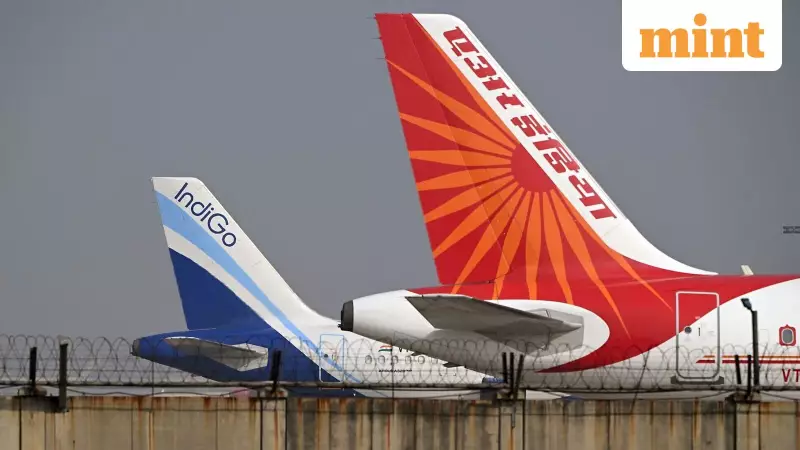
Air India's Four-Year Tata Journey: Recovery Mode Persists as IndiGo Maintains Lead
Four years after the Tata Group acquired Air India from the government on 27 January 2022, the airline finds itself in a state of gradual recovery rather than a dramatic breakout. While significant strides have been made under the ambitious Vihaan.ai transformation plan, the pace of turnaround has lagged behind management expectations, particularly when compared to the dominant performance of rival IndiGo.
Domestic Market Dynamics: Steady Growth with Mixed Results
India's domestic aviation market has witnessed consistent expansion post-pandemic. Passenger numbers climbed from approximately 152 million in 2023 to around 161 million in 2024, with estimates for 2025 suggesting 165-170 million travelers. Within this growing market, Air India Express achieved a milestone by crossing a 10% passenger share for the first time in 2025. However, Air India's domestic share experienced a decline following route frequency reductions after the June 2025 Ahmedabad crash.
Comparing market share evolution between 2022 and 2024 reveals telling patterns. The Air India duo (Air India and Air India Express) collectively gained 4.2 percentage points during this period. Meanwhile, market leader IndiGo added 5.9 percentage points from a substantially larger base, demonstrating more robust growth despite facing operational challenges related to pilot shortages under new regulations.

International Segment: Similar Trends with Revenue Nuances
The international aviation segment has followed comparable trajectories. Passenger numbers increased from 28.4 million in 2023 to 32.7 million in 2024, with 2025 projections reaching approximately 36 million. Indian carriers now collectively hold about 46% of this market. Following the 2025 plane crash, Air India reduced capacity on certain long-haul routes, resulting in a noticeable drop in its 2025 market share.
A more accurate comparison between 2022 and 2024 shows the Air India duo gaining 1.2 percentage points in passenger share, while IndiGo gained 2 percentage points. An important distinction emerges when examining distance and revenue metrics. Air India operates more wide-body aircraft designed for longer routes with higher seating capacity. Consequently, while Air India held a 35.9% share of passengers among Indian airlines in 2024, it commanded a significantly higher 53.1% share of passenger-kilometre, indicating stronger revenue generation per passenger.
Fleet Modernization and Pilot Recruitment Challenges
The June 2025 plane crash represents a substantial setback for Air India's recovery trajectory. The airline's transformation plan includes multiple critical components: purchasing new aircraft, retrofitting older planes, integrating multiple airlines, expanding route networks, increasing operational staff, and enhancing training and maintenance infrastructure.
Air India placed substantial orders for 470 new aircraft with Boeing and Airbus in 2023, followed by an additional 100 planes in 2024. However, delivery timelines have trailed behind IndiGo's progress. Boeing delivered 26 planes to Air India in 2024 and 15 in 2025, while Airbus delivered 49 aircraft to IndiGo in 2025 alone—nearly one per week.
Both Air India and Air India Express urgently require new aircraft to expand operations and improve fleet specifications. With current average fleet ages of 8.6-8.8 years, they rank among the oldest fleets among Indian airlines, highlighting the pressing need for modernization.
Pilot recruitment presents another critical area where Air India has needed to catch up significantly. Between March 2016 and March 2022, Air India's pilot count declined from 1,411 to 1,116, while Air India Express saw modest growth from 269 to 333. During the same period, IndiGo dramatically expanded from 1,747 to 3,791 pilots.
Since the Tata acquisition, both Air India and Air India Express have pursued aggressive hiring campaigns and benefited from merging other Tata airlines (Vistara with Air India, and AirAsia with Air India Express) in late 2024. Between March 2022 and March 2025, Air India's pilot strength tripled, while Air India Express experienced sixfold growth. By March 2025, the combined Air India stable was only 51 pilots short of IndiGo's total.

On a per-plane basis, Air India's pilot metrics actually surpass IndiGo's, though this advantage is partially offset by the greater pilot requirements for wide-body aircraft that constitute a larger portion of Air India's operations. These recruitment efforts gain additional importance considering new regulations mandating higher pilot-to-aircraft ratios across all airlines.
Financial Performance: Revenue Growth Versus Persistent Losses
Ultimately, all transformation efforts—whether fleet modernization, pilot recruitment, or route expansion—must converge to achieve operational and financial turnaround. Under Tata stewardship, Air India has successfully scaled revenue through both inorganic means (absorbing other Tata airlines) and organic growth (carrying more passengers with higher realizations).
However, profitability remains elusive. In the 2024-25 fiscal year, Air India and Air India Express reported combined net losses of approximately ₹9,700 crore. Setbacks like the 2025 crash have compounded challenges from both reputational and financial perspectives. Recent reports indicate the airline may face net losses around ₹15,000 crore for 2025-26.
This contrasts sharply with IndiGo, which reported consistent net profits in both 2023-24 and 2024-25. For airlines, fuel constitutes the primary operational cost, and favorable crude oil prices have created advantageous conditions. While Air India has capitalized on this window to some extent, it has not achieved the financial transformation initially envisioned.
The four-year journey under Tata ownership demonstrates measurable progress but underscores the considerable distance still to travel. With IndiGo maintaining market dominance and Air India navigating both internal transformation challenges and external setbacks, the aviation landscape remains intensely competitive as India's air travel market continues its expansion.