

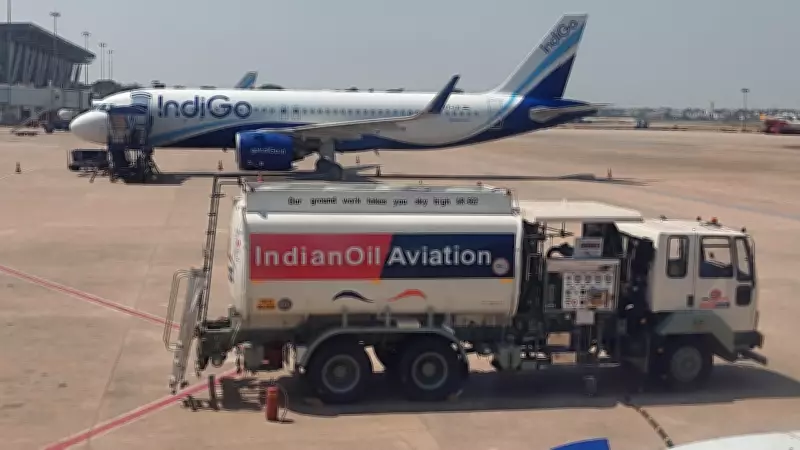
Airfares Set to Skyrocket as Jet Fuel Prices More Than Double in April
Air travelers across India should brace for a significant surge in ticket prices as aviation turbine fuel (ATF) costs have more than doubled for the month of April. This dramatic increase, a direct fallout of the Iran war, is delivering a severe blow to the financial stability of Indian carriers.
Historic Price Hikes Announced for Domestic and International Flights
Oil Public Sector Undertakings (PSUs) announced the revised ATF pricing early Wednesday morning. The figures reveal staggering hikes: prices for domestic flights have increased by approximately 115%, while international flight ATF has risen by about 107%.
Domestic ATF Pricing Reaches Unprecedented Levels

In a historic first, the price of ATF for domestic operations has crossed the Rs 2-lakh per kilo litre (KL) mark at key airports. At Delhi's Indira Gandhi International Airport (IGIA), India's busiest aviation hub, a KL now costs Rs 2,07,341.22—a massive 114.5% jump from Rs 96,638.14 last month. Similarly, at Mumbai's Chhatrapati Shivaji Maharaj International Airport (CSMIA), the price has soared 115% to Rs 194,968.67 from Rs 90,451.87. This refined kerosene, essential for keeping aircraft aloft, has itself defied gravity with these record-breaking rates, also witnessed in Kolkata and Chennai.
International ATF Pricing Breaks the $1,000 Barrier
For international flights operated by Indian carriers, ATF pricing has surpassed the $1,000 per KL threshold for the first time in the country. In Delhi, the cost is now $1,690.81, up 107% from $816.91 in March. Mumbai shows a comparable hike, while Kolkata records the highest price at $1,727.3, marking a 102% increase. The situation is exacerbated by the Indian rupee hitting record lows against the US dollar, currently trading above 95, which further inflates these dollar-denominated costs. This contrasts sharply with April-May 2024, when international ATF was over $900 but the exchange rate was a more favorable 83-84.
Severe Impact on Airline Economics and Operations
Even prior to this anticipated hike—a consequence of the Iran conflict mirroring global trends—ATF for domestic flights in India was among the most expensive worldwide. Jet fuel typically constitutes 40% to 45% of an airline's total operating costs. This proportion is now set to increase dramatically, potentially rendering operations unviable for financially weaker players.
Airlines are expected to respond by raising fares to offset the heightened operating expenses. This move is likely to dampen demand, leading to potential flight reductions as carriers meticulously assess the economic feasibility of each route. Major airlines like IndiGo, the Air India group, and Akasa had already imposed or increased fuel surcharges last month, ranging from Rs 150 to $200. These surcharges may now be revised upward. Notably, the fare cap of Rs 18,000 for domestic flights was removed on March 21, 2026, providing airlines more pricing flexibility.
With no fiscal relief on ATF excise duties from the central government or Value-Added Tax (VAT) from states like Delhi and Mumbai, airlines have explicitly requested that the government only consider capping airfares if their costs can be similarly controlled.
Industry Leaders Warn of Turbulent Times Ahead
Air India CEO Campbell Wilson highlighted the looming challenges in a recent communication to employees. He stated, "The financial impact of the Iran war crisis is yet to be fully felt, as although the spot price of jet fuel has more than doubled, most of the impact will only hit us from next month." Wilson cautioned that escalating operating costs could force more airlines to cut flights, depending on the interplay of fuel costs, airfares, and customer demand.
He further explained the complex dynamics at play: "Not every customer is willing to pay higher airfares, so there is a limit to how high we can price before demand drops. Additionally, given economic uncertainties, it is not certain that customers or companies will be as willing to travel as they were prior to the conflict, and may choose to stay put for a while."

While airlines are identifying pockets of new demand, such as on routes to Europe and North America, Wilson noted that carriers in other regions are already reducing flights due to high fuel prices. He emphasized that Indian airlines may also need to adjust their operations based on evolving market conditions.
The combination of record-high ATF prices, a weakening rupee, and elongated flight routes to and from the West due to the conflict creates a perfect storm for the aviation industry. Passengers can expect:
- Substantial increases in airfares across both domestic and international sectors.
- Possible reductions in flight frequencies on less profitable routes.
- Continued volatility in ticket pricing as airlines navigate this cost crisis.
The coming months will be critical for airlines as they balance survival with maintaining service levels in an increasingly challenging economic environment.





