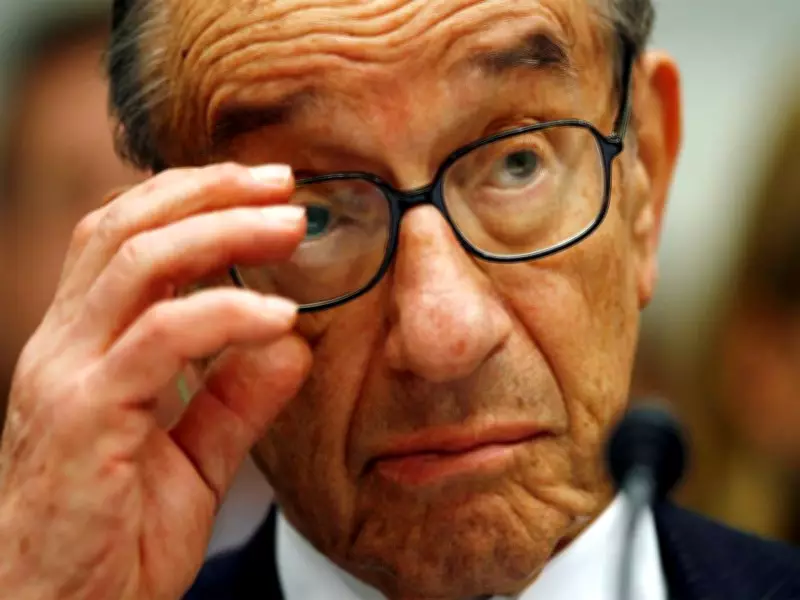
Alan Greenspan, the legendary former chairman of the U.S. Federal Reserve, passed away on June 22, 2026, at the age of 100. His death was attributed to complications related to Parkinson's disease and occurred at his home in New York City.
His wife of 29 years, Andrea Mitchell, NBC News' chief Washington correspondent and chief foreign affairs correspondent, confirmed the news. In a statement reported by NBC, Mitchell said: "Alan passed away at our home this morning at the age of 100 from complications of Parkinson's disease. He was a giant of a man who helped shape the U.S. economy for decades under presidents of both parties, but was always honest in acknowledging his mistakes."
Greenspan's Tenure and Impact
Greenspan served as Federal Reserve chairman from 1987 to 2006, presiding over the U.S. economy under four presidents: Ronald Reagan, George H.W. Bush, Bill Clinton, and George W. Bush. His tenure spanned from the end of the Cold War to just before the global financial crisis of 2007-2008.

A staunch free-market advocate, Greenspan was credited with deregulating financial markets, which many argue spurred economic growth. However, he was also criticized for policies that some believe laid the groundwork for the 2007-08 financial crisis, particularly his decision to keep interest rates low in the early 2000s.
Early Life and Career
Born on March 6, 1926, to Jewish parents in the Washington Heights neighborhood of New York City, Greenspan rose from humble beginnings to become one of the most influential central bankers in history. He earned a degree in economics from New York University and later served as chairman of the President's Council of Economic Advisors under President Gerald Ford from 1974 to 1976, having been appointed by Richard Nixon in his final year in office.
When Greenspan first entered public service, interest rates were regulated, financial derivatives were rare, and the dollar was pegged to gold. During his chairmanship, the U.S. economy experienced its longest period of expansion on record, from 1991 to 2001.
Philosophy and Influence
In the 1950s, Greenspan was an associate of Ayn Rand, author of "Atlas Shrugged" and a prominent free-market proponent. He later wrote in his memoir, "The Age of Turbulence: Adventures in a New World": "Ayn Rand and I remained close until she died in 1982, and I'm grateful for the influence she had on my life. I was intellectually limited until I met her."
Greenspan is known for using monetary policy to preemptively combat inflation, but his low-interest-rate policy in the early 2000s is often cited as a contributing factor to the housing bubble and subsequent financial crisis.
Legacy and Key Moments
In a famous 1996 speech, Greenspan coined the term "irrational exuberance" to describe the phenomenon where investor enthusiasm drives asset prices beyond their fundamental values. This phrase became synonymous with market bubbles.
Greenspan's legacy remains complex: he is celebrated for steering the economy through a period of unprecedented growth but also criticized for policies that may have contributed to one of the worst financial crises in modern history. He served as the second-longest-serving Federal Reserve chairman, after William McChesney Martin Jr.