

Audi India Expresses Strong Confidence in India's Economic Resilience Amid Global Challenges
German luxury car manufacturer Audi has publicly affirmed its belief in the strength and resilience of the Indian economy to overcome challenges arising from current geopolitical uncertainties, including conflicts in regions like Iran. The company emphasized that India's series of Free Trade Agreements (FTAs) and its inherent economic robustness will ensure sustained demand in the long term.
Leadership Insights on Economic Fundamentals and Future Prospects
Balbir Singh Dhillon, the head of Audi in India, acknowledged that while "short-term challenges" may exist, the economic fundamentals remain solid from a long-term perspective. In an interview with Times Internet, Dhillon stated, "If you look at whatever is happening across the world, we are seen as one of the hopes. So, I think that is something which is very, very positive. Also, as an economy, I think we have been able to address all the challenges that we are seeing very, very well so far. I continue to believe that we will also handle them well going forward and come out stronger."
He added, "I believe we have to see a lot of success in the next few decades. So, the success of India is ahead of us, not past us. I continue to have a very, very positive mindset from that point of view… long term, I think from an industry point of view, we are extremely positive."

FTAs as a Catalyst for Economic Growth and Resilience
Dhillon highlighted that India's growing network of trade agreements will serve as a foundation for greater economic resilience. He explained that increased economic activity, including exports, will boost GDP growth. "The nine FTAs that India has signed open so much for us as a country. We are opening up to so many developed markets where per capita GDP is much higher than ours. This will see our exports go up, FDI will come into India, wealth creation will happen, MSMEs will grow faster, companies will have more profits, and the stock market will go up. So, between 3-5 years, you will see a lot of opportunities coming into India."
Specifically, the FTA with the European Union (EU) is expected to benefit brands like Audi by allowing more cars to be imported at subsidized duties for market testing. However, Dhillon clarified that this agreement will not lead to a reduction in Audi's operations or expansion plans in India. "First of all, we are extremely, extremely happy that this (EU FTA) happened after many, many years of negotiations. Of course, the fine print is not yet out, and implementation may still take a year or little more. But what it opens up is more opportunities. We have been saying in the past that if we get an opportunity to test-market more cars in the country, we will know what to bring in at higher volumes and where to invest more. This opens up that window for us — to bring in more cars to test the market, and then whatever makes sense, we will make in India."
Notably, Audi locally assembles approximately 95% of the cars it sells in India, and Dhillon confirmed that expansion plans will continue unabated.
Market Position and Future Launches in India
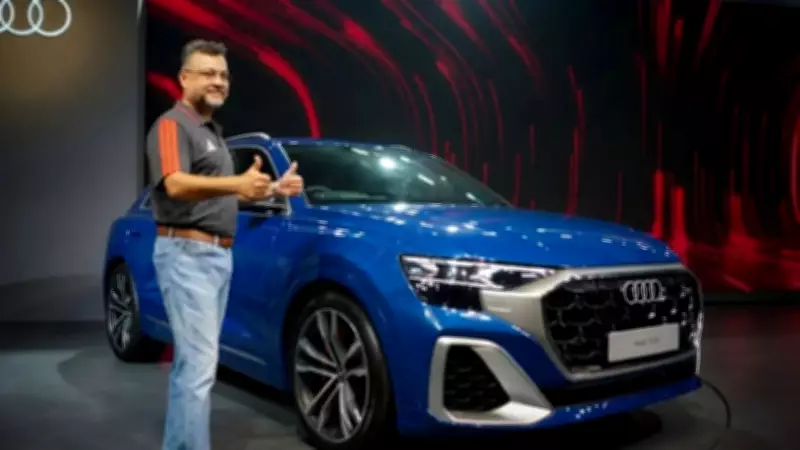
Audi recently introduced the SQ8 model in India, priced at Rs 1.7 crore (ex-showroom), featuring a 4.0-litre V8 TFSI engine that accelerates from 0–100 km/hr in just 4.1 seconds with a top speed of 250 km/hr. Dhillon revealed that more car launches are in the pipeline, stating, "There are many more cars in the pipeline… a very, very exciting future is ahead of us."
Although Audi currently trails competitors like Mercedes-Benz and BMW in the Indian luxury car market, Dhillon asserted that the brand maintains its "swag" in India. He cited customer loyalty as a key indicator, noting that every third car sold by Audi in India goes to an existing customer, and for every new car sold, one luxury pre-owned car is also sold, predominantly Audis. "First of all, the swag exists. For us, the swag is what our customers think. I can give you certain data points that speak for themselves. Every third car that Audi sells today in India is sold to an existing customer. That says a lot about the confidence and loyalty our customers have."

On sales performance, Dhillon attributed current limitations to a restricted model lineup but expressed optimism for future growth. "Today's luxury space is about 10% electric, 30% diesel, and the rest is petrol. We are currently addressing only a limited part of it. As the industry moves and we get more and more products, we will get our rightful market share. But we are not chasing numbers for the sake of it — the growth has to be sustainable, for ourselves and for our partners."
Challenges and Outlook for the Luxury Car Market
Dhillon addressed factors impacting the luxury car market in India, which records annual sales of around 50,000 units, lagging behind growth in other luxury segments like watches and real estate. He pointed to rupee depreciation as a significant challenge, leading to increased car prices due to expensive imported components from Germany. "One of the challenges we have been facing for the last 1-2 years is currency fluctuations. Whatever is said and done, we are assembling these cars in India, but we are still largely dependent on imports of components. Because of currency depreciation, we have no choice but to pass on that cost increase to potential customers. This is one of the challenges."
He provided an example, noting that entry-level luxury cars, previously priced at Rs 35-40 lakh, now cost around Rs 50 lakh. "If the entry-level transaction price five years back was between Rs 35–40 lakhs, now it is above Rs 50 lakhs. This is the challenge that we are facing. But looking ahead, I do see the industry continuing to grow — not necessarily by 20–25% every year, but decent percentage growth. We definitely need to see a year or two with a drastic jump, so maybe we cross 100,000 units in yearly sales by 2032 or a little earlier."





