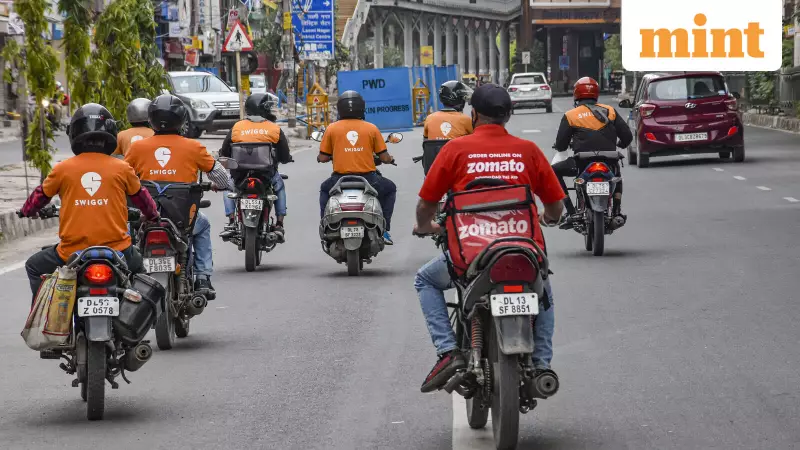
Food Delivery Platforms Rethink Strategy as 10-Minute Promise Faces Backlash
In a significant shift for India's hypercompetitive food delivery sector, major platforms are phasing out their aggressive 10-minute delivery propositions following regulatory pressure and safety concerns. This strategic pivot from speed-focused marketing to execution excellence is expected to reshape customer acquisition dynamics and operational priorities across the industry.
Regulatory Pressure Forces Marketing Shift
The move away from 10-minute delivery promises gained momentum after Union Labour Minister Mansukh Mandaviya urged hyperlocal platforms to reconsider aggressive timelines, citing serious concerns about rider safety and working conditions. In response, leading companies including Swiggy Ltd (operating Bolt and Snacc services) and Eternal Ltd (with Blinkit's Bistro) have systematically removed the 10-minute proposition from their marketing materials and app descriptions.
This fundamental change in messaging comes at a critical juncture when food delivery platforms face slowing growth in transacting users and increasing market saturation. According to Satish Meena, founder of market research firm Datum Intelligence, "new customer additions could slow in the near term because food delivery as a category is anyway seeing slower growth in transacting users."

Impact on Customer Acquisition and Advertising
The removal of speed-based differentiation presents immediate challenges for marketing effectiveness. Siddharth Jhawar, country manager at ad-tech firm Moloco, explains that "targeted branding such as '10-minute deliveries' typically has a strong pull and helps ad creatives perform better." The absence of this compelling promise could potentially lower click-through rates and reduce consumer interest in first-time trials.
Platforms now face increased customer acquisition costs as they must work harder to attract first-time users who previously found the speed promise particularly appealing. The differentiation between ultra-fast delivery and regular food delivery narrows significantly when timelines extend to 15-20 minutes, making consistent execution more crucial than ever.
Execution Takes Center Stage
With speed claims taking a backseat, food delivery companies must now emphasize execution excellence to sustain growth. Sandeep Abhange, research analyst at LKP Securities, notes that "trust and consistency will now matter more than a numeric delivery timer." Firms are increasingly focusing on ensuring reliably fast deliveries, better assortment curation, and addressing supply constraints through innovative solutions.
Platforms are leveraging order data to identify cuisine gaps and unavailable quick-demand items, while expanding their infrastructure through cloud kitchens and additional fulfillment points. This operational refinement aims to maintain perceived convenience even without explicit speed promises.
Growth Metrics and Market Adaptation
Despite the strategic shift, key performance indicators show continued resilience in the sector. Swiggy's food-delivery business added nearly 900,000 average monthly transacting users in the September quarter, while Eternal's food delivery arm added 1.2 million users during the same period. Eternal's food-delivery business saw its net order value grow 16.6% year-on-year in the December quarter, aided by strategic pricing adjustments.
The ultra-fast delivery services that pioneered the 10-minute promise have demonstrated remarkable scalability. Swiggy's Bolt service expanded to 700 cities within a year of launch and now contributes over 10% to the company's overall food delivery orders. Similarly, Eternal's Bistro feature shows "early signs of product-market fit" according to the company's investor communications.
Long-Term Implications and Industry Evolution
This transition represents more than just a marketing adjustment—it signals a maturation of India's food delivery ecosystem. As platforms move away from headline-grabbing speed claims, they must cultivate deeper relationships with customers through reliability, quality, and tailored offerings. Swiggy's approach of "segmented propositions that feel customised" reflects this evolving strategy.

While the immediate impact may include slower new customer additions and higher acquisition costs, industry experts believe the market will adapt in the long run. The fundamental consumer demand for convenience remains strong, and platforms that successfully execute on consistency and quality will likely maintain their growth trajectories despite the absence of explicit speed promises.
The food delivery sector's pivot from speed to substance reflects broader trends in India's digital economy, where sustainable growth increasingly depends on operational excellence rather than marketing superlatives.