

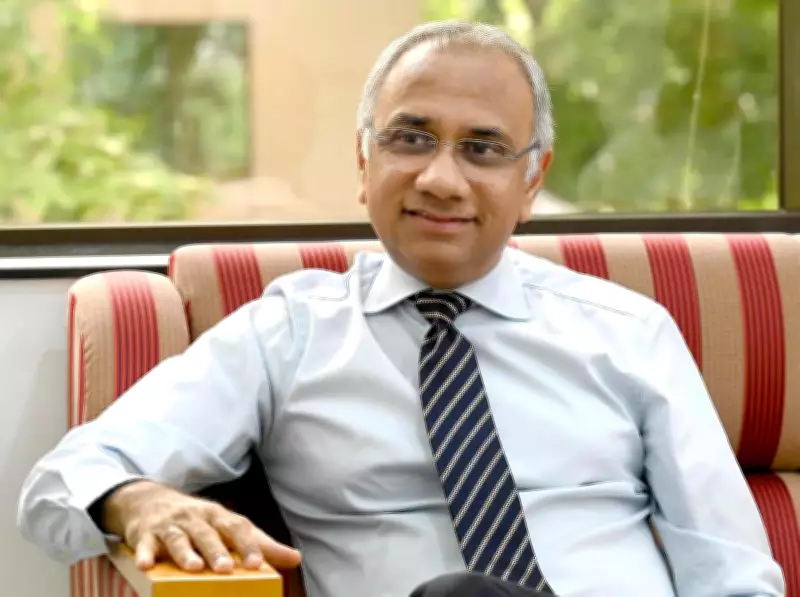
Infosys CEO Salil Parekh's Compensation Rises 2.5% to Rs 82.5 Crore in FY26
Bengaluru: Infosys CEO Salil Parekh's compensation increased by a modest 2.5% to Rs 82.5 crore in FY26, as per the company's annual report. His fixed salary stood at Rs 8.5 crore, while variable pay and incentives totaled Rs 23.3 crore. The package also included Rs 50.7 crore from the exercise of restricted stock units (RSUs). In comparison, TCS CEO K Krithivasan received compensation of Rs 28 crore in FY26, up 6.3% from the previous year.
Infosys stated that Parekh's total compensation was 742 times the company's median employee remuneration after accounting for gains from stock awards. Excluding stock-option gains, the ratio was 289 times the median employee salary. The median remuneration at Infosys stood at Rs 11.1 lakh in FY26, up from Rs 10.7 lakh in FY25, reflecting an increase of around 4%.
The company reported that the average annual salary increase for employees in India was 11%, after accounting for promotions and other compensation revisions. Among other top-paid executives at Infosys, Karmesh Vaswani, segment head for CPG, logistics and retail, received remuneration of Rs 24.2 crore, while chief legal officer Inderpreet Sawhney was paid Rs 21.6 crore.

Shareholders to Vote on Nilekani's Reappointment
Separately, Infosys shareholders will vote on the reappointment of chairman Nandan Nilekani as a director liable to retire by rotation at the company's upcoming annual general meeting (AGM). Nilekani, initially appointed in 2017 and last reappointed in 2024, is eligible for reappointment, the company said. Based on his performance evaluation and the recommendation of the nomination and remuneration committee, the board has recommended his reappointment.
Nilekani Highlights Legacy System Challenges
In his letter to shareholders, Nilekani noted that trillions of dollars of enterprise capability remain locked inside legacy technology systems built for a different era, before cyber threats became a daily concern. "That technical debt is no longer a background cost. It has become a strategic liability: systems that grow more expensive to maintain each year and constrain the very agility AI demands," he said.
Nilekani stated that one of the biggest challenges in enterprise AI adoption is not the technology itself, but the complexity of enterprise context and legacy systems. "Every company has a different legacy, different data, and different undocumented dependencies. Modernizing brownfield systems is far harder than greenfield development. Enterprise AI faces the same truth," he added.
He emphasized that while Infosys would continue embracing AI-powered coding tools to improve productivity, software development still requires rigorous testing, validation, and resilient architectures designed for speed and scale. According to Nilekani, the AI revolution has created urgency among enterprises to modernize legacy systems, eliminate data silos, address AI-identified cyber vulnerabilities, and reduce accumulated technical debt.
Opportunities in Enterprise AI
"The preference will be to build versus buy for software. All this creates significant opportunities," he said, adding that one of the biggest opportunities lies in integrating AI models and agents with traditional enterprise systems. He also noted that many enterprises continue to struggle with scaling AI deployments because of legacy architectures, organizational inertia, and evolving regulatory frameworks. "This is not an opportunity gap. It is a deployment gap," Nilekani said.
He added that enterprises would require "root-and-branch surgery" by redesigning business processes, customer journeys, and operating models instead of merely layering AI onto existing systems. Parekh, meanwhile, said enterprise technology services clients are increasingly focused on rapid AI adoption for coding, code modernization, and building AI agents across business functions.






