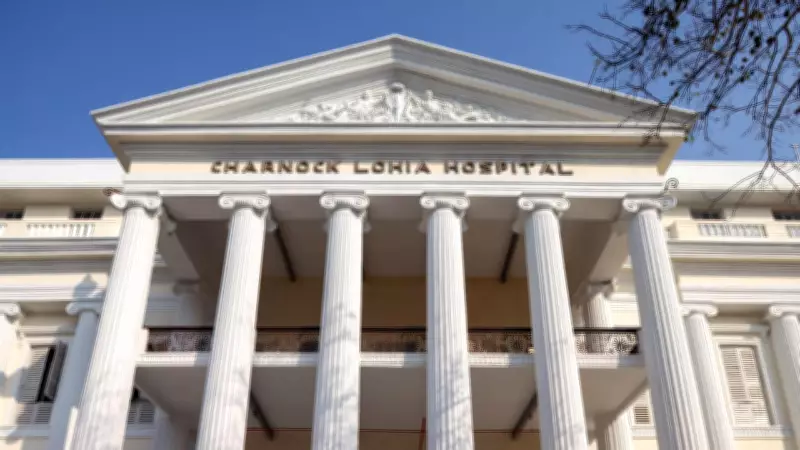
In a city that treats its past as living memory, Kolkata witnessed history reborn as a 200-year-old aristocratic palace transformed into the state's first private super-speciality hospital housed within a Grade-I heritage landmark.
A New Chapter for Heritage
Kolkata has always worn its history on its sleeve. Its crumbling cornices, colonnaded courtyards, and moss-streaked balconies are not relics but living witnesses. However, for the first time, this heritage has found new custodians in the healthcare industry. On Thursday evening, a 200-year-old Grade-I heritage palace — once home to Bengali aristocratic families in the pre-Independence era — reopened its doors as the Charnock Lohia Hospital, a 250-bed modern medical facility housed within Greco-Roman grandeur.
Red, Ritual, and Remembrance
Red was the colour of the day. Women in red-and-white saris lined the bonedi staircase, shankha shells in hand, as the facade glowed under carefully placed lights. Some of the many lives once born at the historic Lohia Matri Seva Sadan — which had shut its doors years ago, leaving a palpable void in North Kolkata — returned as guests. When it closed, it marked more than the end of a maternity home; it was the quiet fading of a neighbourhood institution. Thursday's unveiling felt like a reclamation.

As conch shells echoed through the courtyard, the red curtain fell away, formally unveiling the hospital in the presence of Mayor Firhad Hakim, who served as chief guest for the day. "I had expressed my apprehensions when Prashant Sharma came to me with this project, as I wasn't sure whether the original building could be properly preserved in this endeavour. I also wanted this building to be once again a part of public service. So, before the permit was issued, I wanted written assurance that the Swastha Sathi scheme would operate here," the Mayor said. He took a round of the property, pausing to absorb both structure and sentiment, before proceeding to the second courtyard crowned by a mango tree. Here, the dialogue shifted towards the future of healthcare.
A Palace of Care
The Charnock team marked the inauguration not as a ceremonial formality but as a conscious turning of the page. There was a sense that the building itself was being reintroduced to the city — not stripped of its past, but carrying it forward. The evening unfolded with deliberate pacing, every segment echoing the idea of continuity.
It was orchestrated by Madhumonti Maitra, who framed the gathering as something larger than an unveiling. This, she suggested, was not merely an event but a journey — one that acknowledged memory while embracing momentum. "This address has lived many lives," she observed, setting the tone for what followed. As an audio narration by Barun Chanda filled the space, the building's layered history resurfaced in fragments and anecdotes — from tales of Harekrishna Mullick to the era of its present custodians. The past did not feel distant; it felt present, almost conversational.
Inside, guests entered through a bespoke vintage-style reception that seemed to suspend time. The detailing of the handwritten signposts allowed the architecture to speak. Beyond it lay the first courtyard, softly illuminated by old lamps whose glow traced the outlines of balconies and pillars.
Standing amongst all the old world charm was the helium-free MRI machine — a contemporary intervention that symbolised the hospital's intent. It was a reminder that preservation need not resist progress.
A Centre for Advanced Speciality Care
In his welcome address, Prashant Sharma traced the institution's arc — from a maternity home to "a temple of specialities." Healthcare, he said, has grown in leaps and bounds, and the new hospital seeks to deliver world-class care while preserving the palace's soul. "Healing is not only clinical," he noted, "it is wellness." The cultural programme, Dharohar, blended Urdu dialogue with kathak. Positioned beside the pillars of the two-storeyed facade, dancers evoked the syncretic legacies of Khusrau, Kabir and Rahim — suggesting that health, like heritage, is a shared inheritance. Conceptualised by the multifaceted thespian, Anubha Fatehpuria, the performance was less spectacle than invocation.

As the evening ended with a walk through the illuminated courtyards, the symbolism was unmistakable. In a city where history often risks becoming museum-bound, this palace now breathes again — a cradle of hope, a lighthouse of tradition, a shared heritage reborn as a modern beacon of healing.