Maharashtra Inks Historic Rs 30 Lakh Crore MoUs at Davos with Major FDI Inflow
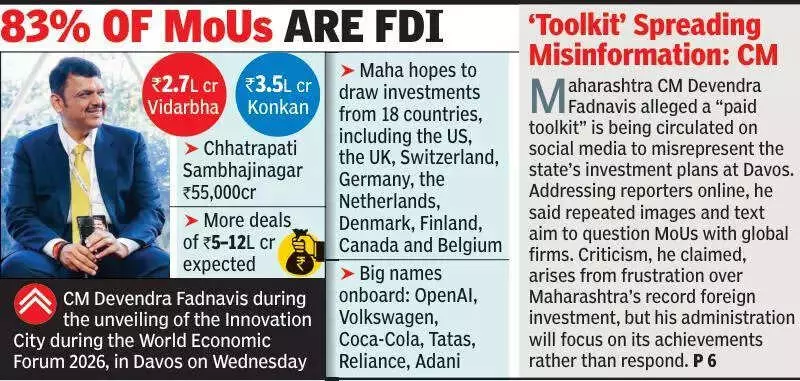
The Maharashtra government has achieved a monumental milestone at the ongoing World Economic Forum (WEF) in Davos, Switzerland, by signing memorandums of understanding (MoUs) worth a staggering Rs 30 lakh crore. Chief Minister Devendra Fadnavis, addressing reporters virtually from Davos, revealed that an impressive 83% of these agreements are Foreign Direct Investment (FDI) proposals, showcasing the state's robust appeal to global investors.
Global and Indian Giants Lead Investment Charge
The list of companies partnering with Maharashtra reads like a who's who of international and domestic business leaders. Notable global entities include:
- OpenAI, the creator of ChatGPT
- Data center specialists Iron Mountain and Princeton Data Group
- Automotive giants Volkswagen and Skoda
- Steel behemoth ArcelorMittal
- Beverage leader Coca-Cola
On the Indian front, corporate powerhouses such as the Tata Group, Reliance Industries, and the Adani Group have also committed to significant investments. Fadnavis emphasized that these Indian companies already have a formidable presence across 165 countries, highlighting their global reach and expertise.

Job Creation and Regional Distribution
Collectively, these MoUs hold the potential to generate approximately 30 lakh jobs, providing a substantial boost to Maharashtra's employment landscape. The investment distribution across the state reveals a promising pattern of regional development:
- Vidarbha region secured deals worth Rs 2.7 lakh crore
- Chhatrapati Sambhaji Nagar attracted pacts valued at around Rs 55,000 crore
- Marathwada is emerging as a new investment magnet
- Konkan region received over Rs 3.5 lakh crore in proposals
- The coastal district of Raigad is also gaining traction as an investment hub
Fadnavis assured that a sizable share of investments is flowing to other parts of Maharashtra as well, ensuring balanced economic growth.
International Reach and Future Prospects
Maharashtra aims to draw investments from 18 countries, including economic powerhouses like the United States, United Kingdom, Switzerland, Germany, the Netherlands, Denmark, Finland, Canada, and Belgium. This diverse international interest underscores the state's strategic importance on the global investment map.
With one day remaining in the WEF summit, the state government anticipates signing additional MoUs ranging between Rs 5 lakh crore and Rs 12 lakh crore. Furthermore, advanced discussions are underway for proposals worth another Rs 7-10 lakh crore, which may materialize into formal agreements by next month if not concluded at Davos.
Tracking Implementation and Addressing Concerns
Responding to queries about the implementation track record, Fadnavis highlighted that over 75% of MoUs signed during last year's WEF have fructified. An MoU is considered successful if project-related activities—such as land acquisition, environmental clearances, or financial closure—are in progress.
The Chief Minister clarified that the realization of MoUs typically takes three to seven years, with operations commencing in stages as milestones are achieved. He noted that some agreements from previous years did not materialize due to geopolitical factors affecting India's relations with certain nations.
Addressing opposition criticism, Fadnavis stressed the importance of understanding the complex and phased nature of large-scale investments. He also pointed out that the remaining MoUs, predominantly FDI-driven, involve partnerships with foreign entities that could lead to significant import substitution, reducing dependency on overseas goods.

Fadnavis explained that FDI inflows are channeled through Indian subsidiaries of multinational corporations or via foreign investment funds, ensuring structured and compliant capital infusion. This approach not only boosts economic activity but also enhances technological exchange and skill development within the state.