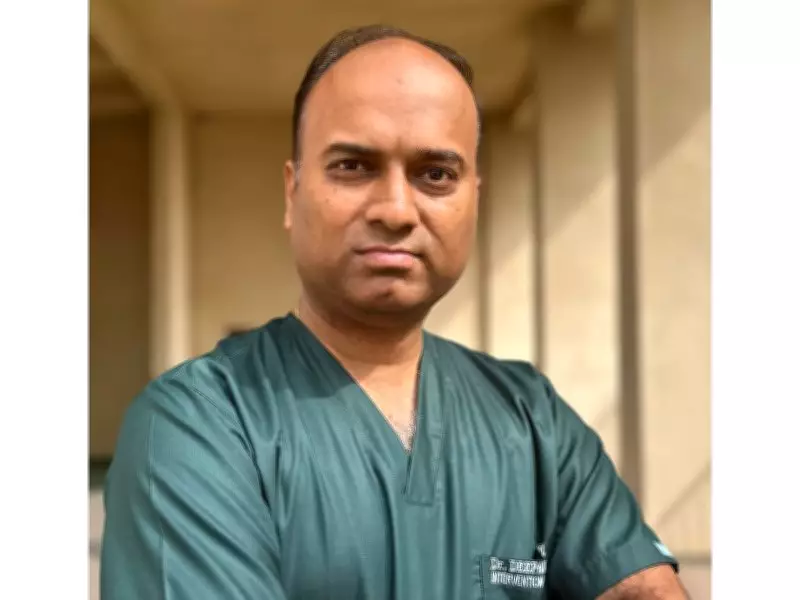
Dr. Deepak Agarwal, an Interventional Radiologist based in Jaipur, highlights that thyroid nodules—abnormal lumps in the butterfly-shaped thyroid gland—are extremely common, especially in women, and their incidence rises with age. The vast majority are benign and do not pose serious health risks.
Discovery and Symptoms of Thyroid Nodules
Many thyroid nodules are found incidentally during routine health check-ups, ultrasounds, CT scans, or other imaging for unrelated reasons. While small nodules often cause no symptoms, larger ones can lead to visible neck swelling, difficulty swallowing (dysphagia), a sensation of pressure or fullness in the throat, voice changes or hoarseness, and cosmetic concerns.
Standard Evaluation and Traditional Treatment
Dr. Agarwal explains that evaluation begins with a detailed thyroid ultrasound to assess size, composition, vascularity, and suspicious features. Based on findings, an Ultrasound-Guided Fine Needle Aspiration Cytology (FNAC) is performed to obtain cells for pathological diagnosis. Benign, small, asymptomatic nodules typically require no active treatment—only periodic ultrasound follow-up. However, when benign nodules enlarge, cause compressive symptoms, or create cosmetic issues, treatment becomes necessary. Traditionally, surgery has been the standard. For malignant nodules, surgery remains the primary and most effective option.

Microwave Ablation (MWA): A Scarless Alternative
Recent advances in Interventional Radiology have introduced Microwave Ablation (MWA) as a safe, effective minimally invasive alternative for selected patients with benign symptomatic thyroid nodules. Performed under ultrasound guidance with local anesthesia, a microwave antenna is inserted through a tiny skin puncture directly into the nodule. Controlled microwave energy generates heat, destroying abnormal tissue while preserving surrounding healthy thyroid gland. Over months, the treated nodule shrinks, improving symptoms and appearance.
Advantages of MWA include no surgical incision or visible scar, local anesthesia, preservation of normal thyroid tissue and function, minimal pain, rapid recovery, same-day or next-day discharge, excellent cosmetic results, and reduced complication risk compared to surgery. Dr. Agarwal notes that many patients seek treatment primarily for neck swelling and cosmetic concerns; MWA offers them an opportunity to avoid surgery while achieving significant nodule size reduction and symptom relief.
Thyroid Artery Embolization (TAE): An Emerging Option
Thyroid Artery Embolization is another image-guided procedure where blood vessels supplying the thyroid gland or nodule are selectively blocked, reducing blood supply and causing gradual shrinkage. It may be useful for large hypervascular benign nodules, toxic nodules causing hyperthyroidism, large multinodular goiters, patients who are poor surgical candidates due to medical comorbidities, those who refuse surgery, or to reduce thyroid vascularity before surgery in selected cases.
The procedure involves a small puncture in the wrist or groin artery. Using advanced angiographic imaging, a microcatheter is navigated into the thyroid arteries supplying abnormal tissue, and tiny embolic particles are injected to block blood flow. Benefits include minimal invasiveness, no neck incision, short hospital stay, preservation of surrounding structures, and potential improvement in compressive symptoms and hyperthyroidism. Dr. Agarwal notes that while TAE is not yet a replacement for surgery in all cases, it represents an exciting advancement that expands treatment options for carefully selected patients.
Future of Thyroid Nodule Treatment
Interventional Radiology is transforming thyroid disease management by offering effective, minimally invasive alternatives to conventional surgery. Dr. Agarwal believes procedures like MWA and TAE are redefining thyroid treatment with excellent clinical outcomes, less pain, no major surgical scar, faster recovery, preservation of thyroid function, and superior cosmetic results. Patients diagnosed with thyroid nodules should undergo proper evaluation with ultrasound and FNAC and discuss all available treatment options with their specialist to determine the most appropriate strategy.

Disclaimer: This article is for informational purposes only and is based on expert opinion. It should not be considered medical advice. Patients should consult a qualified healthcare professional before making medical decisions.