

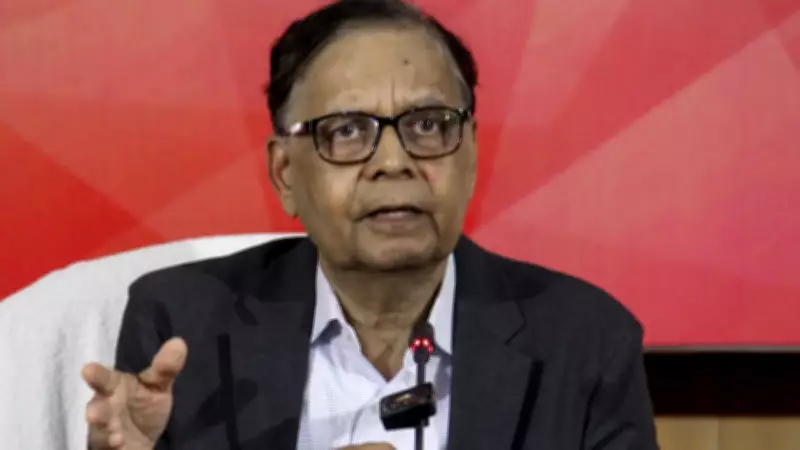
Former Niti Aayog vice chairman Arvind Panagariya has called for reviving the government's privatisation agenda for public sector undertakings (PSUs) and public sector banks (PSBs), arguing that disinvestment remains a key pillar of India's economic reforms.
In an interview with PTI, Panagariya also advocated the creation of an independent privatisation ministry to accelerate the government's disinvestment programme.
"I firmly believe that, regardless of fiscal pressures, the privatisation of PSUs and most public sector banks is integral to our economic reforms," he said.

"Modernisation of the economy as a part of our India@2047 movement, we need to resuscitate the PSU and PSB privatisation," he added.
Panagariya said aggressive PSU and bank privatisation should continue irrespective of the West Asia crisis and broader geopolitical uncertainties.
Under Panagariya's tenure as Niti Aayog vice chairman, the government's privatisation programme was launched in 2016.
FDI remains strong despite capital outflows
Addressing concerns over capital outflows despite India's relatively strong growth rates, Panagariya said gross foreign direct investment (FDI) inflows continue to reflect investor confidence in the Indian economy. He noted that gross FDI rose from $71.3 billion in FY24 to $80.6 billion in FY25 and further to $94.5 billion in FY26.
"Clearly, foreign investors continue to see the long-run productivity of investments in India very positively," said Panagariya, who is currently a professor of economics at Columbia University and chairman of the 16th Finance Commission.
He explained that a significant portion of gross FDI comes through private equity investments, which naturally see exits when companies go public.
"A large part of gross FDI into India has come in the form of private equity. At some point, these investors decide to exit these investments. Typically, this happens when the privately-owned firm goes public through an IPO. In the past two years, IPO activity in India has accelerated, leading to more-than-usual exits by private-equity investors," he said.
Panagariya also pointed to rising overseas investments by Indian companies.
"If this is a short-term phenomenon, we have nothing to worry about regarding outflows. If it is a long-term trend, it is an excellent development. For it indicates that Indian firms are reaching a high degree of maturity as they are spreading their wings abroad," he said.
Rupee correction, exports and inflation outlook
Panagariya said foreign portfolio investment (FPI) outflows had also contributed to capital leaving the country over the last two years.
"By all accounts, Indian equities had become overvalued, which accelerated the exit. But now a valuation correction has happened," he said.
"Therefore, I expect this source of outflows to calm down in FY27," he added.
On the rupee, Panagariya said it would be reasonable to conclude that the currency is no longer significantly overvalued after recent depreciation.
"I think we have now turned a corner by letting rupee depreciation accelerate," the former Niti Aayog vice chairman said.
He also reiterated that he hopes the RBI "will not fall into the psychological trap of refusing to let the rupee cross the Rs 100-per-dollar mark for too long".
Citing the impact of an overvalued rupee on exports, he noted that India's merchandise exports fell from $310 billion in 2011-12 to $260 billion in 2015-16 and recovered to $320 billion in 2019-20.
On concerns over below-average monsoon forecasts and inflation, Panagariya said India's dependence on rainfall has declined over time.
"Our water reservoirs are in good shape, and, based on the increase in the area sown over last year, farmers seem to have taken a generally optimistic view of the situation. Our buffer stock is also robust," he said.
"I do not see a compelling reason to be concerned on this account," Panagariya added.






