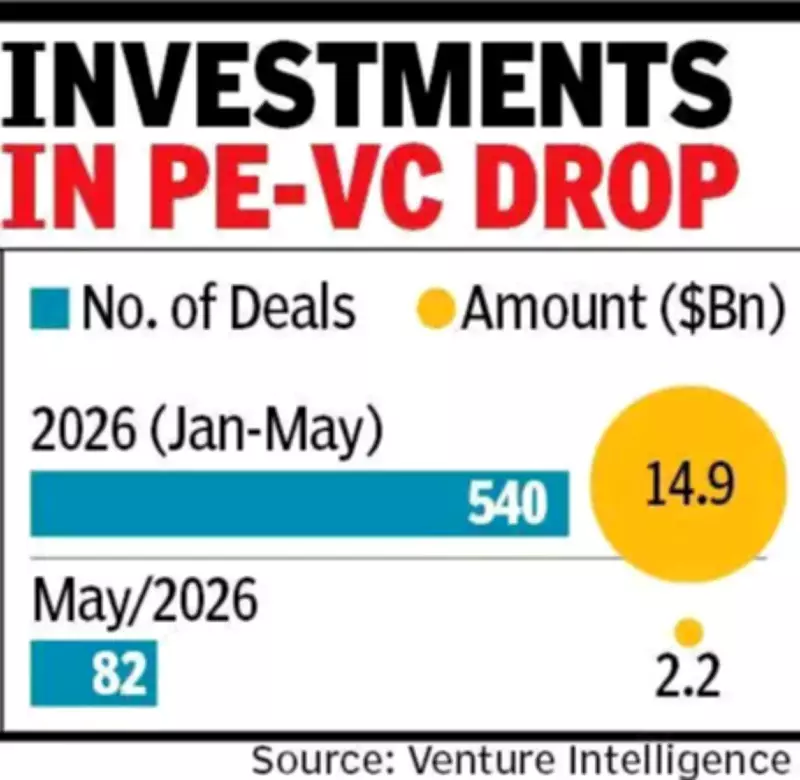
Chennai: Private equity and venture capital (PE-VC) investments in India declined 9% year-on-year during the January-May period of 2026, totaling $15 billion. In the corresponding five-month period of 2025, PE-VC deals, excluding those in the real estate sector, stood at $16.4 billion.
Revival in May 2026
Interestingly, May 2026 witnessed a revival in investment activity, with deal value rising 25% year-on-year, or by $450 million, to $2.2 billion from $1.8 billion in May 2025. A total of 540 PE-VC deals were reported during the January-May 2026 period, according to data released by research firm Venture Intelligence on Monday.
Market Insights
“The slowdown in the IPO and public markets, partly owing to the West Asia situation, has been percolating into private markets over the past couple of months, dragging down average deal values. The May figures were slightly boosted by the large renewable energy platform commitment in North Star (by BII-CIP, which will be deployed over time), as well as a few cross-border investments,” Venture Intelligence founder Arun Natarajan told TOI.

Stage-wise Investment Distribution
Late-stage companies (those more than 10 years old or that have raised Series G or later rounds of institutional funding) dominated investment activity this year, attracting $3.5 billion. They were followed by growth-stage and early-stage firms, which garnered $2.4 billion and $1.4 billion, respectively.
Expert Comments
Ajay Modi, director at Piper Serica, said the decline was concentrated in late-stage consumer internet and edtech companies. “Early-stage and deep-tech deal volumes have remained comparatively resilient, suggesting the ecosystem’s foundation is healthier than the headline numbers imply,” he added.
Vikas Choudhury, founding partner at Playbook Partners, said the public market correction has begun to compress the bid-ask spread that had constrained deal closures through much of the year. This is improving risk-adjusted returns on new commitments and creating conditions for a more active deployment environment in the coming months. “This has played out differently across strategies, with growth-stage capital emerging as a beneficiary, as quality assets have become accessible at more attractive valuation multiples,” he said.