

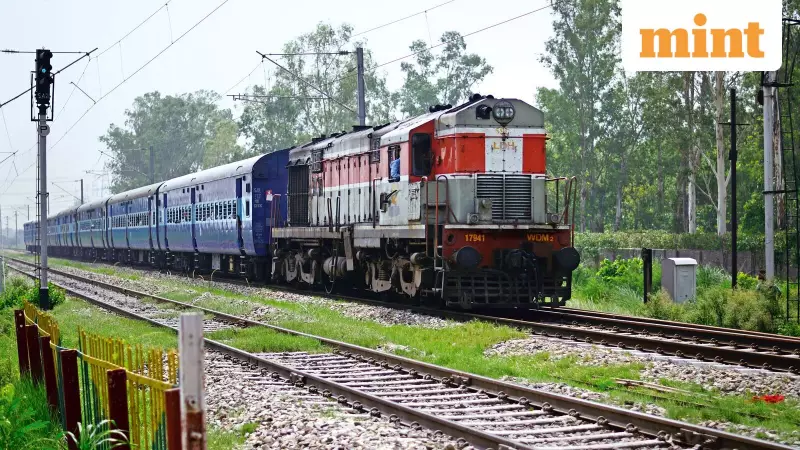
In a major push to enhance passenger and operational security, the Indian government is planning its largest-ever allocation for railway safety in the upcoming Union Budget for the fiscal year 2026-27 (FY27). According to sources familiar with the matter, the proposed outlay is likely to exceed ₹1.3 trillion, marking a significant shift in capital expenditure priorities for the national transporter.
Record Allocation for Safety and Modernization
This planned safety budget, which is roughly 12% higher than the current fiscal year's allocation, is expected to constitute nearly half of the Indian Railways' total capital expenditure for FY27. The overall capex is projected to rise to approximately ₹2.76 trillion from ₹2.52 trillion in the ongoing financial year. The substantial funds will be directed towards critical areas including track renewals, maintenance of rolling stock and locomotives, and the accelerated nationwide deployment of the indigenous Kavach automatic train protection (ATP) system.
The move comes amidst sustained public and political scrutiny following a series of train accidents. A tragic collision near Bilaspur this year, where a MEMU passenger train overshot a signal and hit a stationary goods train, resulting in 11 fatalities and over 20 injuries, has kept safety in sharp focus. While the Railways has reported a 73% improvement in operational safety metrics—with accidents per million train kilometres falling from 0.11 in FY15 to 0.03 in FY24—the push is to sustain and accelerate this positive trend.

Beyond Funding: The Challenge of Implementation
Experts point out that while funding is being ramped up, the core challenge lies beyond financial constraints. Railroad professional and former chief of Rail Wheel Plant, Bela, Shubhranshu, noted that over ₹1 trillion is already committed for Kavach, track renewals, and new rolling stock. He emphasized that safety outcomes depend more on organizational discipline, proper upkeep, training, and accountability than on mere capital outlays.
The data underscores a long-term increase in safety spending. Expenditure on safety-related projects rose 2.5 times from ₹70,273 crore during FY05-FY14 to ₹1.78 lakh crore in the FY15-FY24 period. The Rashtriya Rail Sanraksha Kosh (RRSK) has already seen over ₹1.08 trillion spent on upgrading critical assets. For FY26, the safety budget stands at ₹1.16 trillion, a modest 2% increase over the previous year.
Technology at the Forefront of Safety Drive
The enhanced allocation will fuel a technology-led transformation. Key initiatives include the replacement of mechanical signalling with electronic interlocking, installation of high-strength rails, GPS-based fog safety devices, and the expansion of the Kavach network. Kavach, which automatically applies brakes if a loco pilot fails to respond, has been deployed on 1,465 route kilometres and 121 locomotives so far. However, its current coverage represents just over 2% of India's vast 67,000 km rail network. The rollout of Kavach 4.0 is planned across 15,512 route kilometres.
Former general manager of Indian Railways and architect of the Vande Bharat Express, Sudhanshu Mani, highlighted the need to move towards a zero-failure regime. He called for the meaningful use of AI to detect near-misses and a faster proliferation of fail-safe signalling systems like Kavach, whose slow rollout has been a point of concern.

The safety drive is also creating significant opportunities for global and domestic players. Companies like Siemens and Alstom are competing for projects ranging from locomotives to advanced signalling systems. Domestic firms like Nova Control Technologix, which has partnered with Tata Elxsi to co-develop Kavach under the 'Make in India' initiative, are seeing increased engagement. The modernization push is evident in the numbers: electronic interlocking stations have increased 3.5 times to 2,964 during FY15-FY24, and production of safer LHB coaches has surged nearly 16-fold to 36,933 units.
As the budget formulation process advances, the proposed record outlay signals the government's intent to make railway safety an uncompromisable priority, blending heavy investment with a pressing call for systemic and operational reforms on the ground.





