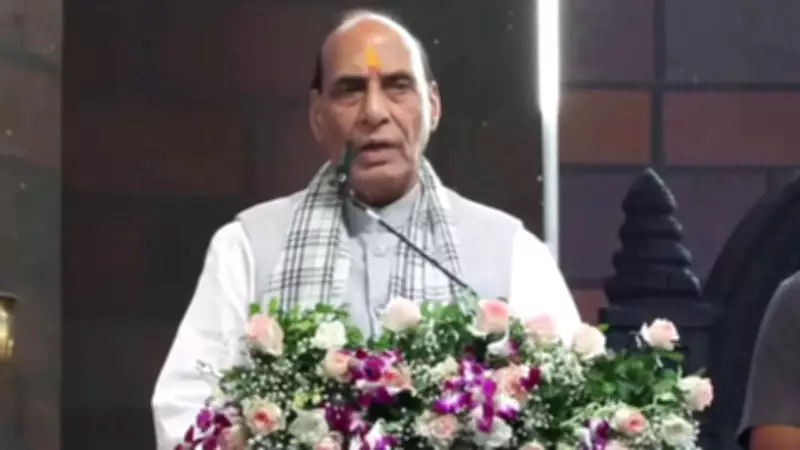
Defence Minister Rajnath Singh on Saturday underscored India's commitment to indigenous defence manufacturing and advanced weapons systems, stating that these efforts would bolster the armed forces and propel the nation toward self-reliance in critical military technologies. He made these remarks while inaugurating a defence manufacturing hub in Maharashtra's Shirdi.
Inauguration of NIBE Defence Manufacturing Complex
Addressing the ceremony for the NIBE Defence Manufacturing Complex, Singh highlighted that future conflicts would hinge on advanced ammunition, automation, and indigenous technology rather than sheer troop numbers. He cited ongoing global conflicts as evidence of this shift.
"The biggest difference in future wars will not depend on how many soldiers you have, but on how advanced and capable your country is in terms of munition and automation. We are seeing glimpses of this in the Russia-Ukraine war and in the ongoing conflict in West Asia. India also demonstrated this strength during Operation Sindoor," Singh said.

The defence minister asserted that the newly inaugurated facilities would enhance India's military readiness while advancing domestic production capabilities. "Today the plants being inaugurated are not merely production units, but are also going to become research-oriented hubs, where work will be done on advanced explosives and next generation weapons. This will further strengthen the capabilities of our armed forces," he added.
Push for Make in India in Critical Technologies
Singh reiterated the government's consistent emphasis on promoting "Make in India" in critical technologies and advanced defence systems. He noted ongoing efforts to encourage Indian companies in the development of the Advanced Medium Combat Aircraft (AMCA) and to maximize indigenisation in the drone sector.
"Our government is continuously emphasising the promotion of Make in India in critical technologies and advanced systems. You can already see that we are encouraging Indian companies in the development of AMCA. At the same time, our effort in the drone sector is to ensure maximum indigenisation. The government is ready to take every necessary step to ensure India emerges as a frontrunner in munition and automated systems," he said.
Call for Self-Reliance in Defence and Space
Calling for greater self-reliance in defence and space technology, Singh urged collective resolve to make India completely self-reliant in these domains. "Let us all resolve together that we will make India completely self-reliant in defence and space technology. Aatmanirbhar Bharat means a secure India. Aatmanirbhar Bharat means a capable India and Aatmanirbhar Bharat means a powerful India," he stated.
The minister warned that dependence on foreign defence manufacturing could jeopardise both national security and the economy. "If we remain dependent on others for defence manufacturing, then both our security and economy can be at risk. That is why defence manufacturing is not only a requirement for war, but also a necessity for peace, development and economic resilience," he explained.
Policy Reforms and Private Sector Participation
Singh highlighted key reforms undertaken by the government, including corporatisation of the Ordnance Factory Boards, liberalized FDI norms, the strategic partnership model, and Positive Indigenisation Lists. These measures have opened new opportunities for private industry.
"Under Prime Minister Narendra Modi’s leadership, we understood that for Aatmanirbhar Bharat and Make in India, it is necessary to utilise the energy of the private sector. Therefore, policy reforms were introduced, FDI was liberalised, the strategic partnership model was implemented, Positive Indigenisation Lists were brought in and schemes like i-DEX, ADITI and TDF encouraged young innovators," he said.

The defence minister noted that the role of private companies in defence production has increased sharply in recent years. "Today, I feel extremely proud to say that our efforts are yielding results. Earlier, the role of the private sector in defence production was negligible, but today it has reached nearly 25 to 30 per cent. Our target is to take this to 50 per cent in the coming years. Today’s artillery shells factory, missile complex and space complex are living examples of this transformation. This is the new India, where the private sector is not merely a supplier of nuts and bolts, but is becoming an innovator and producer of complete advanced and state-of-the-art weapon systems," he added.
New Facilities and Strategic Impact
Singh revealed that the artillery shells manufacturing unit in Shirdi would have an annual production capacity of five lakh shells. Meanwhile, the Universal Rocket Launching System missile complex would significantly boost India's future warfare capabilities.
"The Universal Rocket Launching System missile complex will give a new direction to India’s future warfare system. Equipped with indigenous technology, this rocket system will multiply the striking capability of our armed forces and prove to be a game changer strategically. The ‘Suryaastra’ emerging from here will be enough to bring sunset to the plans of our enemies," he said.
The minister also announced a contract with BlackSky to support satellite assembling capabilities for India’s private space sector. Additionally, a renewable compressed biogas plant with a capacity of 15 tonnes per day will be established at the site. "From the earth to the sky, from artillery shells to satellites, today is a very important day for our entire defence and space ecosystem," Singh remarked.
Economic and Employment Opportunities
The defence hub is expected to generate employment and create opportunities for MSMEs, ancillary units, and local industries in and around Shirdi. "I am happy that this establishment will not only be a high-technology industry, but will also create a large ecosystem for MSMEs, small industries and the local economy. Production of ammunition, missile, rocket systems and satellite parts will connect ancillary units, suppliers and vendors, increase employment and provide youth in Shirdi and surrounding areas with skills in cutting-edge technology," Singh concluded.