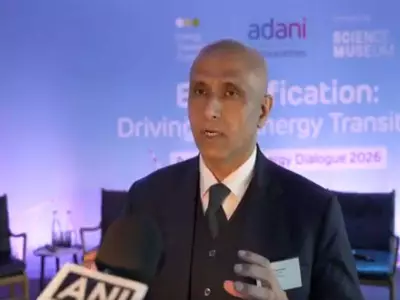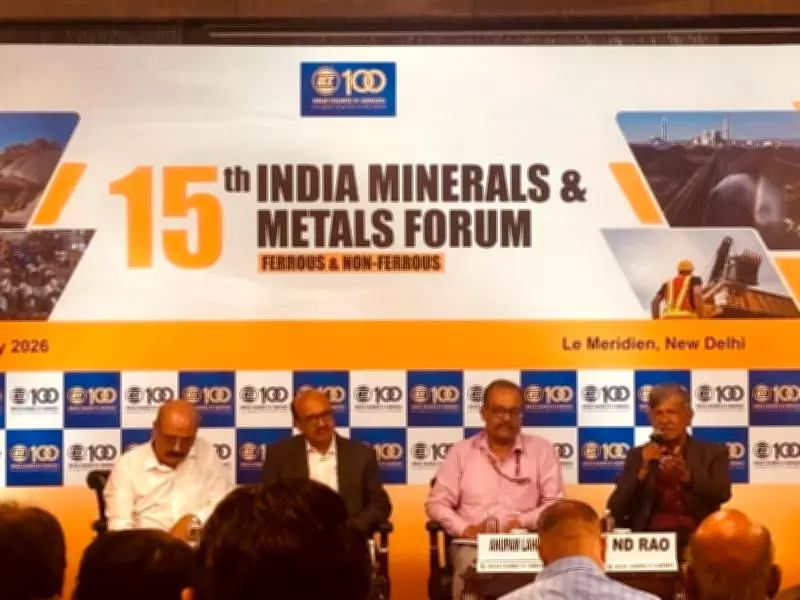
Recycling and the commercial-scale extraction of critical minerals from secondary raw materials are set to significantly reduce India's reliance on imports, even though achieving complete self-sufficiency will take time, said Anupam Lahiri, Principal Director (Minerals) and Additional Director General at NITI Aayog.
Three-pronged strategy to reduce import dependence
Speaking on the sidelines of the 15th India Minerals and Metals Forum, Lahiri outlined India's critical minerals strategy, which focuses on three key areas: increasing domestic exploration, acquiring mineral assets abroad, and expanding recycling. While recycling has already gained momentum, exploration and overseas acquisitions are progressing but face long gestation periods.
“We cannot say exactly when self-sufficiency will be achieved. But it can reduce much of the dependency because there is a big source of secondary raw materials. And their extraction at a commercial scale is also coming up. So there will be less dependency,” Lahiri told ANI.

Recycling ecosystem gains momentum
Lahiri noted that the recycling ecosystem has witnessed strong momentum over the past year, with many companies entering the sector. The Ministry of Mines has also introduced a CAPEX incentive scheme to support the establishment of recycling plants for extracting critical minerals.
“With the concerted efforts of both public sector as well as private sector, I hope that it will reach its level but it will take some time because of its long gestation period,” he said.
On challenges facing the recycling industry, Lahiri stated that there are no major hurdles at present, as many players have already entered the sector. However, some regulatory support is still required, and the Ministry of Mines is working on it.
“Recycling, I don't think at this point of time there are major challenges because many of the players have already entered. Only some regulatory support is required, that is also the Ministry of Mines is taking up,” he added.
Overseas acquisitions and lithium imports
Regarding overseas resource acquisition, Lahiri said India is pursuing critical mineral assets through government-to-government engagement in countries such as Argentina, Chile, and Australia. Challenges vary by country, including local disturbances and higher financial commitments.
“Actually, the challenges are varied, depends on country to country. In some countries, there are local disturbances. Somewhere, the financial commitments are more. These types of challenges are there,” he explained.
On lithium, Lahiri acknowledged that India continues to rely on imports, but lithium recovered from black mass and battery waste is helping reduce dependence. While recycling cannot eliminate import dependence completely, it can substantially reduce it.
“We are relying on imports but in India also from black mass as well as from battery waste, we are producing lithium. In that way, it cannot weed out complete dependence but to a big extent, it can clear up,” he said.
National Critical Mineral Mission and technology role
Lahiri expressed confidence in the future of the critical minerals sector, noting that the recycling industry has received a major boost over the past year. He also highlighted that the National Critical Mineral Mission, established last year, is progressing well, and more success stories are expected.
“National critical minerals mission was set up last year and it is working perfectly fine. More success stories are going to come in future,” he said.
Emphasizing the role of technology, Lahiri said innovation will be key to reducing extraction costs and improving India's critical minerals ecosystem.
“Whatever you do to extract the minerals at a lower cost, that itself will be an innovation,” he said, adding that the Indian scientific community is working in this direction and he hopes it will become “a game changer” one day.