

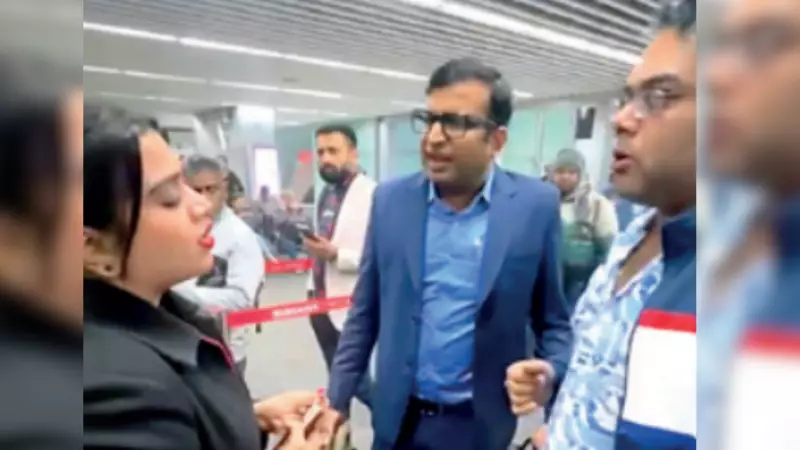
A heated confrontation at Kolkata's Netaji Subhas Chandra Bose International Airport early Sunday morning has ignited a fierce online debate about airline regulations, passenger rights, and the fine line between security enforcement and customer harassment.
The Early Morning Standoff at the Boarding Gate
The incident unfolded around 5 am when a SpiceJet ground staff member stopped a passenger, businessman Swarnab Banerjee from Deshapriya Park, at the boarding gate. The staffer flagged that Banerjee was carrying an extra handbag. Banerjee, who was traveling to Mumbai with his brother and a friend, proposed a solution: his friend, booked on a separate ticket and carrying no cabin luggage, could take one bag to avoid excess charges.
The airline employee refused this transfer, leading to a prolonged and tense argument. After several minutes, with the flight departure looming, Banerjee relented and paid the excess baggage fee to board the SpiceJet flight. However, the conflict was far from over.

Airline's Stance: A Matter of Security and Rules
SpiceJet officials defended the ground staff's actions, stating they were technically correct and in line with security protocols. An airline source explained that transferring cabin baggage to a traveler with a different Passenger Name Record (PNR) is a security violation as per Directorate General of Civil Aviation (DGCA) norms.
The rationale provided was twofold. First, it is a security protocol to prevent unclaimed bags from entering the aircraft. Second, if overhead bins are full and bags need to be moved to the cargo hold, the PNR is crucial for identifying and claiming baggage later. "Once the ground staff notice a violation at the boarding gate, s/he cannot ignore it. Allowing another passenger to carry that bag would go against DGCA norms," an airline official stated, adding the issue might have been avoided if the bag was consolidated before reaching the gate.
Passenger's Grievance: "This Felt Like Loot"
Swarnab Banerjee, however, found the airline's explanation unsatisfactory. He argued that he and his brother, on one PNR, had cleared security with two large handbags each. His friend, on a separate PNR, had offered to help by carrying one.
Banerjee's primary contention was the timing of the intervention. "Had they flagged the issue earlier at the security gate, I could have checked in the bag. Raising it at the boarding gate left me with no choice. This felt like some kind of loot," he said. He alleged the customer service agent was inflexible, repeatedly citing company policy and giving him an ultimatum: pay or leave the bag behind.
The controversy took another turn when Banerjee alleged a discrepancy in his payment receipt. He claimed he paid Rs 9,750 as an excess baggage charge, but the official receipt from SpiceJet only acknowledged Rs 6,000. He has since demanded a refund of the difference and action against the staff involved.
Broader Fallout and the Social Media Debate
By midday, the episode became a major talking point among travelers at the airport and on social media platforms. The debate split public opinion. One side argued that rules are rules, especially concerning aviation security, and the staff was merely doing their job. The other side criticized the rigid enforcement at the final point of boarding, calling it a tactic that causes avoidable stress and borders on harassment, leaving passengers feeling cornered and exploited.
In an official statement, SpiceJet denied the passenger's allegations as "misleading." The airline reiterated, "As per govt regulations requesting another passenger to carry one’s baggage is a security violation. Additionally, passengers travelling on different PNRs are not permitted to club hand baggage, as this can compromise security and hinder accurate identification of baggage ownership in the event of an emergency."
The incident at Kolkata airport highlights the ongoing tension between strict regulatory compliance and customer-centric service in the aviation industry, leaving flyers questioning where the balance should lie.






