Telangana's Corporate Spending Shows Stark Environmental Neglect
Hyderabad faces intensifying water stress, land degradation, and biodiversity loss, yet corporate spending meant to address these critical environmental challenges remains alarmingly thin. Official data reveals a profound disconnect between ecological urgency and corporate priorities in the state.
Minimal Allocation to Environmental Causes
Over the last five financial years, agroforestry, conservation of natural resources, and animal welfare together accounted for barely 2 percent of corporate social responsibility expenditure in Telangana. According to figures tabled in the Lok Sabha, companies operating in the state spent Rs 3,857.62 crore on CSR between FY 2019-20 and FY 2023-24 under disclosures mandated by the Companies Act.
The breakdown shows:

- Agroforestry received just Rs 5.13 crore
- Conservation of natural resources received Rs 57.08 crore
- Animal welfare received Rs 17.71 crore
Combined, these critical ecological sectors drew only Rs 79.92 crore, representing a mere 2.07 percent of total CSR spending. This highlights a persistent corporate tilt toward socially visible but environmentally limited interventions.
Supreme Court's Landmark Environmental Ruling
The spending anomaly becomes especially telling against the backdrop of a landmark Supreme Court judgment delivered in December 2025. The apex court fundamentally reframed CSR obligations, ruling that corporate social responsibility is not merely a matter of corporate charity but flows from a constitutional duty to protect the environment.
The court interpreted Article 51A(g) to hold companies, as legal persons, responsible for safeguarding nature and wildlife. By reinforcing the 'polluter pays' principle, the court directed corporate resources toward ecological restoration, including for endangered species such as the great Indian bustard. This judgment firmly anchored environmental spending in legal responsibility rather than voluntary philanthropy.
Detailed Analysis of Environmental Spending Patterns
Despite the legal mandate, ground reality reveals concerning patterns in environmental allocations. Agroforestry, widely recognized as a low-cost, high-impact tool for climate adaptation, farmer income stabilization, and carbon sequestration, has remained particularly neglected.
Over five years, annual CSR spending on agroforestry never crossed Rs 1.50 crore, peaking at Rs 1.44 crore in FY 2021-22. In FY 2023-24, it accounted for a mere 0.13 percent of that year's CSR outlay of Rs 1,054.92 crore.
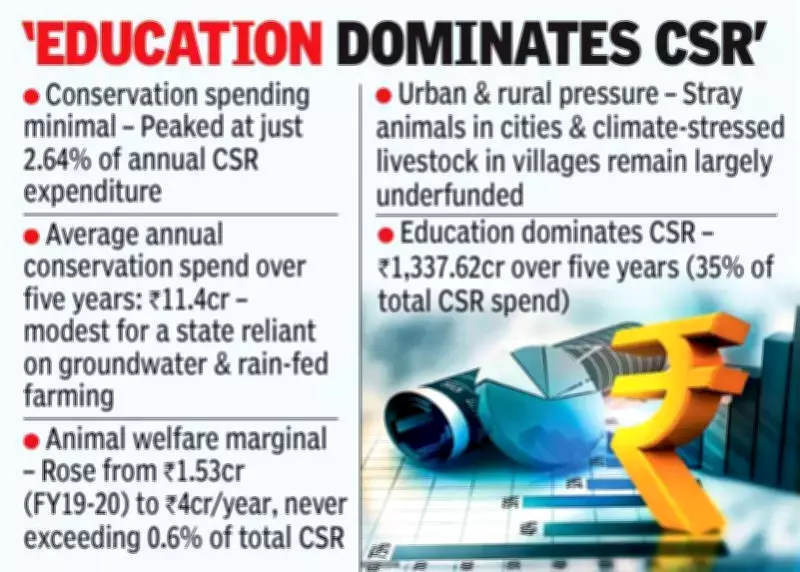
Conservation of natural resources shows a similar pattern of episodic attention without sustained prioritization. Allocations rose to Rs 27.47 crore in FY 2022-23 amid heightened water security concerns but fell sharply by nearly 45 percent to Rs 15.08 crore in FY 2023-24. Even at its peak, conservation spending formed only 2.64 percent of annual CSR expenditure.
Over five years, average annual spending on conservation stood at about Rs 11.4 crore, a modest amount for a state heavily dependent on groundwater and rain-fed agriculture. Animal welfare has remained consistently marginal, with spending rising from Rs 1.53 crore in FY 2019-20 to around Rs 4 crore annually thereafter, yet never exceeding 0.6 percent of total CSR spending in any single year.
Dominance of Traditional CSR Sectors
In sharp contrast to environmental neglect, education and healthcare continue to dominate corporate social responsibility portfolios. Education alone absorbed Rs 1,337.62 crore over five years, representing nearly 35 percent of total CSR spending, while healthcare received Rs 871.95 crore.
Even smaller social categories cumulatively attracted more funding than agroforestry, underscoring how environmental action, despite legal and ecological imperatives, remains peripheral in corporate boardroom calculations. This imbalance persists despite Telangana's mounting ecological pressures and the clear legal framework established by the Supreme Court.

The data reveals that while companies are complying with CSR spending requirements, their allocation priorities have not shifted significantly toward environmental protection despite the constitutional duty established by the Supreme Court. This raises questions about corporate commitment to sustainable development in a state facing significant environmental challenges.