In a major development concerning 891.38 acres of land handed over to Indian Drugs and Pharmaceuticals Limited (IDPL), a central public sector undertaking, the Telangana High Court has ordered an interim suspension of a 2008 order that previously blocked the state government from taking back the property.
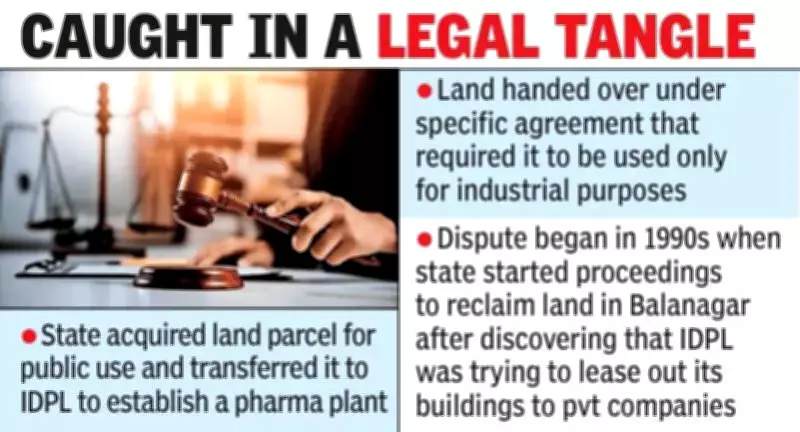
According to sources, the market value of the land parcel, as of today, is approximately ₹50,000 crore. The state acquired the land for public use and transferred it to IDPL to establish a pharmaceutical plant. The land was handed over under a specific agreement that required it to be used exclusively for industrial purposes. The dispute dates back to the 1990s, when the state initiated proceedings to reclaim the land located at Balanagar in the heart of the city, after discovering that IDPL was attempting to lease out its administrative buildings to private companies rather than focusing on pharmaceutical production.
Following this, the Board for Industrial and Financial Reconstruction (BIFR) issued an order in 2008, directing the district collector to withdraw the land reclamation process and stopping any further coercive steps against the company.

Hearing the matter on Tuesday, Justice Nagesh Bheemapaka stated, "There shall be an interim suspension of the February 2008 order passed by BIFR, pending disposal of the writ petition, as prayed for," and adjourned the matter to June 22 for further hearing. During the hearing, Advocate General A. Sudharshan Reddy, appearing for the petitioner (state government), argued that the original 2008 BIFR decision was highly problematic because the state authorities—the very entity that originally provided the land—were never given notice or an opportunity to be heard before that order was passed.
He further emphasized that land transferred by the government for a specific public purpose cannot be treated like a standard private sale. It was clarified that while the agreement allowed IDPL to use the land for its industry, it did not grant the company an unrestricted right to lease or sublease the property to third parties to generate operational revenue. "Allowing such leasing would undermine the original public purpose for which the land was acquired and leave the state powerless to protect valuable public assets from whimsical actions," the Advocate General added.
Responding to the petition, IDPL argued that the case should be dismissed due to excessive delays and maintained that the state was aware of the proceedings all along. They also suggested that the matter should be handled under the Insolvency and Bankruptcy Code. However, the High Court rejected these arguments, pointing out that the legal landscape had changed significantly since 2008. With the repeal of the law that governed BIFR and the subsequent dissolution of that body, there was no evidence that the case was properly transferred to the National Company Law Tribunal.
Justice Nagesh Bheemapaka's bench noted that given that the land was already formally resumed by the government in 2008 and that BIFR's order lacked proper reasoning and due process, the state would suffer irreparable harm if the 2008 directive remained in place. Consequently, the bench granted an interim suspension of the BIFR order, allowing the state's reclamation of the land to remain in effect while the larger legal challenge continues.
The case has been adjourned to June 22 for further hearing, and the High Court's interim order provides significant relief to the state government in its efforts to reclaim the valuable land parcel.