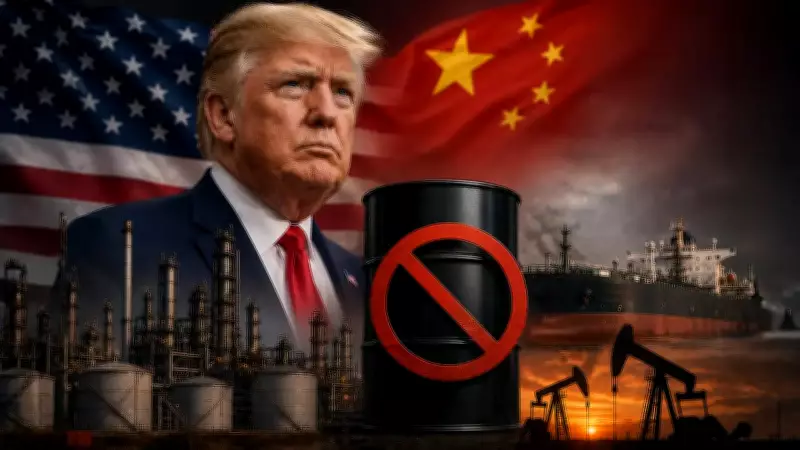
The Donald Trump administration's decision to sanction one of China's largest privately owned oil refiners over its links to Iran carries implications that extend far beyond the oil sector. China has long been the largest buyer of Iranian crude, much of which reaches the country indirectly through private refiners before being processed into gasoline, diesel, and other fuels. Official Chinese customs figures do not capture this trade, with the last publicly recorded shipment from Iran dating back several years. The US move is expected to deepen challenges facing China's already pressured petrochemicals industry, but its repercussions are likely to be felt across multiple sectors.
Sanctions Target Hengli Petrochemical
On Friday, the US Treasury Department added Hengli Petrochemical (Dalian) Refinery Co. to its sanctions list. This marks Washington's most significant action against China's refining industry and underscores its determination to increase pressure on Iran, even weeks before a much-anticipated meeting between President Donald Trump and Chinese President Xi Jinping, according to a Bloomberg report.
Why Hengli Is a Significant Target
Until now, the US had largely focused on smaller Chinese companies and facilities to curb Iran's oil revenues, partly to avoid broader economic and diplomatic consequences. Hengli represents a far more significant target. It is one of China's most advanced private refiners, operating a large integrated refining and petrochemicals complex in Liaoning province in the country's northeast. While China still has many smaller independent refiners, commonly known as "teapots," companies like Hengli have emerged as major industrial players.

"With Trump set to visit Beijing in May, this move is like a bargaining chip deployed by Washington, given the lack of progress on the Iran War and the Strait of Hormuz," Liao Na, founder of GL Consulting, which analyzes China's energy and industrial sectors, told Bloomberg.
Private Refiners' Role in China's Energy Security
Private refiners now account for roughly one-third of China's total refining capacity. This underscores their importance in a country where energy security remains a top national priority. Erica Downs, senior research scholar at Columbia University's Center on Global Energy Policy, described the sanctions as a clear escalation. She noted that Hengli exemplifies the kind of large, integrated refining and petrochemical operation that Beijing is actively promoting. She also pointed out that the company is a customer of Saudi Aramco.
Hengli's Response and Future Plans
In a stock exchange filing on Sunday, Hengli rejected the US allegations as unfounded. The company stated that it has never conducted business involving Iranian oil and that all its crude suppliers are contractually required to ensure their shipments do not originate from jurisdictions subject to US sanctions. Hengli also said it currently holds enough crude oil inventory to meet more than three months of processing requirements and that its procurement activities remain unaffected. Going forward, however, the company intends to settle future crude purchases in Chinese yuan.
Shifting US Policy on Iranian Oil
Washington's approach to Iranian oil has shifted repeatedly since the onset of the conflict in the Persian Gulf. Initially, the US allowed certain waivers for Tehran's seaborne crude exports to prevent a sharp rise in oil prices. Those exemptions have since lapsed and have not been reinstated. The expansion of sanctions to include trading partners is now expected to have wider consequences for supply chains across Asia and beyond. According to people familiar with the matter quoted in the Bloomberg report, at least two of Hengli's petrochemical customers in Asia have already moved to cancel their orders.

Impact on Global Petrochemical Supply Chains
Hengli ranks among China's leading producers of purified terephthalic acid and is one of the world's largest suppliers of petrochemicals. China's steadily rising demand for plastic-based products, ranging from textiles to toys, has attracted billions of dollars in investment from major global companies, including Saudi Aramco and Germany's BASF SE. Saudi Aramco, which has a long-term crude supply agreement with Hengli, has previously explored acquiring a minority stake in the company, but those discussions have since stalled.
With Hengli effectively cut off from the dollar-based payment system, a wide network of chemical, synthetic fibre, and textile manufacturers across East Asia could face immediate disruptions to critical raw material supplies. While this may benefit rival producers in China, Japan, and South Korea, it could also intensify inflationary pressures already exacerbated by the ongoing conflict in the Middle East.
Hengli's Position in China's Refining Sector
Hengli operates a crude refining capacity of 400,000 barrels per day, making it one of the largest private refiners in China. It ranks alongside Shandong-based Yulong Petrochemical Co., which was sanctioned by the European Union last year over its involvement in the Russian oil trade. Together with Zhejiang Petrochemical Co. and Shenghong Group, these four companies are regarded as China's "mega" private refiners and collectively account for around 10 per cent of the country's refining capacity.