The Roots of India's Dollar Drought
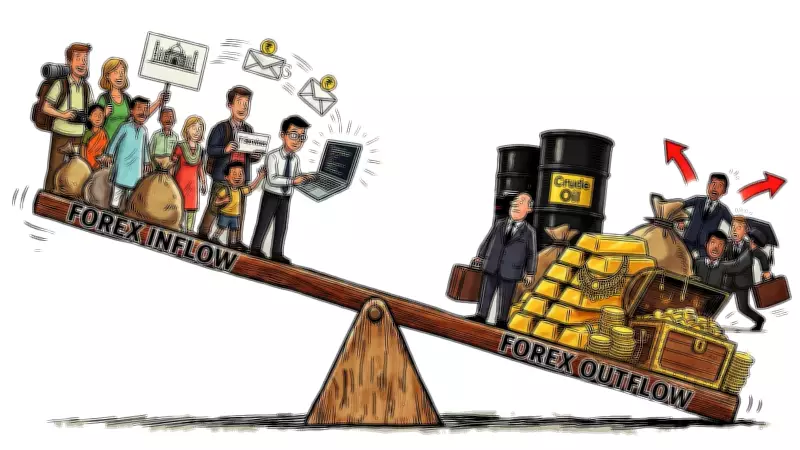
The reasons for the drought of dollars in India — most visible in the weakening value of rupee — are not rooted in the events of the past few months. It has been brewing for nearly three years, and has now been pushed to a crisis point by the Iran conflict and shifting US trade policies.
For decades, the rupee value (called exchange rate) was a simple tug-of-war between products we imported (oil/gold) and products we exported. It is called the trade balance. But, in India’s case, that meant 'trade deficit' because we imported more than we exported. However, starting in the 1990s, and especially in the past two decades, the math got more complicated.
The Trade Deficit Legacy
India has historically run a trade deficit, importing more than it exports. This structural imbalance has been a persistent feature of the economy. The deficit widened significantly after the 1990s economic reforms, which opened up the economy to global trade and capital flows. The reliance on imported oil and gold has been a major contributor, with oil alone accounting for a large share of the import bill.

Capital Flows Enter the Equation
Since the 1990s, capital flows — foreign investments, loans, and remittances — have become crucial in financing the trade deficit. Foreign portfolio investments (FPI) and foreign direct investments (FDI) have helped bridge the gap. However, these flows are volatile and sensitive to global economic conditions. The recent tightening of US monetary policy and geopolitical tensions have led to capital outflows, exacerbating the dollar shortage.
The Three-Year Buildup
The current crisis has been brewing since 2023. A combination of factors — rising global interest rates, a strong US dollar, and domestic economic challenges — has steadily eroded India's foreign exchange reserves. The Iran conflict further disrupted oil supplies, pushing up import costs. Simultaneously, US trade policies, including tariffs and trade barriers, have impacted Indian exports, widening the trade deficit.
The Austerity Appeal
Prime Minister Modi's recent austerity appeal is a response to these mounting pressures. The government is urging citizens to reduce non-essential imports and boost domestic production. The appeal aims to curb the trade deficit and conserve foreign exchange. It also signals a shift towards self-reliance, echoing the Atmanirbhar Bharat initiative.
Eight Charts That Tell the Story
- Chart 1: The trade deficit has been widening since 2023, with imports growing faster than exports.
- Chart 2: Oil imports surged due to the Iran conflict, adding to the import bill.
- Chart 3: Foreign portfolio investments have been net outflows since early 2024.
- Chart 4: The rupee has depreciated steadily against the US dollar over three years.
- Chart 5: Foreign exchange reserves have declined from a peak in 2023.
- Chart 6: US interest rate hikes have attracted capital away from emerging markets like India.
- Chart 7: India's export growth slowed due to US trade policies.
- Chart 8: The current account deficit has widened, reflecting the dollar shortage.
Conclusion
The dollar drought is a complex issue with deep-rooted causes. While the immediate trigger is the Iran conflict and US policies, the underlying trends have been developing for three years. PM Modi's austerity appeal is a short-term measure to alleviate the crisis, but long-term solutions require structural reforms to boost exports and reduce import dependence.