

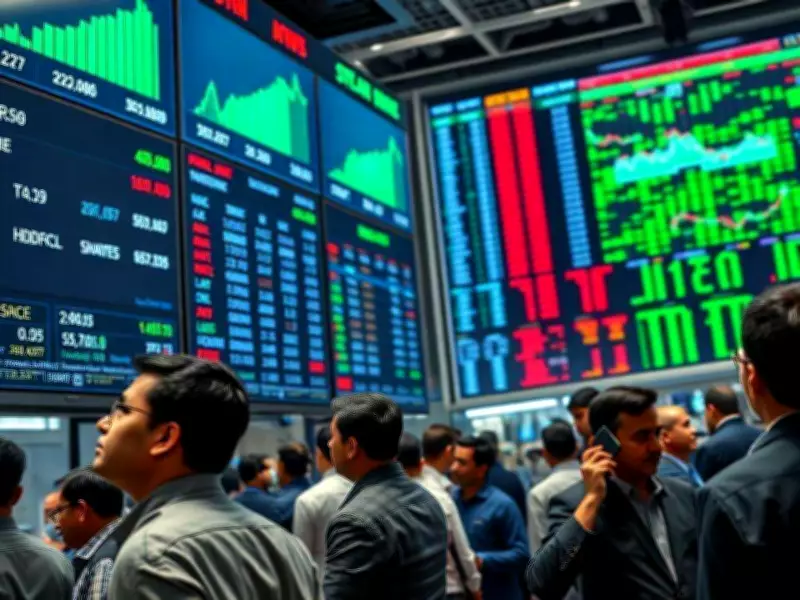
Asian Markets Trade Higher Amid Mixed Global Economic Signals
Asian share markets exhibited a positive trend on Wednesday, trading in the green as investors navigated a complex landscape of weak United States consumer data and persistent concerns about the American economy. The cautious yet optimistic mood followed a mixed performance on Wall Street, where technology stocks relinquished earlier gains, reflecting broader unease in global financial markets.
Regional Market Performance Highlights
Key Asian indices demonstrated varied but overall upward movements during the trading session. Hong Kong's Hang Seng Index (HSI) added 97 points, equivalent to a 0.36 percent increase, reaching 27,280 at 9:30 am Indian Standard Time. South Korea's Kospi also inched higher, gaining 46 points to settle at 5,348. Japan's Nikkei extended its rally significantly, surging by 1,286 points or 2.28 percent to achieve 57,650.
In mainland China, markets presented a mixed picture. The Shanghai Composite Index traded up by 9 points, representing a 0.22 percent rise, while the Shenzhen Component Index dipped into negative territory, trimming 10 points or 0.07 percent. This divergence underscores the nuanced investor sentiment across different regional markets.

Underlying Economic Concerns and Data Focus
The trading activity occurred against a backdrop of heightened attention to upcoming United States economic data. Investors are closely monitoring jobs numbers due later in the day and inflation figures expected towards the end of the week. These datasets are viewed as crucial in shaping expectations for the Federal Reserve ahead of its March policy meeting, potentially influencing global monetary policy directions.
Data released by the US Commerce Department on Tuesday revealed that retail sales in the United States remained unchanged in December, following a 0.6 percent increase in November. This reading provides policymakers with some flexibility to consider reducing borrowing costs next month, especially after interest rates were left unchanged in January following three consecutive cuts. However, it also highlights emerging signs of caution among American consumers, who play a central role in driving economic growth, pointing to potential risks of further economic weakness.
Shifting Market Dynamics and Analyst Perspectives
Some financial analysts have cautioned that the long-standing market belief—where poor economic data automatically boosts equity markets by increasing the likelihood of interest rate cuts—may no longer hold true in the current environment. This evolving perspective adds complexity to investment decisions and market forecasting.
In the United States, equity markets displayed a fragmented performance. The Dow Jones Industrial Average managed to edge to another record high, while the S&P 500 and Nasdaq Composite indices slipped, with technology shares among the biggest decliners. This contrast reflects the sector-specific challenges facing investors, particularly in the technology domain.
Artificial Intelligence Investment Apprehensions
A significant source of market unease revolves around the technology sector, specifically the massive financial investments being channeled into artificial intelligence projects. Investors are growing increasingly wary that the hundreds of billions of dollars poured into AI initiatives may not deliver substantial returns in the near future, leading to concerns about overvaluation and speculative bubbles.
Interestingly, there was little market response to data indicating that consumer inflation in China slowed last month, suggesting that global investor focus remains predominantly fixed on Western economic indicators and technological investment trends.
The overall market sentiment in Asia, while positive, remains tempered by these multifaceted economic and technological considerations, creating a delicate balance for traders and investors navigating the global financial landscape.






