

The Times of India Budget Dialogues 2026: Charting India's Economic Future
The Times of India Budget Dialogues 2026, convened in New Delhi on Tuesday, served as a significant platform for policymakers, economists, industry leaders, and opinion-makers to deliberate on the priorities and direction of the upcoming Union Budget. This gathering occurred at a crucial juncture marked by global economic uncertainty and rising domestic expectations, setting the stage for comprehensive discussions on India's economic trajectory.
Focus on the Common Man: Direct and Indirect Benefits
The third session, titled Impact of Budget on the Aam Aadmi, meticulously examined how budgetary decisions permeate the lives of ordinary citizens. Panelists unanimously highlighted that the government's emphasis on stability, infrastructure development, and key sectors could yield substantial benefits for the common man, both directly and indirectly.
Sonu Iyer, National Leader of People Advisory Services–Tax at EY India, emphasized the advantages of simplification of the Budget for the aam aadmi. She pointed out that focused attention on the right industries like infrastructure, new-generation technology, and medical tourism is pivotal. If the ecosystem is thriving, the aam aadmi is definitely going to be helped, she asserted, underlining the trickle-down effect of a robust economic environment.

Shiv Agrawal, Managing Director of ABC Consultants, lauded the Budget as very pro-job-creating. He explained that employment opportunities flourish when businesses operate with confidence. As a businessperson, I get confidence with the continuity of policy. I am actually glad there was no big-bang announcement, he remarked, advocating for steady, predictable policy frameworks over disruptive changes.
Beyond Tax Relief: A Call for Holistic Development
Other speakers urged a broader perspective, moving beyond mere tax relief. Himani Choudhary, a mutual fund distributor and finance educator, noted that while the aam aadmi often fixates on tax cuts, there is a pressing need to incorporate environmental costs into budgetary considerations. The quality of our infrastructure also impacts GDP. There is a need for holistic development, she stressed, advocating for a comprehensive approach to national progress.
Kashika Malhotra, Director at Brandman Retail, highlighted the symbiotic relationship between infrastructure spending and domestic manufacturing. With more budget towards infrastructure, it helps Make in India and leads to a rise in job production, she stated, reinforcing the link between public investment and industrial growth.
Prof. Dr. Sanjeev Bagai, Padma Shri awardee and Chairman of Nephron Clinics, described the Budget as a working Budget and a consolidation phase. He welcomed the 11 per cent increase in healthcare allocation, emphasizing its critical role in national development. If the nation has to become fully developed, it has to be healthy, and in that context, it is absolutely critical that the Finance Minister has discussed mental health, he added, spotlighting the importance of comprehensive healthcare initiatives.
India Looking Forward: Long-Term Growth and Ecosystem Support
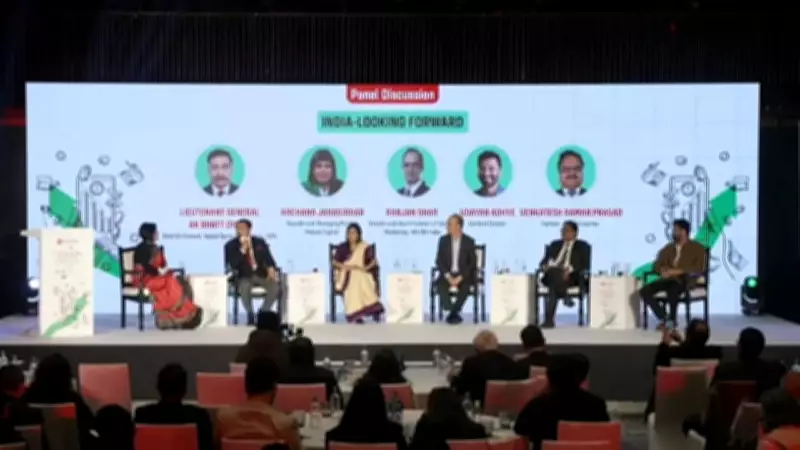
The fifth panel, India Looking Forward, delved into the country's long-term growth prospects, emphasizing the roles of capital, policy clarity, and ecosystem support.
Archana Jahagirdar, Founder and Managing Partner at Rukam Capital, underscored the dependence of founder growth on a conducive environment. If it is favourable for a consumer tech founder, it will grow, she noted, while raising concerns about access to risk capital, particularly in emerging fields like artificial intelligence. If we are talking about AI, we have to be alive to how much risk capital is available, she cautioned.

Venkatesh Raman Prasad, Partner at JSA Associates, identified predictability as a cornerstone for investment. We need solutions around certainty of policies, tax certainty, quality of contract enforcement and the talent pool. India now has the talent pool, but the first three have been debated without finding a solution. Perhaps in this Budget, we are seeing some clarificatory language, he observed, hinting at incremental progress in policy formulation.
Ranjan Dhar, Director and Vice President of Sales and Marketing at AM/NS India, articulated that a developed nation rests on strong infrastructure and manufacturing. We are bringing some of the best construction technologies into India. In steel, soon the need for imports for automobiles will be zero, he announced, attributing past imports to commercial reasons and the erstwhile lack of high-quality domestic steel.
Lt Gen A.K. Bhatt (Retd.), Director General of the Indian Space Association, highlighted the public-centric design of India's space programme. Isro’s aim was use for the common man, unlike other countries where exploration was the goal. By 2060, the space between the Earth and the Moon will have thousands of people working, he projected, envisioning a future where space technology benefits everyday life.
Udayan Adhye, a content creator, emphasized the necessity of offline engagement for impactful content creation. There has to be an offline way of helping people who follow you as a content creator. This is critical for any content creator to make an impact, he stated, advocating for a blend of digital and real-world interactions.
In summary, the Times of India Budget Dialogues 2026 provided a multifaceted exploration of India's economic priorities, balancing immediate concerns of the common man with long-term strategic goals. The discussions underscored the interconnectedness of policy stability, infrastructure investment, job creation, and holistic development in shaping a resilient and prosperous economic future for the nation.





