

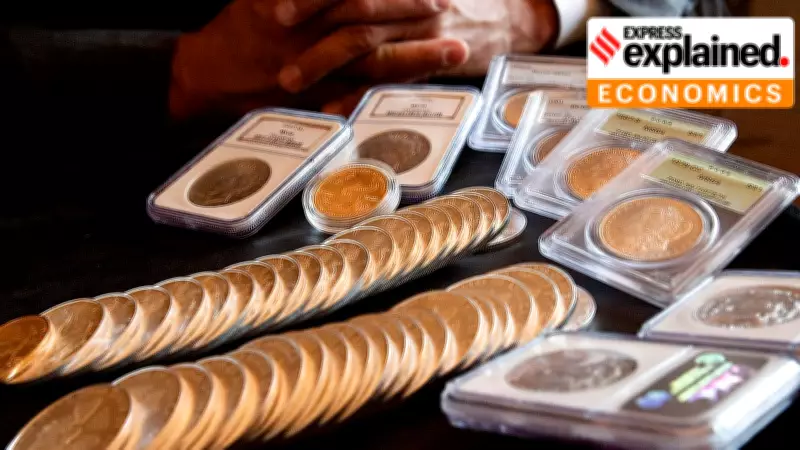
How New Fed Chair Nomination Halted Rally in Gold and Silver, Exposed Their Volatility
The latest dip in silver prices coincides with a stronger US dollar, as the Federal Reserve signals reduced urgency to institute interest rate cuts in the near term. The dollar has also gained strength following planned US talks with Iran regarding Tehran's nuclear programme, adding further pressure on precious metals.
Unprecedented Rally Abruptly Halted by Presidential Announcement
An unprecedented rally in gold and silver prices came to an abrupt halt last week when US President Donald Trump announced Kevin Warsh as his nominee for the next Federal Reserve chair. This nomination triggered immediate market volatility, with gold declining from a peak of $5,523 per ounce on January 29, and silver falling from $116 per ounce on January 30.
Over the following week, both metals experienced sharp rebounds before resuming a downward trend. By Thursday, February 5, spot silver had fallen by approximately 16.5%, while gold averaged around $4,920 per ounce. This decline occurred amid the Fed's indication of a lower likelihood for rate cuts and renewed concerns about US-Iran tensions, despite planned diplomatic talks scheduled for Friday.

Warsh's Nomination: The Immediate Trigger for Market Correction
While Warsh's nomination served as the most immediate catalyst for market volatility over the past week, analysts have concluded that gold and silver prices were destined to undergo corrective market action regardless. Warsh has long been regarded as tough on inflation, raising expectations of potential monetary tightening under his leadership.
Investors also perceive Warsh as someone who would defend the Federal Reserve's autonomy amidst President Trump's frequent attacks on the central bank and its current chair, Jerome Powell, for not implementing rate cuts. This perception proved favorable for the US dollar but detrimental for dollar-denominated bullion.
On January 30, gold prices shed 9%, marking the largest single-day decline since 1983. The latest dip in silver prices accompanies this stronger dollar environment, with the Fed signaling reduced urgency to institute rate cuts in the interim period.
Factors Behind the Original Metals Rally
President Trump has consistently maintained a preference for a stronger dollar, yet his actions have often produced counterintuitive results. In January, he triggered fresh waves of uncertainty across global markets through various geopolitical maneuvers.
His administration deposed Nicolas Maduro as president of Venezuela, revived territorial claims on Greenland, and threatened tariffs against Canada and South Korea for alleged trade violations. Canada faced pressure over potential trade deals with China, while South Korea was criticized for slow implementation of its trade agreement with the United States.
These actions collectively triggered a selloff in the US dollar, whose value maintains an inverse relationship with gold prices. When the dollar weakens, gold typically strengthens as investors seek alternative stores of value.
Safe-Haven Assets with Distinct Characteristics
Gold and silver are regarded as safe-haven assets to varying degrees. While global currencies were backed by gold until 1971, central banks worldwide continue maintaining reserves of both precious metals alongside US dollar holdings.
During periods of heightened volatility, central banks frequently increase their gold reserves to hedge against potential currency collapses. Silver, however, traditionally exhibits greater volatility due to its smaller market size and lower liquidity compared to gold.
Silver's relative scarcity and industrial utility contribute to marked price swings, though it remains an important "store of value" and hedge against inflation. Since the 1997-98 Asian financial crisis, central banks have transitioned from net sellers to net buyers of gold.
De-Dollarization Trends Accelerating
According to World Gold Council data, global foreign exchange reserves expanded from $3 trillion in 2000 to $13 trillion in 2014 before plateauing. Central banks began stockpiling gold more aggressively following the Russia-Ukraine war in 2022, with this trend continuing through President Trump's second term.

Gold purchases by central banks averaged 400-500 tonnes annually before 2022, exceeded 1,000 tonnes during 2022-2024, and dropped to approximately 863.3 tonnes in 2025—still significantly above pre-2022 averages.
The US dollar's share in global reserves has declined from 71% in 2000 to 58% today, indicating a gradual erosion of trust in its value. This de-dollarization push, which commenced with the Russia-Ukraine War outbreak in 2022, has accelerated during Trump's second administration.
Since his January 2025 inauguration, Trump has announced evolving tariff series against US trading partners and threatened Federal Reserve autonomy. The result: a 9% decline in the US dollar during 2025, representing its largest annual decline in nearly a decade. This depreciation has further driven demand for safe-haven assets like gold, contributing to price increases before the recent correction.
The combination of geopolitical tensions, monetary policy expectations, and shifting central bank strategies continues to shape the precious metals landscape, with volatility likely to persist as markets digest the implications of leadership changes at the world's most influential central bank.





