

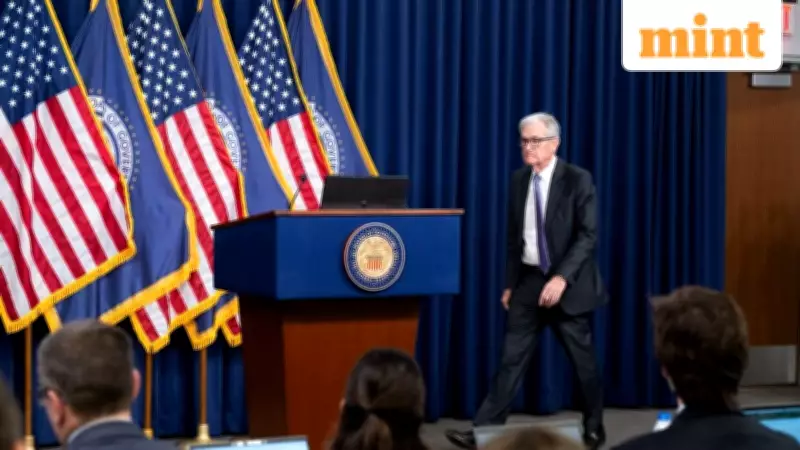
Federal Reserve Enters Holding Pattern on Interest Rates Amid Political Uncertainty
The Federal Reserve has decided to maintain its benchmark interest rates steady for the first time since July, marking a significant pause in its monetary policy adjustments. The decision, approved in a 10-2 vote, keeps the federal-funds rate within a range of 3.5% to 3.75%. This move comes after three consecutive meetings where officials implemented contentious rate reductions, signaling a shift in the central bank's approach as it navigates competing economic risks.
Internal Divisions and Political Pressure Shape Fed's Decision
Officials offered minimal clarity regarding when rate cuts might resume, retaining language in their post-meeting statement that indicates openness to future moves without committing to a specific timeline. The decision was not unanimous, with two Federal Reserve governors—both appointed by President Trump—dissenting in favor of a quarter-point rate cut. This dissent highlights the growing internal divisions within the Fed's 12-person rate-setting committee, which includes seven presidentially-appointed governors and five regional bank presidents who are not political appointees.
The meeting occurred against a backdrop of heightened political pressure from the White House. The Justice Department recently opened a criminal investigation into Fed Chair Jerome Powell, who disclosed the probe in a video statement, characterizing it as a pretext to advance Trump's desire for lower interest rates. Powell's term as chair concludes in May, and Trump's advisers have indicated that the president is close to naming a successor, adding to the uncertainty surrounding the Fed's leadership.

Economic Risks and the Path Forward for Monetary Policy
The Federal Reserve has been balancing competing economic risks for months. While inflation slowed in 2023 and 2024, it has since stalled above the central bank's 2% target over the past year, advocating for patience in policy adjustments. Conversely, concerns about a cooling labor market prompted last year's three rate cuts. The current economic landscape presents a dilemma: officials must decide whether to prioritize combating persistent inflation or supporting employment growth.
According to projections from December, twelve of nineteen officials anticipated that at least one more rate cut would be appropriate this year. However, the timing of any future cuts depends on which risk materializes first—a significant weakening of the job market or a convincing decline in inflation toward the 2% goal. Since December, neither scenario has fully unfolded. Job growth has slowed sharply, but the unemployment rate has stabilized, while inflation readings have been clouded by data-collection disruptions stemming from the government shutdown.
Expert Analysis and Future Outlook for Interest Rates
William English, a former senior Fed economist, expressed concerns that the political situation could alter how the committee operates. "Normally the Fed's an institution that operates in a kind of consensus manner," he noted. However, with political stakes elevated and Powell's tenure ending, he worries that "people are getting more dug in than has been the case in the past." This sentiment was reflected in December's meeting, which saw one of the most divided votes in years, with three officials dissenting—two opposing any cut and one favoring a larger reduction.
The debate is further complicated by uncertainty over how much current interest rates are still weighing on the economy. Some officials fear that rates may no longer be sufficiently high to continue pushing inflation down, while others believe policy remains restrictive enough that holding steady risks unnecessarily weakening the job market. Even if cuts resume, English suggests that the process will likely be gradual, stating, "Unless they really think the economy is weak and it needs accommodation, I'm not sure they cut a lot from here."
Without further labor market weakening, the next rate cut may not occur until after Powell's term as Fed chair ends in May. As the central bank navigates this complex economic and political landscape, analysts predict that the Fed is likely to remain on hold for an extended period unless significant economic surprises emerge.






