

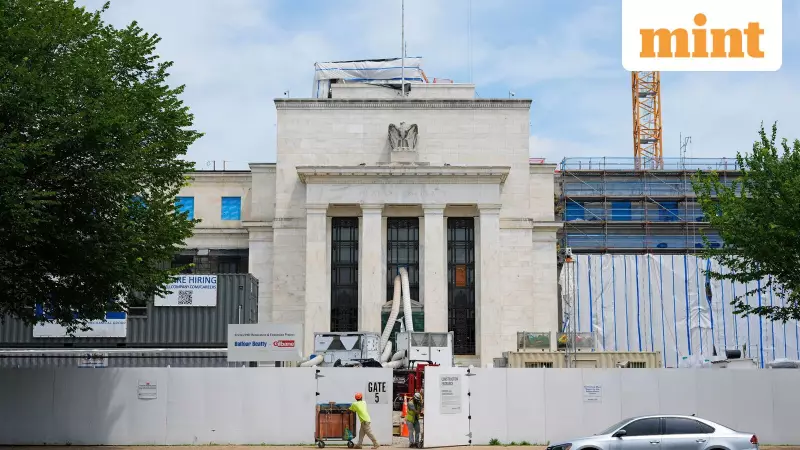
Marble Controversy at Federal Reserve Headquarters Sparks Criminal Probe
The United States Department of Justice has launched a criminal investigation targeting Federal Reserve Chair Jerome Powell. This unprecedented move centers on the massive $2.5 billion renovation of the Fed's Marriner S. Eccles headquarters and the adjacent building at 1951 Constitution Avenue in Washington.
Budget Overruns Draw Sharp Criticism
Federal officials have expressed outrage over the project's cost overruns, which reportedly total around $700 million. The director of the Office of Management and Budget compared the lavish renovation to the Palace of Versailles, calling the budget deviations "outrageous." Critics argue the central bank appears to have confused monetary policy with extravagant interior design.
However, experts point out that such budget overruns are hardly unique to the Federal Reserve. A Columbia University professor of law and finance noted that "renovations go over budget all the time" and exceeding budgetary estimates does not necessarily constitute malfeasance.

The Iron Law of Megaprojects
Research on large-scale projects reveals a consistent pattern of budget and timeline failures. According to data spanning 16,000 projects across 136 countries, only 8.5% meet both cost and time targets. A mere 0.5% achieve cost, time, and benefit goals simultaneously.
This phenomenon affects projects worldwide. The European Central Bank's Frankfurt headquarters arrived three years late with €350 million in overruns. NASA's James Webb Space Telescope finished seven years behind schedule at 450% over budget. Even Switzerland's Lötschberg Base Tunnel experienced 100% cost overruns.
The true problem lies in systematic underestimation during planning phases. Project managers frequently set unrealistic anchors, make overly optimistic forecasts, and face political pressures that prioritize approval over accuracy.
Questionable Design Choices
The Fed's renovation included several expensive additions that contributed to budget escalation. The central bank chose to construct an underground staff parking facility and a connecting tunnel between buildings. Critics estimate this subterranean option cost nearly ten times more than leasing 500 parking spaces nearby would have required.
At approximately $2,000 per square foot, the project appears extravagant. Yet historical comparisons provide context. The Smithsonian's National Museum of the American Indian cost about $800 per square foot when completed in 2004, equivalent to nearly $1,400 in today's dollars.
Art Collections and Central Bank Comparisons
Some critics have questioned the Fed's art collection, which includes staff displays, presidential portraits, and abstract works. However, compared to other central banks, the Federal Reserve appears relatively restrained. Austria's central bank owns nearly 50 historical string instruments, including nine Stradivarius violins. The Banque de France maintains interiors so opulent that one banker joked France could return to the gold standard by melting down the décor.
Broader Implications for Institutional Independence
The criminal investigation into procurement decisions represents a significant escalation with troubling implications. Federal prosecutors targeting a central bank chief over construction matters has captured global attention. This development threatens the Federal Reserve's institutional independence at a critical moment.
Reserve currencies depend fundamentally on credible institutions. The marble used in the renovation will likely endure for decades. Whether the institutional norms supporting the U.S. dollar's global dominance will prove equally durable remains a far more serious question. The political scrutiny surrounding this renovation could inadvertently provide ammunition to those seeking to challenge dollar supremacy in international markets.
As the investigation proceeds, observers worldwide will watch closely to see how this unusual case affects perceptions of Federal Reserve independence and the long-term stability of the global financial architecture built around the U.S. dollar.






