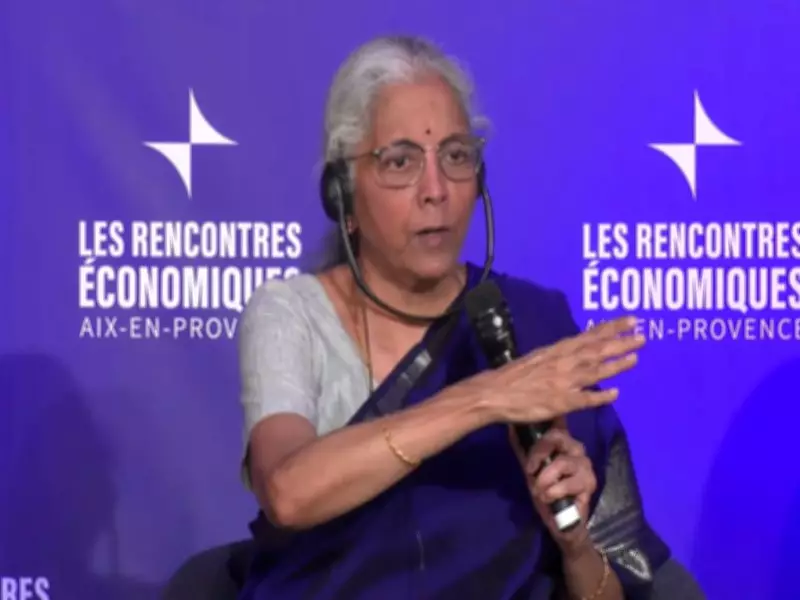
Union Finance Minister Nirmala Sitharaman declared on Friday that India's expanding middle class has become the nation's primary engine of economic growth, propelled by increasing consumption and supported by government initiatives in financial inclusion, digital connectivity, tax relief, and social welfare. Speaking at a session titled "How to promote the rise of a new middle class?" during Les Rencontres Économiques d'Aix-en-Provence 2026 in France, she emphasized that middle-class consumption is a key driver behind India's status as the fastest-growing large economy in the post-pandemic period.
Middle Class as Growth Engine
"In India, the middle class is the engine of the growth. And since after COVID, you've seen India remaining the fastest growing large economy. Primarily, it is because of the consumption, which is triggering from the middle class," Sitharaman stated. She noted that the middle class currently constitutes 31 percent of India's population and has been expanding steadily since economic reforms began in the 1990s.
"Between 1995 and 2021... the middle class is growing at a 6.3 percent annual rate. And as per OECD's projection, India will surpass China in absolute number terms in its middle class population size between 2030 and 2035," she added. The Finance Minister highlighted that India's growth model ensures the middle class is not confined to metropolitan cities but extends across tier-II and tier-III cities, thereby distributing economic activity more widely.

Government Measures Fueling Consumption
Sitharaman explained that financial inclusion through Jan Dhan accounts, easier access to credit, and digital payments have enabled millions to enter the formal economy. Government-backed loans without traditional collateral requirements have allowed small entrepreneurs to build businesses and improve their credit profiles, while digital payment systems available even on feature phones have strengthened financial inclusion. She also pointed to policy support such as reduced GST rates on several commodities, expanded investments in education and skills—particularly for women in STEM fields—and training in emerging sectors like animation, visual effects, gaming, and digital content creation.
Tax Relief and Social Welfare
Recent income tax relief has been a significant measure to boost household spending. "People earning 1.2 million rupees up to that number don't pay any tax at all. As a result we've allowed people to have more money in their hands which again goes into the consumption cycle," Sitharaman said. She also noted that universal health insurance coverage and affordable generic medicines have reduced household expenses, further strengthening the purchasing power of the middle class.
India-France Strategic Engagement
The Finance Minister is on a four-day official visit to France to participate in high-level engagements aimed at strengthening the India-France Strategic Partnership and deepening cooperation in investment, technology, innovation, and economic ties.