

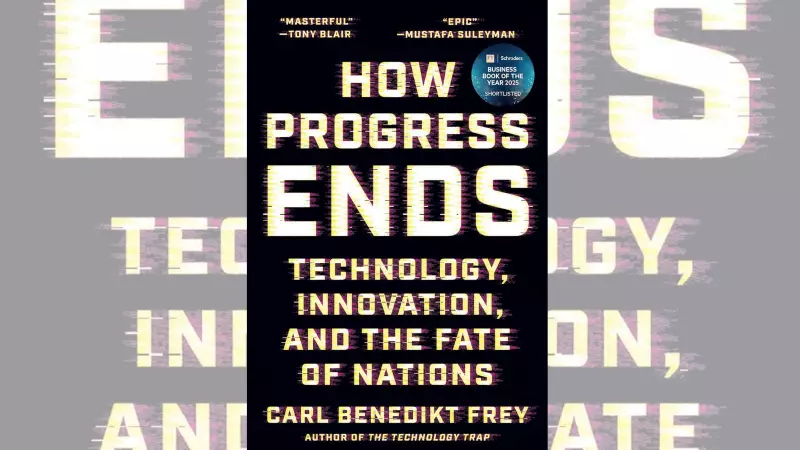
In the literary contest for the most impactful business book of 2025, a sharp divide emerged. While many hailed Stephen Witt's The Thinking Machine on NVIDIA's Jensen Huang, a formidable contender presented a sweeping historical thesis: Carl Benedikt Frey's How Progress Ends: Technology, Innovation and the Fate of Nations. Although Witt clinched the Financial Times and Schroders Business Book of the Year Award, Frey's 540-page opus offers a crucial lens on why nations rise, fall, and stagnate through the prism of technology.
The Core Thesis: Technology as the Engine of Civilisation
Frey's central argument is that the economic trajectory of nations is fundamentally shaped by their relationship with technological innovation. Moving beyond traditional economic metrics, he embarks on a journey spanning over a millennium—from ancient China and Rome, through Europe's Industrial Revolution, to our modern AI era. The book posits that progress is intrinsically driven by technology, but its sustenance is a fragile affair.
A critical pattern Frey identifies is the lifecycle of innovation. It typically germinates at a small, decentralized level—in workshops, garages, or small firms. The pivotal moment arrives when this innovation scales. As larger institutions and governments介入, processes become bureaucratic. The focus shifts from creation to control, from fostering new ideas to protecting established turf and blocking competitors. This shift, Frey argues, is where progress ends and stagnation begins.

Decentralise to Innovate, Centralise to Consolidate
The book presents a nuanced analysis of two systems: decentralized (largely capitalist) and centralized (often communist or socialist). Frey demonstrates that radical, cutting-edge innovation overwhelmingly springs from decentralized systems where individuals have the freedom to experiment, fail, and collaborate. He cites the success of the computer revolution in the United States, fueled by its federal structure and the culture of Silicon Valley, as a prime example.
"While Boston and Detroit—once at the forefront of the Second Industrial Revolution—were dominated by hierarchically run incumbents, the computer age was made in Silicon Valley, where institutions supported decentralization and exploration," Frey notes.
However, centralized systems excel at the mass propagation and adoption of technology. They can efficiently deploy resources to spread critical innovations across a vast population. The key, Frey insists, is a blend: decentralization for creation, centralization for consolidation. He warns that when centralized systems, like the former USSR, try to force innovation through top-down bureaucracy, they fail, as attempts to create a state-led Silicon Valley proved.
India's Place in the Narrative and the AI Warning
While India does not have a dedicated chapter, Frey references it strategically. He suggests that for developing economies like India, the immediate priority should be diffusing existing technology widely rather than heavy investment in frontier innovation. He points to bureaucratic complexities, such as those in Delhi's administration, as hurdles that can prevent new technologies from being easily adopted.
The book concludes with a sobering look at the AI-dominated future. Frey warns that AI's immense potential could be subverted into a tool for surveillance and control, stifling progress. He sees alarming parallels between modern China's use of AI for social management and dynastic China's investment in surveillance tech, both cementing authority at the cost of dynamism.
He extends the caution to the United States, where lobbying by powerful incumbents threatens the competitive disruption that has long fueled its economic strength. "Despite their differences, both superpowers face a troubling trend: faltering productivity over the past decade," Frey observes.

Despite its heavyweight subject, Frey makes the narrative accessible with engaging anecdotes, like how America's Prohibition era inadvertently stifled innovation by shutting down saloons—key hubs for workers to exchange ideas. It is not a breezy page-turner but stands as a compelling blend of history, politics, and economics, challenging readers to rethink the forces that shape our technological destiny.





